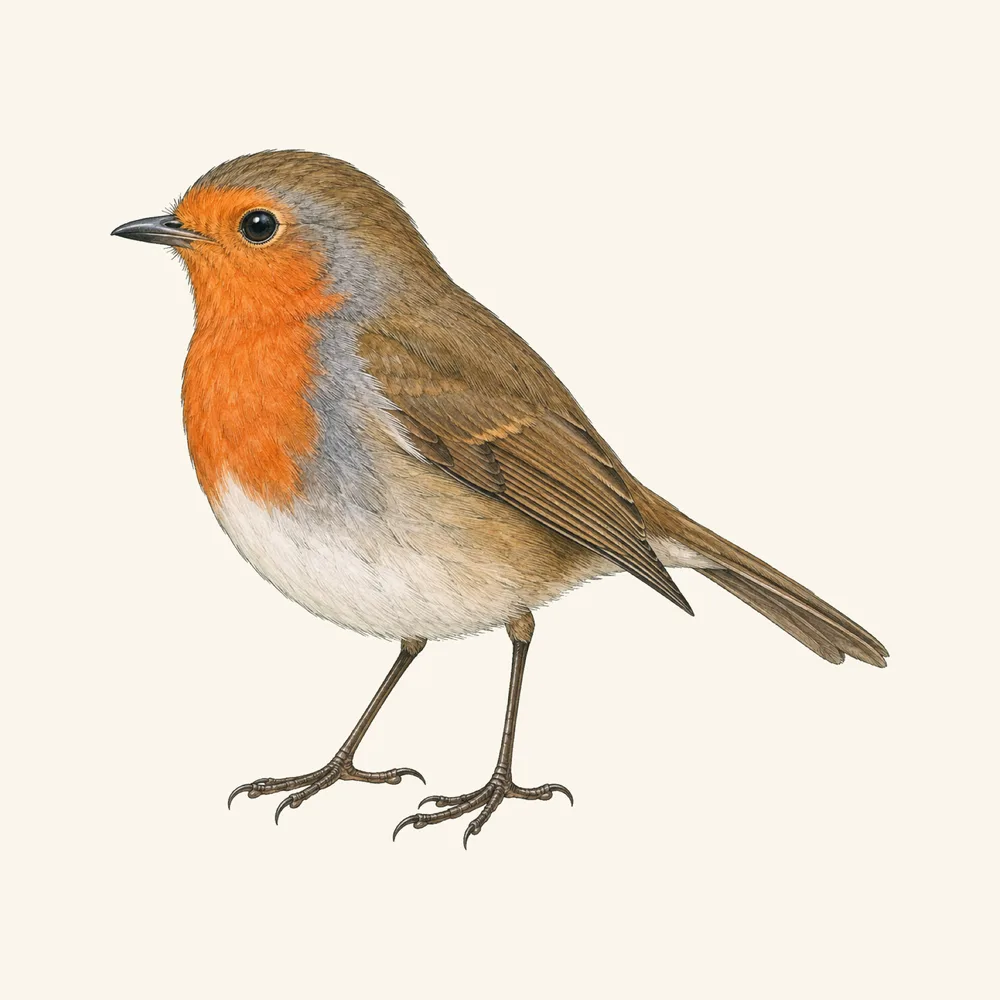
Robin
Erithacus rubecula
The gardener's shadow. Orange-red breast, upright stance, and a fierce territorial streak hidden behind a very tame manner.
In most gardens
Present in almost every UK garden year-round, and among the ten most recorded species in the RSPB Big Garden Birdwatch 2026.
Green list
Not currently of conservation concern in the UK.
Birds of Conservation Concern 5 records this species as “Green listed”. BTO gives no headline percentage: numbers have increased consistently since the mid-1980s, apart from a brief dip between 2008 and 2012 likely caused by severe winters. Source.
- Wildlife and Countryside Act 1981, section 1 — It is an offence to intentionally kill, injure or take any wild bird, or to take, damage or destroy the nest of any wild bird while that nest is in use or being built, or to take or destroy its eggs. law
At a glance
-
Size
The reference bird — about 14cm, round-bodied, with a habitually upright stance.
-
Where you'll see it
Low perches, borders and freshly dug soil; on the ground far more than on feeders.
-
What it eats
Worms, beetles, spiders and other invertebrates; berries and seeds in winter, plus mealworms and suet.
-
When
Resident all year. Territories are held by both sexes through the winter.
-
Nests
Open-fronted box, or a ledge or cavity in dense cover — never a box with a round entrance hole.
-
Song
A wistful, fluid warble with long pauses; thinner and sadder-sounding from about August through winter.
Not to be confused with
- Juvenile Robin — The commonest mistake in a British garden in July. A young robin has no red on it at all — it is mottled gold and brown all over, head included — and is regularly reported as an unknown species. The giveaway is everything except the colour: same plump upright shape, same big dark eye, same habit of dropping to the ground from a low perch. It gains the red breast in its first autumn moult.
- Dunnock — A similar size and also shuffling about under the hedge, but a dunnock is grey and streaky brown with no orange anywhere, and has a fine, sharp insect-eater's bill rather than the robin's stubby one. Dunnocks creep along the ground with the body held low; robins stand tall and still between hops. Robin or Dunnock?
- Bullfinch — A male bullfinch's underparts are a far deeper pinkish-red than a robin's orange, and the red covers the whole breast and belly. It also has a solid black cap and a thick, stubby black bill, and shows a bright white rump as it flies away — a robin shows none. Robin or Bullfinch?
Through the year
Spring
Nesting from March, sometimes earlier. Two or three broods are normal. Song quietens a little once birds are busy feeding young.
Summer
Adults moult and go quiet and secretive in July and August, so gardens can seem robin-less. Speckled brown juveniles are out and about with no red at all.
Autumn
Song restarts in late summer, and in autumn both males and females sing to hold separate winter territories — one of the few UK birds in which the female sings.
Winter
Highly territorial and often the most visible garden bird. Continental robins arrive to winter here, so the bird on your lawn in January may not be the one that nested there.
Feeding
Takes: live or dried mealworms, suet pellets and crumbs, sunflower hearts, grated mild cheese, windfall fruit.
Robins are ground and ledge feeders, not natural clingers. They struggle on tube feeders with small perches and do far better from a shallow dish or a low platform set among cover. Bird tables and tray feeders would suit a robin perfectly, but the RSPB and BTO now advise against flat feeding surfaces because of disease transmission, so a dish you can lift and scrub daily is the better answer. Put out small amounts and clear anything uneaten within a day or two.
Why it follows you round the garden
The tameness is not affection, it is opportunism with a long history. In continental Europe robins are shy woodland birds that will not come near people. British robins learned, over centuries, that a large animal disturbing the ground turns up worms and grubs — and in an ancient British woodland that animal was a wild boar. Your fork has simply replaced the boar's snout. This explains the specific behaviour: a robin does not follow you across a lawn, it follows soil being turned. Dig a bed and one will appear within a minute or two, perch on the handle when you stop, and drop in the moment you step back. If you want it closer, work slowly, stop often and leave the turned soil exposed for a few minutes rather than raking it flat straight away.
An open-fronted box, not a hole
This is where most people go wrong. Robins will not use the standard hole-fronted tit box, whatever the hole size, because they are not hole nesters — they nest on ledges and in recesses hidden inside dense cover. What they take is an open-fronted box, with the upper part of the front panel left off. National Nestbox Week specifically recommends siting one under thick, overhanging vegetation, or on a fence with climbing plants growing up it. Concealment matters more than height: a robin box screwed to a bare wall in plain view will be ignored and, if used, is easily found by a cat or a magpie. Tuck it well back into ivy, honeysuckle or a clematis, where you can barely see it yourself. Put it up in autumn or winter so the site is familiar before nesting begins.
The bird that sings at Christmas
Robins are one of very few British birds in full song in December, and one of fewer still in which the female sings. That is because outside the breeding season males and females hold separate individual winter territories, each defending its own patch of ground, so both sexes advertise. The autumn and winter song is noticeably different from the spring one — thinner, slower and more melancholy — and once you have heard the two you will never confuse them. Robins also sing at night more than any other garden bird, especially near street lights and security lighting, which is why they are so often mistaken for nightingales in towns. And the territoriality is real: a robin will fight another robin seriously and sometimes fatally, which is why you will almost never see two feeding calmly together outside the breeding season.
The one thing not to do
Robins nest low, in dense cover, in sites that look exactly like garden clutter: a gap behind a shed, the middle of an ivy-covered wall, a shelf in an open outbuilding, a hanging basket, even a coat pocket left on a nail. Between March and August, check any of these before you tidy, cut or clear them. It is an offence to damage or destroy a nest in use or being built, and a hedge trimmer is the commonest way it happens. If you find an active nest, stop work, leave the area alone, and come back in a few weeks — robins can be off and fledged within a fortnight of hatching. A robin that has been disturbed early in building will usually abandon and start again elsewhere, so a few minutes' checking in advance is not a small kindness, it is the whole difference.
Plant this for it
- clematis A dense clematis grown up a fence or wall gives exactly the concealed, overhung ledge a robin nests on, and National Nestbox Week specifically recommends fences with climbers for siting an open-fronted box.
- apple Leaf litter and windfalls under an apple tree hold the beetles, worms and spiders robins spend most of the year hunting, and windfall fruit itself is taken in hard weather.
Guides
- Binoculars for garden birdwatching: what the numbers mean, and how little you need to spend
- Bird baths in winter: keeping water open in a freeze
- Bird boxes: hole size, height and which way to face — and why autumn is the time to put one up
- Birds flying into windows: why it happens and what stops it
- Do cats kill garden birds? What the numbers show, and what helps
- Feeders back on: what to put out from 1 November
How we checked this
- BTO BirdFacts: Robin
- National Nestbox Week: Nestboxes — Open Front
- Wildlife and Countryside Act 1981, section 1
- RSPB: What Does the Wildlife and Countryside Act 1981 do?
Checked against the sources above. Reviewed on 2026-09-20. Legal position checked 2026-09-20.