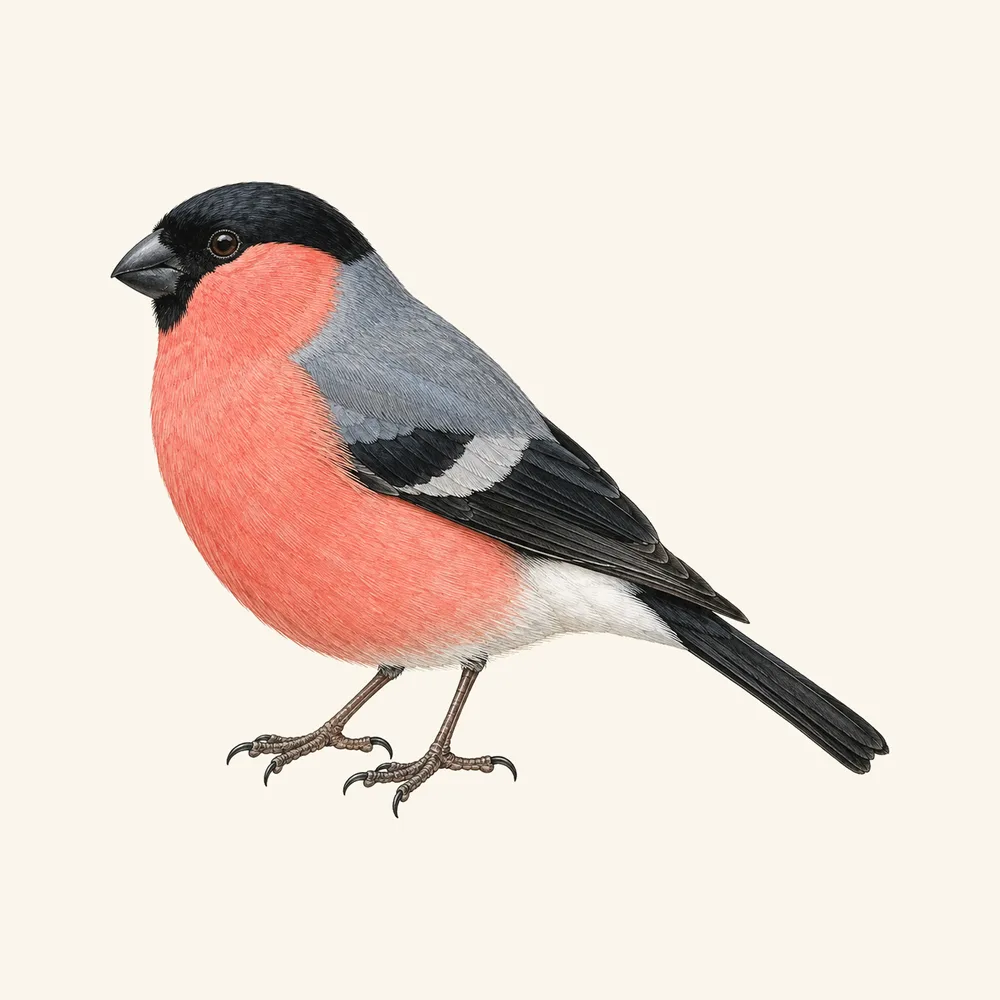
Bullfinch
Pyrrhula pyrrhula
A thickset, shy finch with a black cap and, on the male, a deep rose-pink breast. You almost always hear the soft piping call first.
Occasional visitor
Widespread but retiring, and much less often seen than its colour suggests. Bullfinches favour woodland edge, orchards and thick hedgerows, and use gardens with dense cover and mature shrubs rather than open, tidy ones. Most sightings are brief and at the back of the garden.
Amber list
Of medium conservation concern in the UK.
Birds of Conservation Concern 5 records this species as “Amber listed”, with a UK population trend of −55% (1967 to 2024). BTO states that the UK breeding population entered a long period of decline in the mid-1970s, with particularly steep losses on farmland; the decline became shallower and eventually ended around 2000, and there has since been some increase, but numbers remain well below historical levels. Source.
- Wildlife and Countryside Act 1981, section 1 — It is an offence to intentionally kill, injure or take any wild bird, or to take, damage or destroy the nest of any wild bird while that nest is in use or being built, or to take or destroy its eggs. law
At a glance
-
Size
A little larger and much heavier-built than a robin — thick-necked, round-bodied, with a stubby bill.
-
Where you'll see it
Inside hedges and large shrubs and along woodland edge; occasionally on sunflower hearts, always close to cover.
-
What it eats
Seeds of ash, nettle, dock and bramble; tree and shrub buds in late winter and spring; some insects for the young.
-
When
Resident all year. Most conspicuous in late winter and early spring when feeding on buds.
-
Nests
A twig platform low in a dense hedge, bramble or evergreen. Does not use a nestbox of any kind.
-
Song
Barely a song — a quiet creaky warble. The call is the thing: a soft, low, melancholy piped 'pew'.
Not to be confused with
- Chaffinch — A male chaffinch has a pinkish breast too, but also bold white shoulder patches and a white wing bar, a blue-grey crown rather than a black cap, and a greenish rump. A bullfinch has no wing bar, a solid black cap and a pure white rump. Chaffinches also feed openly on lawns; bullfinches stay in cover. Bullfinch or Chaffinch?
- Robin — A robin's breast is orange, not pink, and stops at the upper belly; a male bullfinch is deep rose-pink right down the underparts. The robin also has a plain brown head with a big dark eye and a fine bill, against the bullfinch's black cap and thick stubby bill. And a robin has no white rump. Bullfinch or Robin?
- Female Bullfinch — Regularly logged as a different species because she lacks the pink. She is a soft pinkish grey-buff underneath rather than rose, but has exactly the same solid black cap, thick black bill, white rump and black tail. If a plain-looking finch flashes a clean white rump as it dives into a hedge, it is a bullfinch whatever colour its breast was.
Through the year
Spring
Bud feeding peaks in late winter and early spring, then pairs nest low in dense hedges and brambles from April. Check before cutting, every time.
Summer
Feeding young on seeds and some insects, deep in cover. Leave the back hedge and the bramble patch alone.
Autumn
Working seed heads — nettle, dock, bramble, ash. Resist the urge to cut everything back; standing seed heads are the winter food supply.
Winter
Pairs range quietly along hedgerows and woodland edge. Sunflower hearts near cover, and any seed heads still standing, carry them through.
Feeding
Takes: sunflower hearts, seeds of ash, nettle, dock and bramble, buds of fruit trees and shrubs in late winter, berries and soft fruit.
Bullfinches come to feeders only where there is thick cover within a short flight — an exposed feeder on a lawn will not be used, however good the seed. Sunflower hearts are the food most often taken. Follow current RSPB guidance and pause seeds and peanuts between 1 May and 31 October, keeping suet and mealworms to small amounts over the summer, and clean feeders at least weekly. Far more effective than any feeder is leaving seed heads standing: nettle, dock, bramble and ash keep bullfinches fed through autumn and winter at no cost.
The bird you hear before you see
Bullfinches are among the most striking British birds and among the least often properly seen, because they are genuinely shy and prefer to slip away through cover rather than fly into the open. The RSPB describes them as easily spooked and inclined to stay hidden. What gives them away is the call: a soft, low, slightly mournful piped note, repeated quietly, quite unlike the sharp chips of other finches. It is easy to overlook because it is so gentle, and once learned it turns bullfinches from a rare treat into a regular presence in hedgerows you walk past every week. The other giveaway is the exit — a flash of brilliant white rump against a black tail as the bird drops into a hedge. That rump is the single most reliable mark on the bird.
Buds, orchards and an old grievance
In late winter and early spring, when seeds have run out, bullfinches turn to the buds of trees and shrubs, and they are efficient at it — a pair can work steadily along a branch removing buds one after another. Historically this made them serious pests of commercial fruit, and the RSPB notes they were long regarded as pests of fruit crops for precisely this reason. In a garden today the picture is different. Bullfinch numbers are down 55% since 1967, so damage on the old scale is rare, and a garden fruit tree usually sets far more buds than it needs. If a young or heavily pruned tree is genuinely being stripped, netting it while dormant is the answer. Nothing else is warranted, and the bird is protected under section 1 of the Wildlife and Countryside Act like any other.
Pairs, and why you see two
Bullfinches pair for the long term and stay together through the year, which is unusual among British finches and is why sightings so often come in twos. The male's rose-pink and the female's soft pinkish-buff look different enough that the second bird is regularly reported as another species, and the fix is to ignore breast colour and check the cap, bill and rump — all three are identical in both sexes. Pairs move quietly along hedgerows and woodland edge together, keeping in touch with the soft piped call, and they do not form the large winter flocks that chaffinches and goldfinches do. A group of six or eight bullfinches is a notable sight; a pair is the norm.
The garden that actually holds one
Two things decide whether bullfinches use your garden, and neither is a feeder. The first is dense, unclipped cover: a thick mixed hedge, a bramble patch, a large evergreen shrub, ideally connected to a hedge or treeline beyond the boundary. Bullfinches nest low in exactly that material and will not cross open ground to reach isolated planting. The second is standing seed heads. Nettle, dock, bramble and ash seed are core bullfinch food through autumn and winter, and the tidy autumn cutback that removes all of it is the most common reason a garden that looks suitable never holds them. Leave a corner uncut, leave the seed heads standing until spring, and put any sunflower feeder within a couple of metres of cover so the birds have somewhere to bolt to.
Plant this for it
- apple Bullfinches take apple buds in late winter and the fruit later; an old apple tree with a hedge nearby is the classic setting for them, and netting a young tree while dormant is enough if buds are genuinely being stripped.
- clematis A thick clematis on a fence or hedge adds the dense low cover bullfinches nest in and retreat to, which matters more to them than any food you put out.
Guides
How we checked this
- BTO BirdFacts: Bullfinch
- RSPB: Bullfinch
- RSPB: Our latest guidance on what and when to feed garden birds
- Wildlife and Countryside Act 1981, section 1
Checked against the sources above. Reviewed on 2026-09-20. Legal position checked 2026-09-20.