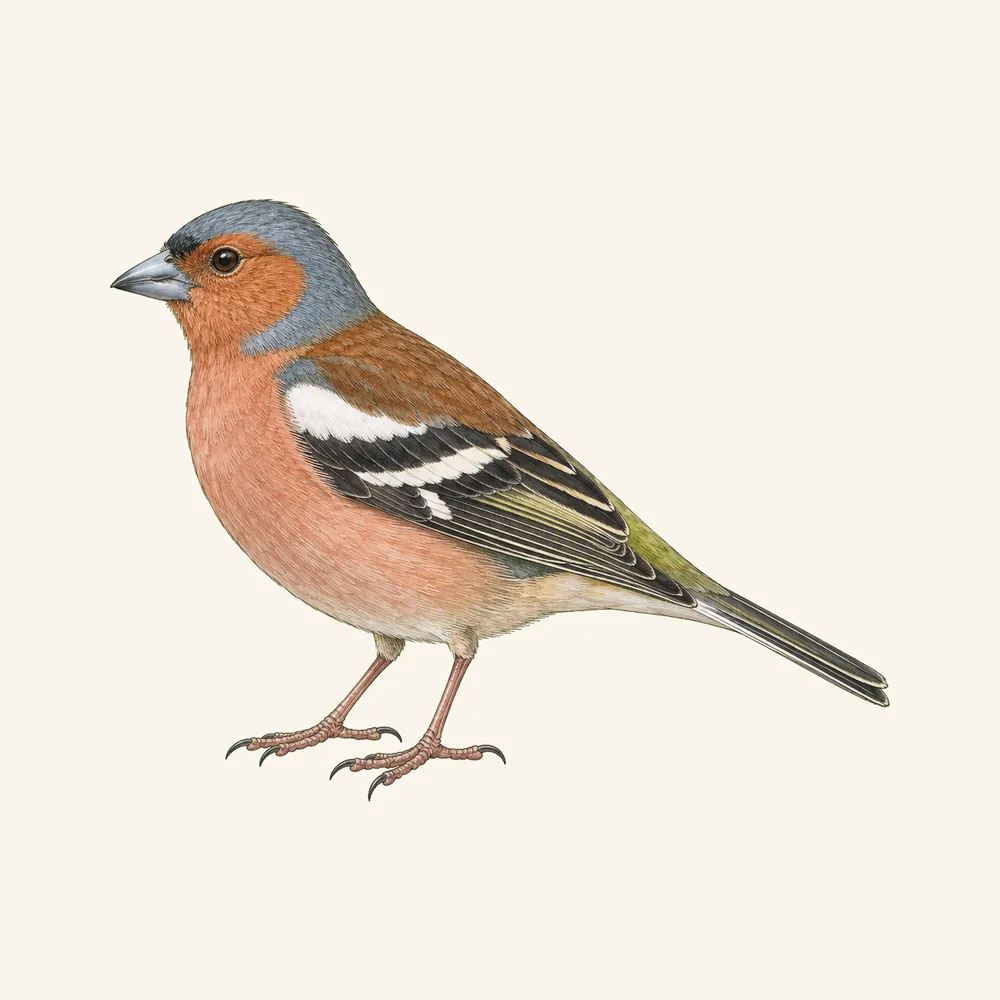
Chaffinch
Fringilla coelebs
Still one of Britain's commonest birds, but quietly falling away. Pink-breasted male, bold white shoulder flash, a rattling downhill song.
In most gardens
Recorded across 94% of the UK during Bird Atlas 2007-11 and a regular garden bird everywhere, though gardens see fewer than they did fifteen years ago.
Green list
Not currently of conservation concern in the UK.
Birds of Conservation Concern 5 records this species as “Green listed”, with a UK population trend of −26% (1967 to 2024). The headline figure hides two different stories: numbers rose rapidly from the early 1970s until 2006, then fell across all four UK countries from around 2010, and BTO notes it is still unclear whether trichomonosis is the main driver behind the steeper downturn that began around 2012 or whether there may be other causes. Source.
- Wildlife and Countryside Act 1981, section 1 — It is an offence to intentionally kill, injure or take any wild bird, or to take, damage or destroy the nest of any wild bird while that nest is in use or being built, or to take or destroy its eggs. law
At a glance
-
Size
Robin-sized but longer and slimmer, about 14-15cm, with a noticeably long tail.
-
Where you'll see it
On the ground under feeders and along hedge bottoms far more often than on the feeder itself.
-
What it eats
Seeds year-round, with caterpillars and other insects taken through the breeding season and fed to chicks.
-
When
Resident all year. Numbers swell from October as continental birds arrive to winter here.
-
Nests
A neat lichen-covered cup built in a tree fork or thick shrub. It will not use a nest box.
-
Song
A short rattling phrase that runs downhill and ends in a flourish, likened to a fast bowler's run-up.
Not to be confused with
- Brambling — The winter confusion, and the clincher is the rump: a brambling flashes a clean white rump as it flies away, a chaffinch shows a greenish one. A brambling is also orange on the breast and shoulder rather than pink, and its flanks are spotted black.
- House Sparrow — A female chaffinch and a female house sparrow are both brown, but only the chaffinch has two crisp white wing bars and white in the tail. The sparrow's bill is thick and blunt, the chaffinch's is finer and more conical, and sparrows are almost never alone while chaffinches often are. Chaffinch or House Sparrow?
- Bullfinch — A male bullfinch's breast is a deep, saturated rose-pink with a hard edge to it, and he wears a solid black cap. A male chaffinch's pink is softer and dustier and his crown is blue-grey, not black. Chaffinch or Bullfinch?
Through the year
Spring
Males sing from mid-February and pair up early; nest-building starts in April in a shrub or tree fork. Leave lichen and moss on branches and walls — it is the nest's outer layer.
Summer
A single brood is usual, and adults switch to hunting caterpillars to feed the chicks. Your seed feeders should be down or reduced to suet between 1 May and 31 October anyway.
Autumn
Family parties break up and flocks form. Continental chaffinches begin arriving from Scandinavia and the near Continent, so garden numbers climb through October and November.
Winter
Feeding flocks work the ground under feeders and along field edges. This is the season when chaffinches are easiest to see and also the season when disease spreads fastest at feeding stations.
Feeding
Takes: sunflower hearts, black sunflower seeds, mixed seed swept up from under feeders, peanut granules, suet pellets.
Chaffinches are ground feeders by preference and will work the spill zone below a hanging feeder rather than cling to it. That spill zone is also where disease passes between birds, so sweep it and move the feeder position every few weeks. Follow the RSPB's seasonal advice: pause seed and peanuts from 1 May to 31 October, and offer only small amounts of suet, fat balls or mealworms through that period. Do not use a bird table, window feeder or tray — the RSPB no longer recommends flat feeding surfaces because contaminated food collects on them.
A common bird that is quietly going wrong
It is easy to look at a chaffinch and assume all is well. It is still Green listed, still on BTO's books as one of Britain and Ireland's commonest birds, and was recorded across 94% of the UK during Bird Atlas 2007-11. But the trend line has turned. BTO's figure is a 26% fall between 1967 and 2024, which conceals a rapid rise to 2006 followed by a decline across all four UK countries from around 2010. BTO has linked that decline to trichomonosis, the same disease that devastated greenfinches, while being careful to say it is still unclear whether trichomonosis is the main driver behind the steeper downturn that began around 2012 or whether there may be other causes. If you have fed birds for twenty years and feel you see fewer chaffinches, you are not imagining it.
The bird under the feeder, not on it
Chaffinches have weak feet for clinging and a strong preference for feeding on the ground, which is why you usually see them hopping about below a hanging feeder picking up what goldfinches and tits have knocked out. That habit matters more than it sounds. The ground under a feeder is where husks, droppings and damp food accumulate together, and it is the single dirtiest part of most feeding stations. Two practical answers, both low effort: sweep or rake the spill zone regularly, and move the feeder a few metres every few weeks so no one patch of ground takes the whole season's load. The RSPB recommends a thorough clean of feeders and baths every week. For chaffinches specifically, the ground is the part people forget.
The song you can set your watch by
A chaffinch's song is one of the most learnable in the garden: a short phrase of a dozen or so notes that accelerates, descends, and finishes with a distinct flourish, repeated with almost mechanical regularity from the same high perch. Males begin in mid-February and go quiet by July. There are regional dialects — chaffinches learn their song from neighbours in their first year, so birds in different valleys genuinely sound different. Alongside the song you will hear a loud, ringing single note, often written as pink, given all year and especially when the bird is agitated. Learn the pink and you will notice chaffinches you would otherwise walk past, because they call far more often than they sing.
What it needs from your garden
Very little that is deliberate, which is the honest answer. Chaffinches nest in the fork of a tree or in a thick shrub and will never use a nest box, so there is nothing to buy. What they do use is nest material most people tidy away: lichen, spider silk and moss make up the beautifully camouflaged outer shell of the cup, so leaving lichen on old branches, fence posts and stone is a real contribution. In the breeding season the chicks are fed on caterpillars rather than seed, which means the useful thing is native trees and shrubs supporting insects rather than a fuller feeder. Between 1 May and 31 October the RSPB asks you to pause seed and peanuts entirely, and that is exactly the window when caterpillars matter most.
Plant this for it
- apple An apple tree carries the caterpillars chaffinches feed to their chicks, and older trees grow the lichen they use for the outside of the nest.
- lavender Left unpruned into autumn, lavender seedheads hold small seeds chaffinches will take, and the plant itself draws the insects adults hunt in summer.
Guides
How we checked this
- BTO BirdFacts: Chaffinch
- RSPB: How to help garden birds — feed seasonally and safely
- RSPB: Keep your garden birds healthy
- Wildlife and Countryside Act 1981, section 1
- RSPB: What Does the Wildlife and Countryside Act 1981 do?
Checked against the sources above. Reviewed on 2026-09-20. Legal position checked 2026-09-20.