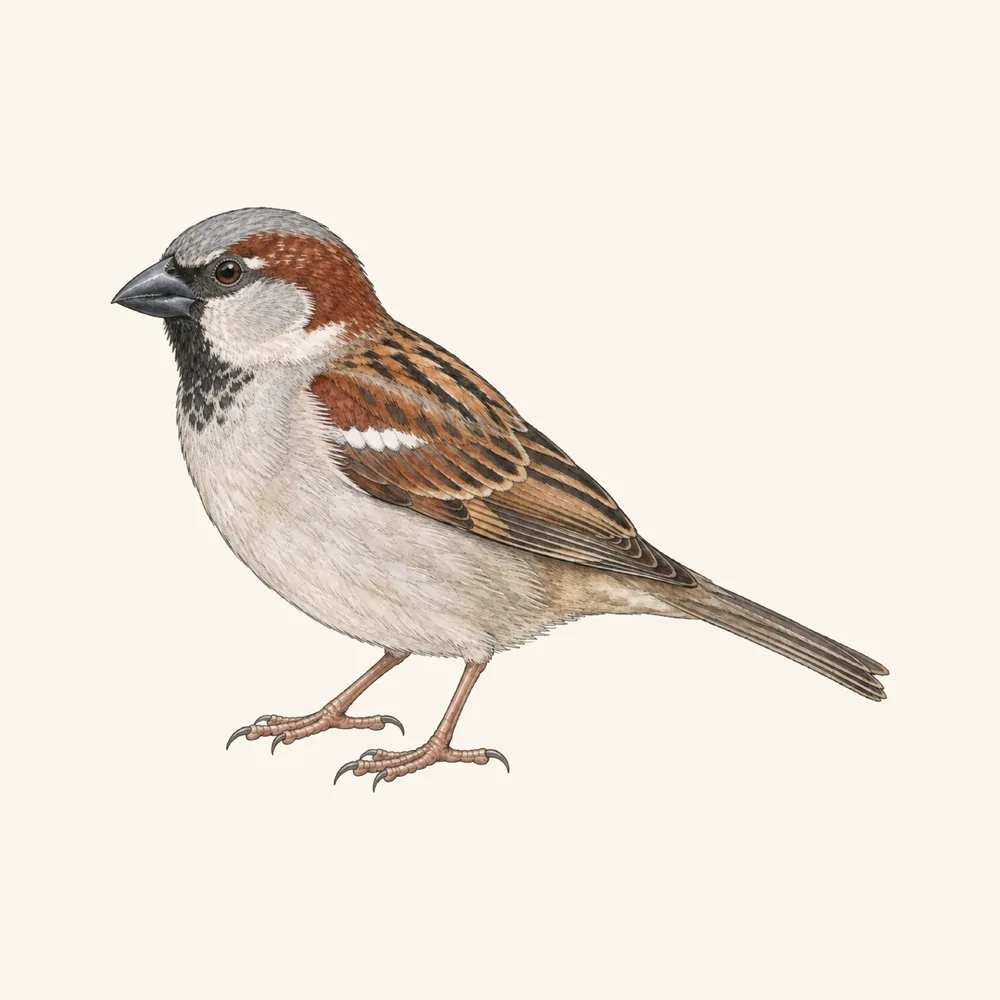
House Sparrow
Passer domesticus
Red-listed despite topping the Birdwatch. Sparrows nest in colonies, so one box rarely works — put up three, near dense cover.
In most gardens
Ranked first in the RSPB Big Garden Birdwatch 2026. Abundance in gardens and conservation status are not the same thing: the House Sparrow is both the bird most often counted and a Red-listed species.
Red list
Of highest conservation concern in the UK.
Birds of Conservation Concern 5 records this species as “Red listed”, with a UK population trend of −18% (1995 to 2024). Source.
- Wildlife and Countryside Act 1981, section 1 — It is an offence to intentionally kill, injure or take any wild bird, or to take, damage or destroy the nest of any wild bird while that nest is in use or being built, or to take or destroy its eggs. law
At a glance
-
Size
Robin-sized at 14–15cm, but chunkier, flatter-headed and thicker-billed
-
Where you'll see it
Feeders, dense hedges, gutters and roof eaves — rarely far from a building
-
What it eats
Seeds and grain all year; adults switch to insects to feed chicks
-
When
Resident, all twelve months
-
Nests
Colonially in roof cavities, or in a 32mm-hole box over 2m up
-
Song
No true song — a flat, repeated cheep given from inside a hedge
Not to be confused with
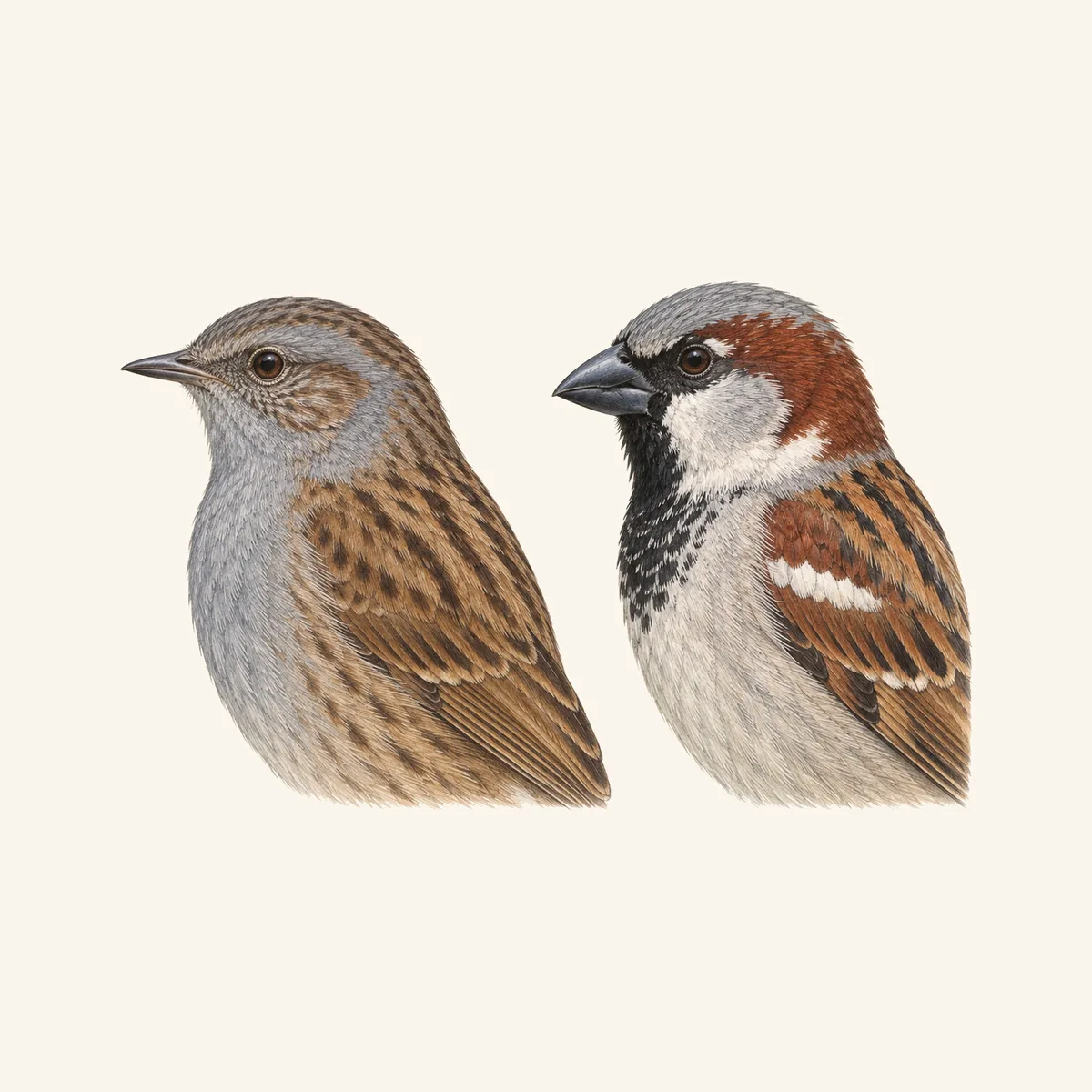
- Dunnock — Bill shape settles it. The dunnock has a fine, sharp, insect-eater's bill; the house sparrow has a thick, blunt, conical seed-cracker. The dunnock is also greyer about the head and shuffles alone along the ground rather than feeding in a flock. House Sparrow or Dunnock?
- Tree Sparrow — Look at the head. A tree sparrow has a solid chestnut crown and a clean black spot on a white cheek. A male house sparrow has a grey crown and no cheek spot at all; the sexes differ, whereas tree sparrows look alike.
Through the year
Spring
Nest-building from mid-March. Males chirp steadily from the same gutter or box entrance for weeks on end.
Summer
Up to four broods run into early August. Streaky, gape-flanged juveniles crowd the feeders and beg loudly from the hedge.
Autumn
Flocks build and move to seeding grass and weedy corners; garden numbers can dip while natural seed lasts.
Winter
Back on the feeders in numbers, and roosting communally in thick hedges, ivy and conifers.
Feeding
Takes: sunflower hearts, mixed seed, millet, suet pellets, mealworms.
Sparrows feed as a group, so a single small feeder empties in a morning. Two feeders within a metre or two of a hedge will hold a flock better than one large feeder in the open, which they tend to leave alone.
Nest box
32mm entrance hole, Over 2m above ground. This species nests colonially, so fit boxes in twos and threes — a single box is unlikely to attract a pair. Nestbox Week states they like to nest colonially, so one box on its own is unlikely to attract a breeding pair. Put up two or three on the same wall, or a terrace box, spaced along the same aspect.
No perch below the hole — it is a handrail for predators. Hole size is from the BTO: National Nest Box Week.
Why one nest box usually gets ignored
Most people put up a single box, wait a season, and conclude sparrows are not interested. The problem is usually the box count, not the box. Nestbox Week is explicit that house sparrows like to nest colonially and that one box on its own is unlikely to attract a breeding pair. They want neighbours within sight and earshot. So put up two or three boxes on the same wall, or a single terrace box with several chambers, all on the same aspect and all over 2m above the ground. The hole must be 32mm; a 25mm blue tit box excludes them entirely, which is worth knowing if you already have boxes up and have never seen a sparrow use one. Give the entrance a clear flight line, away from a fence a cat can walk along.
Feeding a flock, not a pair
Sparrows arrive together and leave together, which changes how you feed them. A flock of twenty will strip a small feeder in a morning, and a feeder standing alone in the middle of a lawn often goes untouched however good the seed is. They will not cross open ground willingly. Hang feeders within a couple of metres of a hedge, wall or shrub so birds can drop into cover in one move, and use two smaller feeders rather than one large one so several birds can eat at once without squabbling. Sunflower hearts, millet and plain mixed seed all work. During the breeding season adults switch to insects for the chicks, so mealworms in late spring genuinely earn their place — a seed-only garden supports fewer broods.
Cover matters as much as food
The thing gardens most often lack is not seed but scruff. Sparrows need somewhere dense to sit between feeder visits, to roost in through winter nights, and to bicker in for most of the day. A clipped fence line gives them nothing. A thick hedge, an unruly climbing rose, or a clematis grown flat against a wall all do the job, and a hedge cut on a two- or three-year rotation rather than annually stays much denser at the base. Leave a patch of dry, bare, sunny soil somewhere too — sparrows dust-bathe in it, and a shallow scrape at the edge of a border is enough. If you cut a hedge, do it outside the nesting season: damaging a nest in use or being built is an offence, and sparrows breed into August.
Plant this for it
- clematis Grown flat against a wall or fence it thickens into exactly the dense, tangled cover sparrows sit and roost in, and they will nest in it as well as in boxes.
- rose A climbing or shrub rose left a little untidy gives thorny cover right next to a feeder, which is the safest place a sparrow can wait its turn.
Guides
- Binoculars for garden birdwatching: what the numbers mean, and how little you need to spend
- Bird baths in winter: keeping water open in a freeze
- Bird boxes: hole size, height and which way to face — and why autumn is the time to put one up
- Birds flying into windows: why it happens and what stops it
- Cleaning bird feeders: the routine that actually cuts the spread of disease
- Feeders back on: what to put out from 1 November
How we checked this
- BirdFacts: House Sparrow — BTO
- Nestboxes for birds with small entrance holes — National Nest Box Week
- The Big Garden Birdwatch 2026 results are in — RSPB
- Wildlife and Countryside Act 1981, section 1 — legislation.gov.uk
Checked against the sources above. Reviewed on 2026-09-20. Legal position checked 2026-09-20.