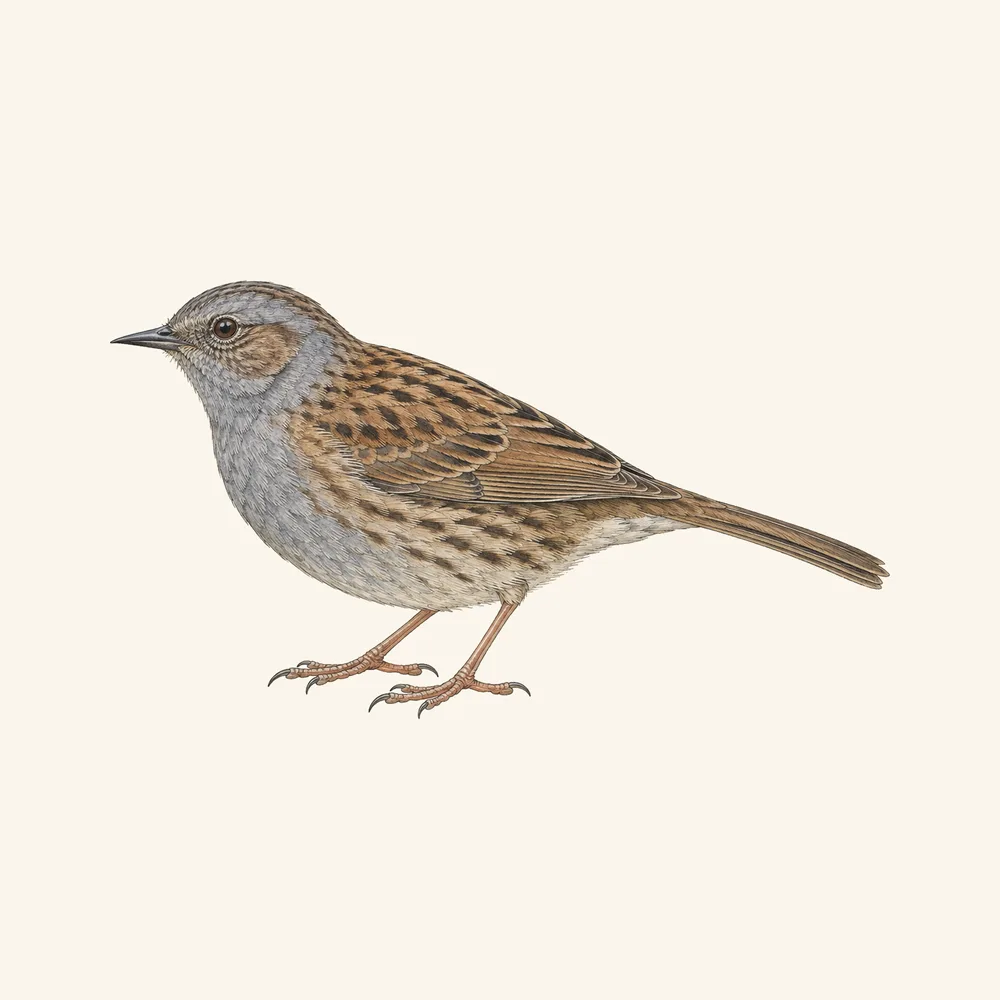
Dunnock
Prunella modularis
The grey bird shuffling under the hedge. Not a sparrow: the bill is fine and pointed, and it is nearly always alone.
In most gardens
A resident of almost every UK garden with a hedge or shrub border, but overlooked because it feeds low, quietly and usually on its own.
Amber list
Of medium conservation concern in the UK.
Birds of Conservation Concern 5 records this species as “Amber listed”, with a UK population trend of −43% (1967 to 2024). Numbers fell substantially between the mid 1970s and the mid 1980s and there has been some recovery throughout the UK since the late 1990s, but the species still meets amber-list criteria. Source.
- Wildlife and Countryside Act 1981, section 1 — It is an offence to intentionally kill, injure or take any wild bird, or to take, damage or destroy the nest of any wild bird while that nest is in use or being built, or to take or destroy its eggs. law
At a glance
-
Size
Almost exactly robin-sized at 14cm, but held lower and flatter, so it looks smaller.
-
Where you'll see it
On the ground under hedges, shrubs and feeders; very rarely on the feeder itself.
-
What it eats
Small insects, spiders and other invertebrates, plus very small seeds in winter.
-
When
Resident all year, and one of the few garden birds you can find singing in January.
-
Nests
A low cup deep inside a dense hedge, conifer or bramble. It will not use a nest box.
-
Song
A short, flat, hurried warble, often described as a squeaky trolley wheel; less tuneful than a wren's.
Not to be confused with
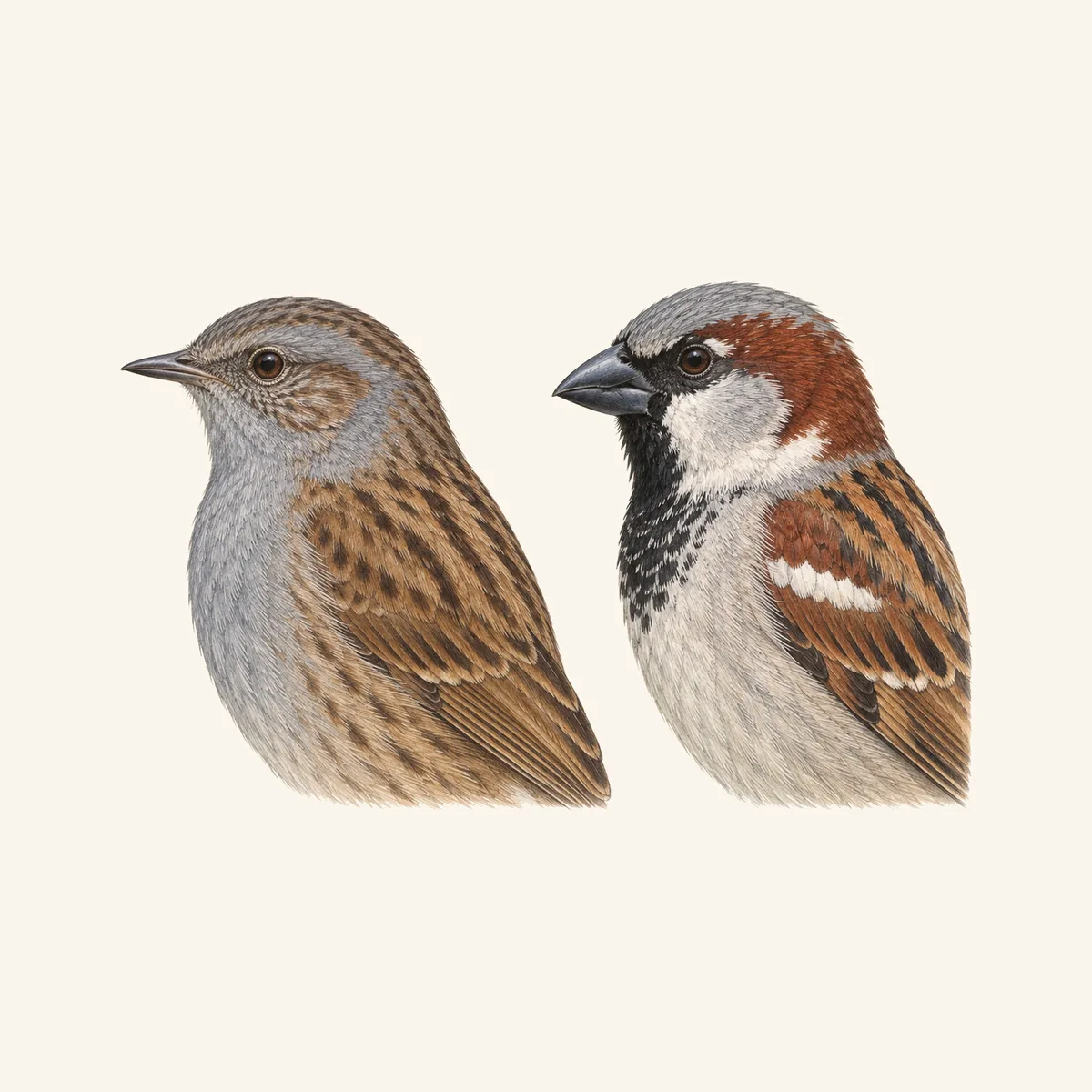
- House Sparrow — The bill decides it, every time. A dunnock has a fine, sharp, needle-like bill for picking insects out of leaf litter; a house sparrow has a thick, blunt, conical bill built to crack seed, and on a male it turns black in the breeding season. Everything else follows from that. The dunnock is soft grey on the face and breast with no bold markings at all, while a male house sparrow has a grey crown, chestnut nape and a black bib, and a female sparrow has a clear pale stripe running back from behind the eye that a dunnock never shows. Behaviour seals it: dunnocks creep alone along the ground with the body low, while house sparrows are gregarious, noisy and rarely seen singly. If it is on the feeder, in a crowd, chirping, it is a sparrow. Dunnock or House Sparrow?
- Robin — Juvenile robins in summer are mottled brown with no red and get mistaken for dunnocks. A young robin still stands tall and upright and has the robin's large dark eye in a plain face; a dunnock stands low and horizontal and is plain grey on the throat and breast with a streaked back. Dunnock or Robin?
- Wren — Both work the hedge bottom, but a wren is far smaller, rich russet-brown, and carries its short tail cocked upright. A dunnock is grey-fronted, almost twice the bulk, and holds its tail down. Dunnock or Wren?
Through the year
Spring
Singing from a hedge top from February and nesting from April. Wing-flicking disputes between several birds at once are the mating system in action, not aggression you need to worry about.
Summer
Two or three broods are normal, all raised low inside dense shrubs — a strong reason to leave hedge-cutting alone until the nesting season is genuinely over.
Autumn
Quiet and inconspicuous, working leaf litter beneath borders. Leaving the fallen leaves under your shrubs is the single most useful autumn job for a dunnock.
Winter
Still here, still alone, still under the hedge. Dunnocks sing on mild January mornings, and thick evergreen cover matters more to them than any amount of food.
Feeding
Takes: finely chopped or small suet pellets, sunflower hearts dropped to the ground, seed spilled below feeders, live or small dried mealworms.
Dunnocks are ground feeders with a small, fine bill and cannot manage large or hard seed. They take what falls. If you want to see them, the useful thing is not a new feeder but cover: a low dish set close to a hedge, or simply scattering a small amount of fine food in the drip line of a shrub. Follow the RSPB's seasonal advice — pause seed and peanuts from 1 May to 31 October, offering only small amounts of suet, fat balls or mealworms in that window. Do not use a bird table or tray feeder; the RSPB no longer recommends flat feeding surfaces because of disease risk.
How to be sure it is not a sparrow
This is the most useful identification in a British garden, because the dunnock's old name was hedge sparrow and the confusion has been passed down for generations. They are not related at all. Look at the bill: a dunnock's is fine, dark and sharply pointed, the bill of a bird that picks tiny insects out of leaf litter. A house sparrow's is thick, pale and conical, the bill of a seed-cracker. The RSPB puts it plainly, describing the dunnock's beak as thinner and more pointed than a house sparrow's. Then look at the front: a dunnock is soft, even slate-grey from throat to belly, with a streaky brown back. No black bib, no chestnut nape, no pale eye-stripe. Finally, count them. A dunnock is nearly always alone; house sparrows are nearly always a crowd.
The most complicated love life in the garden
Behind that drab exterior is one of the most unusual mating systems of any British bird. BTO describes dunnocks as polyamorous, with both males and females mating with more than one partner. In practice a garden might hold a pair, or two males sharing one female, or one male with two females, or a group of several of each. The rapid wing-flicking you see when two or three dunnocks meet on a lawn is part of that system rather than a simple territorial fight. It has consequences the gardener can actually observe: where two males share a female, both often help feed the chicks, so you may see three adults visiting one hedge. None of this needs managing. It is simply worth knowing, because a garden's dunnocks make no sense until you do.
What it actually needs: cover, not food
A dunnock will take fine seed and small suet crumbs from the ground, but food is not the limiting factor for this bird. Structure is. Dunnocks need dense, low, tangled cover to feed under, sing from and nest inside — a mixed hedge, a bramble patch, an untidy corner behind the shed, ivy on a wall. BTO links part of the long decline to agricultural intensification and reduced winter food, and gardens with thick low cover genuinely help. The corollary is that the worst thing you can do is tidy. A hedge clipped hard and flat every year, a border stripped of leaf litter and a lawn kept to the edges leave a dunnock nowhere. If you want one thing to change, let the bottom metre of one hedge grow thick and leave the leaves beneath it.
Nesting low, and the hedge trimmer
Dunnocks build a neat cup of moss and twigs low down inside a dense hedge, conifer or bramble, typically well under head height, and they raise two or three broods between April and August. That is a long window in exactly the places people cut. It is an offence under the Wildlife and Countryside Act 1981 to take, damage or destroy the nest of any wild bird while it is in use or being built, and there is no date in the calendar that makes it safe — the offence is destroying an active nest, and nests can be active outside the months you would expect. So the rule is not a date, it is a habit: check before you cut, every time. Part the branches, look for a cup low inside, and if you find one, stop and come back in a few weeks.
Plant this for it
- clematis A clematis grown thickly over a fence or into a hedge gives exactly the dense, low, concealed structure a dunnock nests inside.
- hosta The damp shaded ground and leaf litter under a clump of hostas holds the slugs, spiders and small invertebrates dunnocks spend most of the year picking over.
Guides
How we checked this
- BTO BirdFacts: Dunnock
- RSPB: Dunnock
- RSPB: How to help garden birds — feed seasonally and safely
- Wildlife and Countryside Act 1981, section 1
- RSPB: What Does the Wildlife and Countryside Act 1981 do?
Checked against the sources above. Reviewed on 2026-09-20. Legal position checked 2026-09-20.