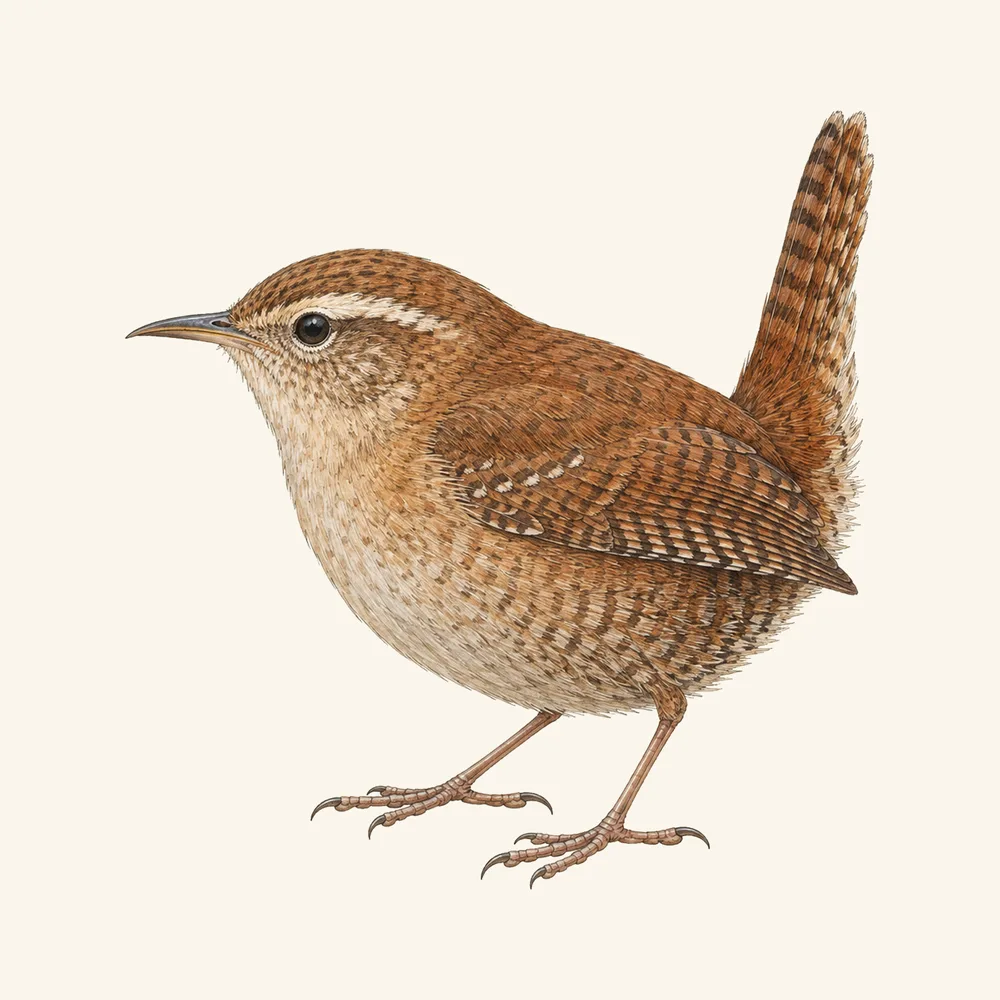
Wren
Troglodytes troglodytes
The UK's most numerous breeding bird and still Amber listed. Tiny, russet, tail cocked upright, with a song far too loud for its size.
In most gardens
Present in almost every UK garden with low cover, though heard far more often than seen because it feeds deep inside vegetation.
Amber list
Of medium conservation concern in the UK.
Birds of Conservation Concern 5 records this species as “Amber listed”, with a UK population trend of +127% (1967 to 2024). Abundance can vary sharply from year to year because survival is severely affected by cold winter weather — numbers were greatly depleted by the cold winter of 1962/63 — so a long-term increase sits alongside real volatility, and a warming climate may have benefited the species. Source.
- Wildlife and Countryside Act 1981, section 1 — It is an offence to intentionally kill, injure or take any wild bird, or to take, damage or destroy the nest of any wild bird while that nest is in use or being built, or to take or destroy its eggs. law
At a glance
-
Size
About 9-10cm and roughly 10g — one of the smallest UK birds, far smaller than a robin.
-
Where you'll see it
Low and deep in cover: ivy, log piles, hedge bottoms, dry stone walls, compost heaps and sheds.
-
What it eats
Almost entirely small invertebrates — spiders, beetles and larvae picked out of crevices and leaf litter.
-
When
Resident all year. Winter is when it is hardest hit and when cover matters most.
-
Nests
A domed ball of moss in a cavity or dense cover. It will use an open-fronted box, hidden in thick vegetation.
-
Song
Astonishingly loud for the size: a fast, rattling, silvery burst ending in a hard dry trill.
Not to be confused with
- Goldcrest — Both are tiny and secretive, but a goldcrest is olive-green with a black-bordered yellow or orange stripe down the centre of the crown, and it flits at the tips of conifer branches. A wren is warm russet-brown with a cocked tail and works the ground and low cover, never the treetops.
- Dunnock — A dunnock is roughly twice the bulk, grey on the face and breast, and holds its tail down as it shuffles. A wren is much smaller, russet all over with fine barring, and carries its tail vertical. Wren or Dunnock?
- Juvenile Robin — A young robin in summer is brown and mottled, but it is robin-sized, stands upright on long legs and has a plain face with a large dark eye. A wren is a third of the weight, barred rather than mottled, and never stands tall. Wren or Juvenile Robin?
- Treecreeper — Similar size and both brown and barred, but a treecreeper is white underneath, has a long downcurved bill and climbs tree trunks in a spiral. A wren is buff underneath with a short straight bill and stays low.
Through the year
Spring
Males build several domed nests and the female chooses one to line. Singing is constant from March. Leave ivy, log piles and sheds undisturbed from now until late summer.
Summer
Two broods are usual. Nests turn up in sheds, hanging baskets, coiled hosepipes and behind garden clutter — check before you move or tidy anything.
Autumn
Disperses into any dense cover it can find. Resist the urge to clear the leaves, cut the ivy or dismantle the log pile: this is the wren's larder.
Winter
The dangerous season. Wrens roost communally in cavities and boxes to share warmth, and survival drops sharply in frost and snow — leave cavities, ivy and roost boxes in place.
Feeding
Takes: live or finely chopped dried mealworms, small suet crumbs, invertebrates from leaf litter and log piles.
Wrens are pure insectivores and take almost nothing from a conventional feeder. Do not expect one on a seed feeder, and do not buy anything for it. What actually feeds a wren is habitat: undisturbed leaf litter, a log pile, ivy on a wall, an unswept corner behind the shed. In hard frost some will take finely chopped mealworms or suet crumbs scattered on the ground beside cover, in small amounts cleared up within a day or two. Do not use a bird table or tray feeder — the RSPB no longer recommends flat feeding surfaces because of disease risk.
Britain's commonest bird, and still Amber listed
There are somewhere around 11 million wren territories in the UK, making it the most numerous breeding bird in the country — and it is Amber listed all the same. That apparent contradiction is the most interesting thing about the species. BTO's long-term figure is a 127% increase between 1967 and 2024, but it also records that abundance can vary sharply from year to year and that mortality rates are severely affected by cold winter weather, with survival negatively correlated to frost and snow days. Wren numbers in the UK were greatly depleted by the cold winter of 1962/63 and have crashed after hard winters since. A tiny, insectivorous bird with a high surface area to volume ratio and no ability to store fat is a bird that lives permanently close to the edge. The long-term line is up; the year-to-year line is a sawtooth.
Why cover beats food, every time
A wren eats spiders, beetles, larvae and other small invertebrates, and it hunts them by creeping into places other birds cannot reach: the inside of an ivy-covered wall, the gaps in a log pile, the space under a shed, the leaf litter at the back of a border. That is why buying wren food is largely pointless and why tidying is the real risk. If you want to help a wren, the work is all subtractive. Leave the leaves where they fall under shrubs. Keep a log pile and let it rot. Leave ivy on a wall rather than stripping it. Leave one corner of the garden genuinely unswept. In a hard frost a small amount of finely chopped mealworm scattered beside cover is worth doing, but habitat is what carries the bird through.
Communal roosting, and why boxes matter in winter
In cold weather wrens do something almost no other British garden bird does: they pile into a single cavity together and share body heat, sometimes in remarkable numbers. Roosts of dozens in one nest box have been recorded. It is a direct response to the problem in the previous section — a 10g bird cannot survive a long frost alone. The practical implication is that a nest box is not only a spring object. An old box left up over winter, an open-fronted box tucked into ivy, a gap under the eaves, a hole in a dry stone wall: all of these can be a winter roost, and blocking them up in autumn tidying removes the thing a wren needs most in January. Leave cavities open, leave boxes up, and clean them out in early autumn rather than late.
Boxes, nests and the tidying problem
Wrens are cavity nesters that build a domed ball of moss with a side entrance, and the male builds several and lets the female pick. National Nestbox Week lists the wren under open-fronted boxes, with a nest height of 1 to 4m above ground but well hidden in thick vegetation — concealment matters far more than height. It gives no entrance hole diameter for a wren, so we do not publish one. In practice, most garden wren nests are not in boxes at all but in things people move: a hanging basket, a coiled hosepipe, a shelf in a shed, a gap behind stacked pots, a jacket on a nail. It is an offence to damage or destroy a nest in use or being built, and no calendar date makes it safe. Check before you move it, every time.
Plant this for it
- clematis A thick clematis on a wall or fence gives wrens both the dense concealment they nest in and the invertebrate-rich tangle they hunt through.
- hosta Damp, shaded ground and undisturbed leaf litter under hostas hold the spiders, beetles and larvae that make up almost the whole of a wren's diet.
Guides
How we checked this
- BTO BirdFacts: Wren
- National Nestbox Week: Nestboxes — Open Front
- RSPB: Wren
- RSPB: Keep your garden birds healthy
- Wildlife and Countryside Act 1981, section 1
Checked against the sources above. Reviewed on 2026-09-20. Legal position checked 2026-09-20.