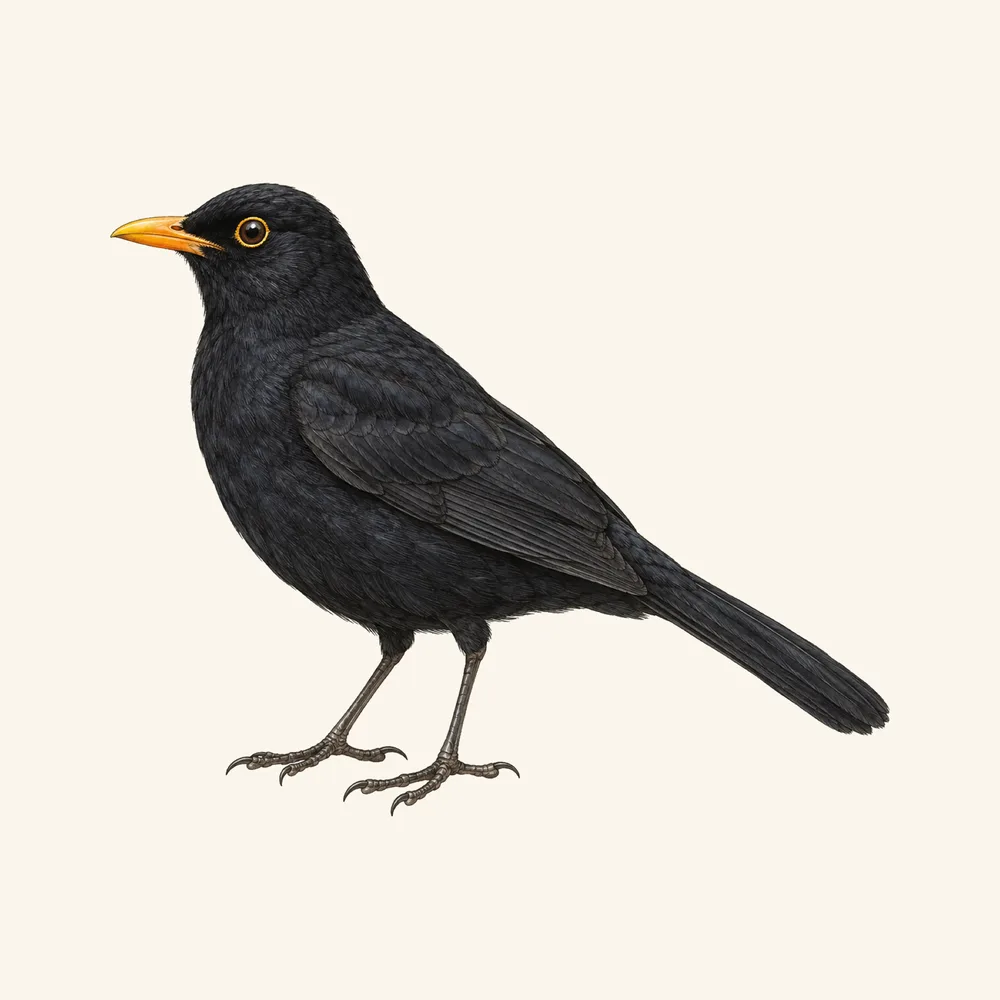
Blackbird
Turdus merula
Green-listed and the best singer in the garden. Helped far more by leaf litter and an unclipped hedge than by anything on a feeder.
In most gardens
Ranked fifth in the RSPB Big Garden Birdwatch 2026. Resident in essentially every garden with a lawn, a hedge and some cover.
Green list
Not currently of conservation concern in the UK.
Birds of Conservation Concern 5 records this species as “Green listed”, with a UK population trend of −21% (1967 to 2024). Source.
- Wildlife and Countryside Act 1981, section 1 — It is an offence to intentionally kill, injure or take any wild bird, or to take, damage or destroy the nest of any wild bird while that nest is in use or being built, or to take or destroy its eggs. law
At a glance
-
Size
About 25cm — the reference bird other species get measured against
-
Where you'll see it
On the lawn, under hedges, in leaf litter, and on the ground below feeders
-
What it eats
Earthworms and insects in spring; berries and windfall fruit in autumn
-
When
Resident, all year, with continental birds joining in winter
-
Nests
A mud-lined cup in a hedge, climber or shrub — never in a hole-fronted box
-
Song
Slow, fluting, unhurried phrases from a rooftop or high branch at dawn and dusk
Not to be confused with
- Starling — Movement first: a blackbird hops and pauses, a starling walks continuously. Then the tail — long on a blackbird, short and triangular on a starling. In good light the starling shows green and purple gloss and pale spangles; the male blackbird is matt black with a yellow eye-ring. Blackbird or Starling?
- Song Thrush — Breast pattern. A song thrush has bold, dark, arrow-shaped spots on a creamy-white breast. A female blackbird is plain warm brown and only faintly mottled on the throat — never spotted down the flanks. The thrush is also smaller and more upright. Blackbird or Song Thrush?
- Juvenile Blackbird — Young blackbirds are rusty-brown with pale streaks and are regularly reported as thrushes. Look for the shape and the company — blackbird proportions, blackbird hop, and an adult feeding it nearby.
Through the year
Spring
Song from February, nesting from March. The first brood of two or three is usually in a hedge or a climber low down.
Summer
Repeat broods run into July. Short-tailed, gape-flanged juveniles sit about on lawns being fed; adults go quiet and scruffy during the moult.
Autumn
Berries and windfalls take over from worms. Song stops; birds become secretive while moulting.
Winter
Numbers rise as continental blackbirds arrive. Hard frost drives them onto fruit and ground-scattered food.
Feeding
Takes: earthworms and insects, windfall apples and pears, berries, mealworms, suet pellets, seed and oats scattered on the ground.
Blackbirds cannot use hanging feeders and rarely try. Scatter food on the ground or use a ground tray near cover, and keep it clear of the drip line below a seed feeder if you want to stop rats finding it.
Leaf litter is the whole trick
Watch a blackbird for two minutes in autumn and you will see it flicking dead leaves sideways under a hedge, looking for the invertebrates underneath. That behaviour is why an over-tidied garden holds fewer blackbirds than a scruffy one, whatever is hanging from the feeder. The practical change is small: stop clearing fallen leaves out from under hedges and shrubs, and rake them into the backs of borders rather than into a bin bag. A damp, undisturbed layer there feeds blackbirds through the whole winter, and it is the single most useful thing most gardens can offer them. Keeping some lawn short helps too, because blackbirds hunt earthworms by listening and cannot work long grass. Short grass, deep litter, and a hedge to run into between the two.
There is no box for a blackbird
Blackbirds nest in a bulky, mud-lined cup built into a hedge, a dense shrub or a climber against a wall, usually low down, and they will not use a hole-fronted nest box. We are not giving a hole diameter on this page because there isn't one to give: our approved source for box dimensions covers small-entrance species only, and a blackbird is not one of them. Open-fronted boxes exist and are occasionally used, but the reliable provision is cover. A hedge that has not been cut for two or three years, or an established climber on a wall, gives them everything they need. Time any hedge cutting outside the breeding season: blackbirds start in March and can still have chicks in July, and damaging a nest in use or being built is an offence.
Song, and why it stops
The blackbird's song is the best reason to keep them in a garden — slow, fluting phrases delivered unhurriedly from a rooftop or a high branch at first light and again at dusk. It starts in February and runs through to early July, then simply stops, which people often read as a bird lost or gone. It has not. Blackbirds moult through late summer, become quiet and secretive, and spend weeks skulking in cover looking faintly disreputable before reappearing in autumn. The same is true of the male's bill colour, which is dullest in autumn and brightest orange in spring. If your garden goes silent in August, nothing is wrong. Continental birds arriving from October are the reason numbers often look higher in midwinter than they did in June.
Plant this for it
- apple Windfall apples left lying under the tree are a major autumn and winter food, especially once frost has hardened the ground and worms are out of reach.
- strawberry Honest warning rather than a recommendation — blackbirds will take ripe strawberries. Net taut over hoops if you want the crop, or plant a few extra and share.
- hosta A clump of hostas holds damp, undisturbed leaf litter and shade at ground level, which is exactly where blackbirds forage for invertebrates in dry weather.
Guides
- Berries for birds: shrubs to plant this bare-root season
- Binoculars for garden birdwatching: what the numbers mean, and how little you need to spend
- Bird baths in winter: keeping water open in a freeze
- Birds flying into windows: why it happens and what stops it
- Do cats kill garden birds? What the numbers show, and what helps
- Feeders back on: what to put out from 1 November
How we checked this
- BirdFacts: Blackbird — BTO
- The Big Garden Birdwatch 2026 results are in — RSPB
- Wildlife and Countryside Act 1981, section 1 — legislation.gov.uk
Checked against the sources above. Reviewed on 2026-09-20. Legal position checked 2026-09-20.