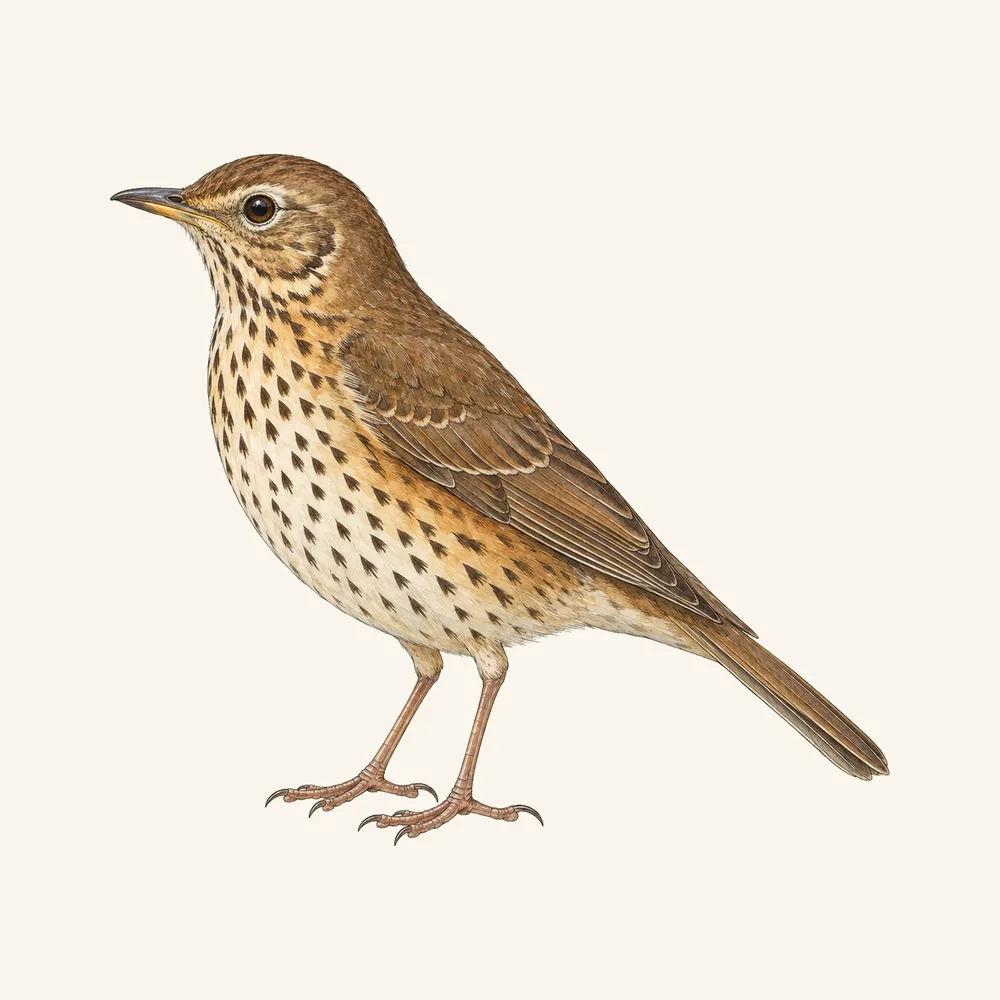
Song Thrush
Turdus philomelos
Amber listed and down 45% since 1967. Warm brown above, small arrowhead spots in neat lines, and a song that repeats every phrase.
In many gardens
Widespread but much thinner on the ground than it was: many gardens hold one pair or none, and it is heard far more often than it is seen.
Amber list
Of medium conservation concern in the UK.
Birds of Conservation Concern 5 records this species as “Amber listed”, with a UK population trend of −45% (1967 to 2024). Short-term increases beginning around 2012 mean the long-term UK decline is now classed as moderate rather than steep, but the population remains substantially lower than in the late 1960s. Source.
- Wildlife and Countryside Act 1981, section 1 — It is an offence to intentionally kill, injure or take any wild bird, or to take, damage or destroy the nest of any wild bird while that nest is in use or being built, or to take or destroy its eggs. law
At a glance
-
Size
Smaller than a blackbird, about 23cm, neat and compact with a short tail.
-
Where you'll see it
On lawns and borders, and singing from the top of a tree, TV aerial or roof ridge.
-
What it eats
Earthworms, snails and other invertebrates; berries and windfall fruit in autumn and winter.
-
When
Resident all year, with song starting as early as late December and peaking in spring.
-
Nests
A mud-lined cup in a dense shrub, hedge or creeper. It will not use a nest box.
-
Song
Loud, ringing and unmistakable because every phrase is repeated two to four times before the next.
Not to be confused with
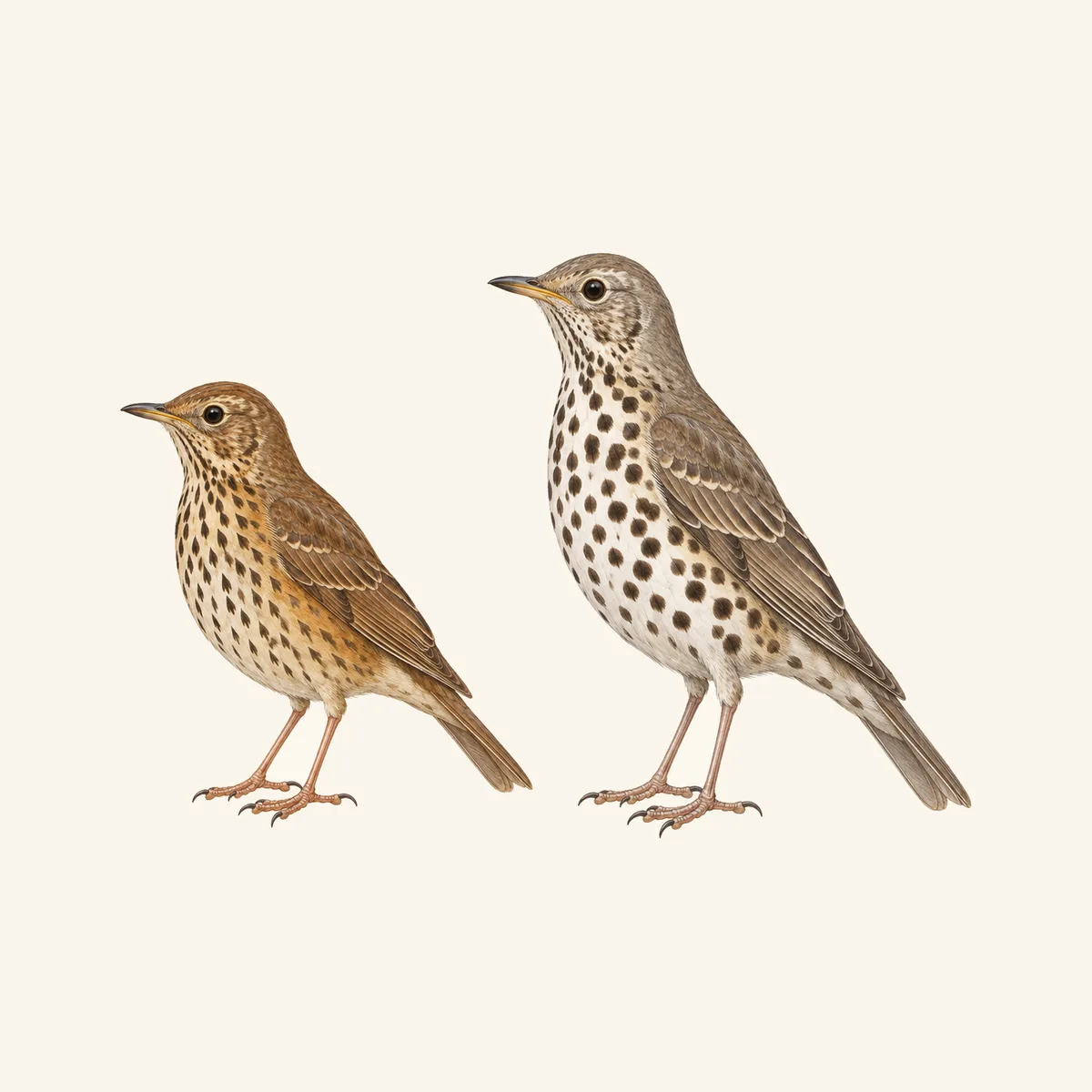
- Mistle Thrush — The spots decide it. A song thrush has small dark arrowhead spots arranged in neat vertical lines down a creamy, buff-washed breast. A mistle thrush has large, round, blackish blotches scattered untidily across a colder, whiter breast, often merging into a dark patch at the side. The size difference is real and obvious once you have seen both: a mistle thrush is clearly bigger than a blackbird, a song thrush clearly smaller, and a mistle thrush stands tall and upright with a long tail while a song thrush looks compact and hunched. Underwing and tail confirm it — a song thrush flashes orange-buff underwings, a mistle thrush flashes white underwings and shows white tail corners as it goes.
- Redwing — A winter visitor of similar size and shape, but a redwing has a bold creamy stripe over the eye and rusty-red flanks and underwing. A song thrush has a plain face and buff, not red, along the flanks. Song Thrush or Redwing?
- Female Blackbird — A female blackbird is dark chocolate-brown all over with vague mottling on the throat only, and is noticeably larger and longer-tailed. A song thrush is paler, warmer brown above and crisply spotted right down the breast and flanks. Song Thrush or Female Blackbird?
- Fieldfare — A fieldfare is larger, with a blue-grey head and rump contrasting with a chestnut back — a two-tone look no song thrush has. Song Thrush or Fieldfare?
Through the year
Spring
Song at full volume from February, and nesting from March, often with two or three broods. Nests sit low in hedges and creepers — check before any cutting.
Summer
Feeding young on worms and snails. A dry summer is hard on them because baked ground puts worms out of reach, so a damp, shaded, un-mown corner is genuinely valuable.
Autumn
Switches to berries and windfall fruit as invertebrates get scarce. Leave fallen apples where they land rather than clearing them.
Winter
Some song thrushes move south or west and continental birds arrive, so your winter bird may not be your summer one. Song can restart on mild days as early as late December.
Feeding
Takes: windfall apples and pears, sultanas and raisins soaked in water, live or dried mealworms, suet pellets.
Song thrushes feed on the ground and will not use a hanging feeder. The most useful thing you can do is not put food out at all but leave windfall fruit lying under the tree through autumn and winter, and leave a corner of the lawn and borders undisturbed for worms. If you do offer food, put a small amount in a shallow dish you can lift and scrub daily, sited near cover. Do not use a bird table or tray feeder: the RSPB no longer recommends flat feeding surfaces because contaminated food collects on them.
The bird that eats your slugs and snails
The song thrush is the only common garden bird that routinely smashes snails, and it is the single best argument for leaving slug pellets on the shelf. It selects a hard surface — a stone, a paving slab, a step — and uses it repeatedly as an anvil, holding the snail by the lip of the shell and striking it down until it breaks. Find a small heap of broken shells on one stone and you have found a thrush's working anvil. Snails are a fallback food rather than a first choice; earthworms and other soft invertebrates come first, and thrushes turn to snails most in hard, dry or frozen conditions when worms are unreachable. That matters for how you help: a damp, shaded, undisturbed patch of ground with leaf litter over it does more for a song thrush than any feeder.
Telling it from a mistle thrush
These two are the classic British garden mix-up, and BTO describes them as readily confused: both grey-brown, both spotted, both pale-legged. The reliable separator is spot shape, not spot presence. A song thrush wears small, dark, arrowhead-shaped spots arranged in tidy vertical lines down a creamy breast washed warm buff at the sides. A mistle thrush wears large, round, blackish blotches scattered untidily across a colder, whiter ground colour. Size backs it up and is more useful than people expect: song thrush is smaller than a blackbird, mistle thrush distinctly bigger, and the mistle thrush stands tall and upright where the song thrush looks compact. If the bird flies off, watch the underwing — orange-buff on a song thrush, white on a mistle thrush, which also shows white tail corners.
A song built out of repetition
You can identify this bird with your eyes shut. A song thrush sings a phrase, then repeats it two, three or four times before moving to an entirely different phrase and doing the same again. Nothing else in a British garden does that. A blackbird's song is mellow, fluid and continuous with no repeats; a mistle thrush sings short, sad, disjointed phrases, often in bad weather from a high treetop. The song thrush is loud, ringing and deliberate, delivered from the most exposed perch available — the top of a tree, a chimney, an aerial — and it carries a long way through a suburban street. Song begins on mild days from around late December, peaks through spring, and includes borrowed phrases: song thrushes mimic other birds, alarms and even mobile phones.
Why it declined, and what helps
BTO puts the fall at 45% between 1967 and 2024, enough to keep the species Amber listed, though short-term increases beginning around 2012 mean the long-term decline is now classed as moderate rather than steep. The causes are mostly agricultural — loss of damp grassland, hedgerow removal and reduced invertebrate food — but gardens are now a significant part of the species' range, and garden management genuinely registers. The useful actions are unglamorous. Do not use slug pellets, which remove the food and can pass through the food chain. Keep an area of lawn or border damp and undisturbed so worms stay reachable. Leave leaf litter under shrubs. Let hedges thicken rather than clipping them tight, and check any hedge or creeper for a mud-lined nest cup before you cut, every time.
Plant this for it
- apple Windfall apples left under the tree are a staple autumn and winter food, and the leaf litter beneath holds the worms and snails thrushes hunt the rest of the year.
- hosta The damp, shaded, snail-rich ground under a hosta clump is exactly the feeding habitat a song thrush works — and the thrush is the reason not to reach for slug pellets.
Guides
How we checked this
- BTO BirdFacts: Song Thrush
- BTO: Identifying Song Thrushes and Mistle Thrushes
- RSPB: Song Thrush
- RSPB: Keep your garden birds healthy
- Wildlife and Countryside Act 1981, section 1
Checked against the sources above. Reviewed on 2026-09-20. Legal position checked 2026-09-20.