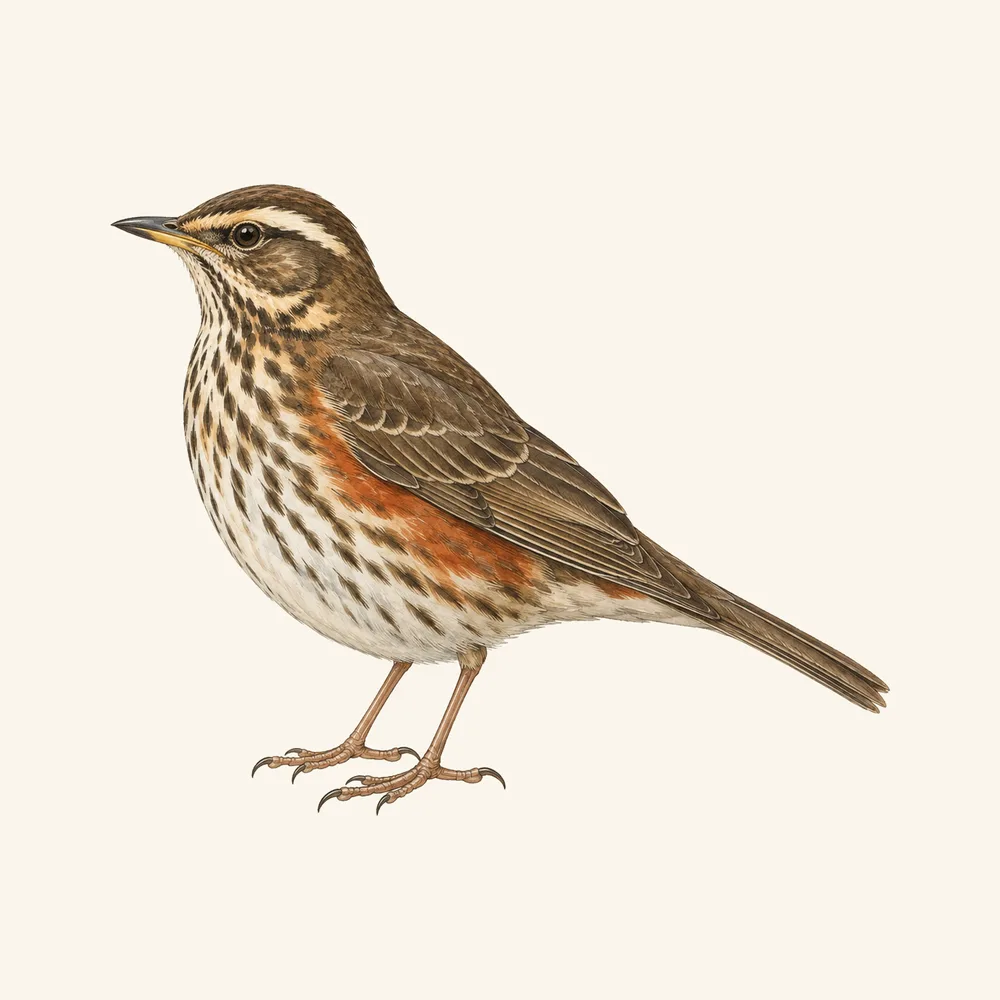
Redwing
Turdus iliacus
A small dark thrush with a cream eye-stripe and rusty flanks. A winter visitor from the north, arriving in October and gone by April.
Seasonal visitor
A winter visitor, not a resident. BTO gives an average autumn arrival date of 1 October and a departure in mid-April, with a wintering population estimated at around 690,000 birds. Garden visits are weather-driven: flocks work hedges and fields first and only drop into gardens when hard frost or snow locks up the countryside.
Amber list
Of medium conservation concern in the UK.
Birds of Conservation Concern 5 records this species as “Amber listed”. BTO gives no headline percentage for the wintering population. The tiny British breeding population, a mean of 27 pairs or singing males between 2015 and 2019, has been broadly stable over 25 years, but breeding range contracted by 32.4% between 1968–72 and 2008–11 while winter distribution expanded by 4.4% between 1981–84 and 2007–11. Source.
- Wildlife and Countryside Act 1981, section 1 — It is an offence to intentionally kill, injure or take any wild bird, or to take, damage or destroy the nest of any wild bird while that nest is in use or being built, or to take or destroy its eggs. law
At a glance
-
Size
Song thrush sized — clearly smaller and neater than a blackbird, and much smaller than a fieldfare.
-
Where you'll see it
On lawns and under fruit trees in hard weather, and stripping berries from hedges. Rarely on feeders.
-
What it eats
Berries, windfall apples and other soft fruit, plus earthworms and invertebrates from open ground.
-
When
October to April only. BTO gives an average arrival of 1 October and departure in mid-April.
-
Nests
Does not normally nest here — Britain holds only a handful of pairs, in northern Scotland. No nestbox applies.
-
Song
A thin, high, drawn-out 'tseep' given in flight, most often heard from migrating flocks passing over at night.
Not to be confused with
- Song Thrush — The face decides it. A song thrush has a plain face with no eye-stripe and warm buff flanks; a redwing has a bold creamy-white stripe over the eye and a second below the cheek, and rust-red flanks. Both are the same size and shape, so ignore size entirely and look at the head. Redwing or Song Thrush?
- Fieldfare — They arrive in the same flocks, which is why this catches people. A fieldfare is much larger — bigger than a blackbird — with a grey head and grey rump against a chestnut back, and a black tail. A redwing is song thrush sized, brown-headed, and has the white eye-stripe and red flanks a fieldfare does not. Redwing or Fieldfare?
- Mistle Thrush — A mistle thrush is the biggest of the thrushes, pale and greyish with large round spots scattered over a white breast, and it stands very upright. A redwing is smaller, darker brown above, streaked rather than round-spotted below, and has the eye-stripe a mistle thrush entirely lacks.
Through the year
Spring
Flocks feed up and leave, with departure around mid-April. The last birds often appear on lawns in March when the ground softens.
Summer
Absent. Britain holds only a handful of breeding pairs, in the far north, and none in gardens.
Autumn
Arrival from Scandinavia and Iceland from about 1 October, often announced by thin 'tseep' calls from migrating flocks overhead at night. Stop clearing windfalls now.
Winter
The months to see one in a garden, and hard frost is what brings them in. Keep windfall apples out and the bird bath ice-free.
Feeding
Takes: windfall apples and pears, berries from holly, hawthorn, rowan and cotoneaster, earthworms and invertebrates from unfrozen ground, halved apples put out on the ground.
Redwings are fruit and ground specialists and will essentially ignore a hanging feeder. BTO notes that old orchard fruits such as apples and pears — the softer the better — are much loved by thrushes including redwing, fieldfare and blackbird. So the effective provision is fruit on the ground, not seed in a tube, and it costs nothing: leave windfalls where they fall rather than clearing them, and add bruised or frost-damaged apples from the store through a cold snap. Scatter them in a few places rather than one pile, and keep a bird bath unfrozen — thirst brings flocks down as reliably as hunger.
A visitor, not a resident
This is the first thing to get right about a redwing, and a lot of garden writing blurs it. Redwings do not live here. They breed in Iceland, Scandinavia and Russia, arrive on our east coast from about the start of October — BTO gives an average autumn arrival date of 1 October — and are gone again by mid-April. A handful of pairs nest in northern Scotland, but for practical purposes Britain is a winter feeding ground, not a home. That changes what a gardener can usefully do. There is no nestbox, no breeding season to protect, no territory to encourage. The whole relationship is compressed into six or seven months of feeding, and it is at its most acute during exactly the few days of hard frost when everything else is locked away.
Windfall apples are the single best thing you can do
If you take one action for redwings, it is this: stop tidying up fallen fruit. BTO states that old orchard fruits such as apples and pears, the softer the better, are much loved by thrushes including fieldfare, redwing and blackbird. A frosted, bruised, half-rotten windfall is exactly what a redwing wants and exactly what most gardeners rake up in November. Leave them where they fall under the tree, and through a cold snap add any apples going soft in the store, cut in half and scattered in several places rather than one heap so a flock can spread out. This needs no equipment and no expenditure, and it will pull down birds that would otherwise pass straight over your garden on their way to a hedgerow.
Telling one from a song thrush
Redwings and song thrushes are the same size and shape, and in poor winter light on a lawn they can look identical at a glance. Ignore size and look at the head. A redwing has a bold creamy-white stripe running back above the eye, and a second pale stripe below the cheek, which together give a distinctly striped face; a song thrush's face is plain. The second check is the flanks: rusty red on a redwing, warm buff on a song thrush. The red is often hidden when the bird is side-on and standing still, but it flares as the bird turns or opens its wings, which is why the eye-stripe is the more reliable mark. Behaviour helps too — redwings arrive in restless flocks and spook easily; song thrushes are usually alone and stay put.
Berries, water and leaving things alone
Beyond fruit, the useful contributions are structural and mostly passive. Berrying shrubs and trees — holly, hawthorn, rowan, cotoneaster, ivy — carry redwings through the early part of winter before they turn to fallen fruit and worms. Cotoneaster is the one to think about before planting: it is on Schedule 9 of the Wildlife and Countryside Act 1981 in England and Wales, which makes it an offence to plant it in the wild, and birds are precisely how it spreads there. Lawful and useful in a garden; near open country, rowan or hawthorn is the cleaner choice. A thick hedge gives them somewhere to bolt to, which matters because they are nervous birds that will not settle on an open lawn with no cover in reach. Unfrozen water matters as much as food in a freeze; a bird bath checked and topped up each morning is a genuine service. And when the ground softens after frost, leave the lawn unrolled and unraked for a few days — a redwing hunting worms on damp turf is using the best food available to it, and it is free.
Plant this for it
- apple Windfall apples left under the tree are the single best thing a gardener can offer a redwing. BTO names old orchard fruits, the softer the better, as much loved by thrushes including redwing.
- clematis A dense clematis on a fence or wall gives the bolt-hole cover redwings need before they will drop onto an open lawn, and adds a sheltered winter roosting site.
Guides
How we checked this
- BTO BirdFacts: Redwing
- BTO: Garden birds in winter
- RSPB: How to identify the UK's thrushes, including two special winter visitors
- Wildlife and Countryside Act 1981, section 1
Checked against the sources above. Reviewed on 2026-09-20. Legal position checked 2026-09-20.