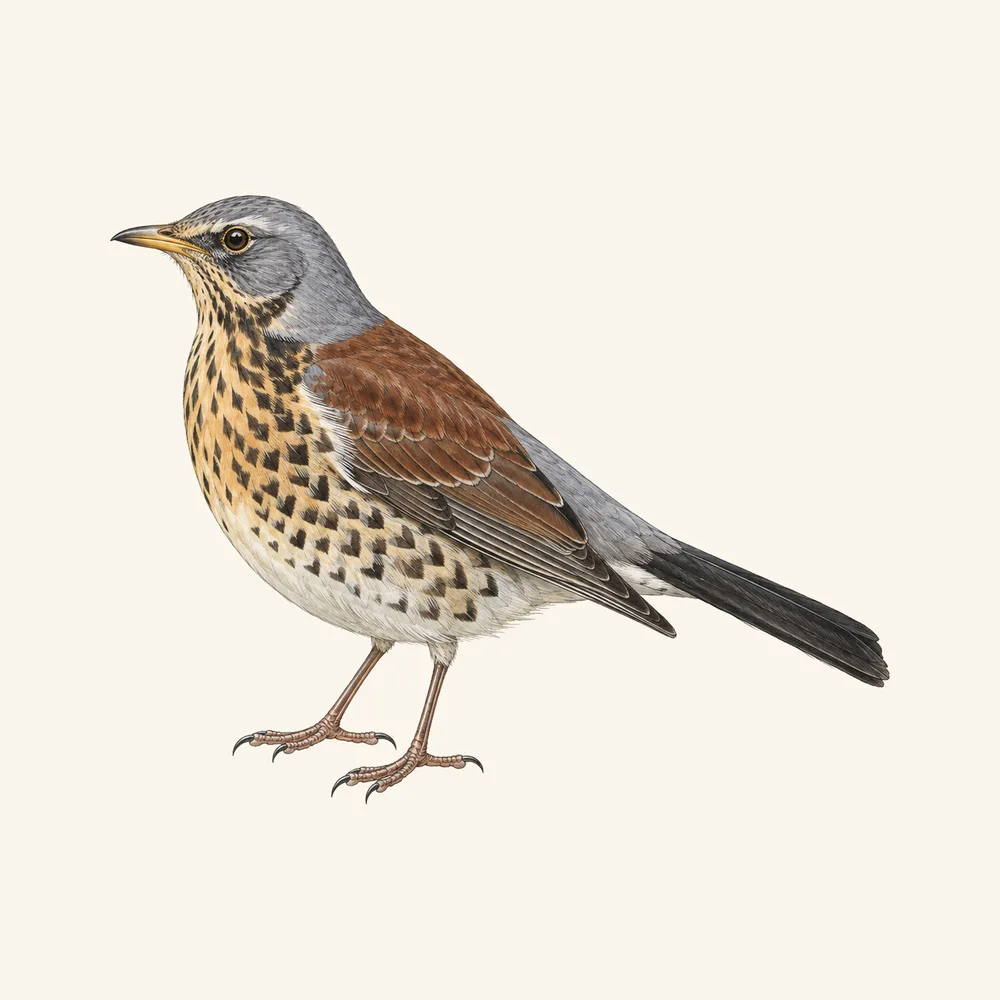
Fieldfare
Turdus pilaris
A big, bold winter thrush with a grey head and chestnut back. Arrives from the north in October, leaves in spring, and loves fallen apples.
Seasonal visitor
A winter visitor, not a resident. BTO records arrival on UK eastern coasts in early October, with birds remaining into late winter and early spring and peak occurrence from November to March. The wintering population was estimated at around 720,000 birds. Fieldfares are field and hedgerow birds first and come into gardens mainly when hard weather strips the countryside.
Red list
Of highest conservation concern in the UK.
Birds of Conservation Concern 5 records this species as “Red listed”. BTO gives no headline percentage. The red listing reflects the near-loss of fieldfare as a British breeding bird — a mean of one breeding pair during 2015 to 2019, a strong decrease over the 25 years to 2019, and a Critically Endangered assessment as a breeder in Great Britain — not the health of the much larger wintering population, whose distribution expanded by 3.7% between 1981–84 and 2007–11. Source.
- Wildlife and Countryside Act 1981, section 1 — It is an offence to intentionally kill, injure or take any wild bird, or to take, damage or destroy the nest of any wild bird while that nest is in use or being built, or to take or destroy its eggs. law
At a glance
-
Size
Larger than a blackbird — the biggest thrush most gardens will see, and noticeably long-winged and upright.
-
Where you'll see it
On lawns, playing fields and under fruit trees in cold weather, and stripping berried hedges. Not a feeder bird.
-
What it eats
Berries and windfall fruit above all, plus earthworms and invertebrates taken from open, unfrozen ground.
-
When
October to April only. BTO gives arrival on eastern coasts in early October and peak numbers November to March.
-
Nests
Effectively does not nest in Britain — around one pair a year in recent surveys. No nestbox applies.
-
Song
No garden song — a loud, excited, laughing 'chack-chack-chack' from flocks, usually heard before the birds are seen.
Not to be confused with
- Mistle Thrush — The genuine difficulty, since both are large, pale, upright thrushes. A mistle thrush is uniformly grey-brown above with no contrast, and shows white tail corners as it flies. A fieldfare has a three-toned back — grey head, chestnut mantle, grey rump — and a solid black tail with no white.
- Redwing — They travel in the same flocks. A redwing is song thrush sized with a bold creamy eye-stripe and rust-red flanks; a fieldfare is bigger than a blackbird, has no eye-stripe, and shows the grey head and black tail the redwing lacks. Size alone is reliable when the two are together. Fieldfare or Redwing?
- Blackbird — A female blackbird is plain dark brown with faint mottling, a dull yellowish bill and no grey anywhere. A fieldfare is boldly patterned, with a blue-grey head and rump against a chestnut back, and black chevrons on an ochre breast. Fieldfares also arrive in flocks; blackbirds in gardens are usually singles or pairs. Fieldfare or Blackbird?
Through the year
Spring
Flocks feed up on the last fruit and leave through March and into April. Nothing further is needed once they have gone.
Summer
Absent. Fieldfare is effectively no longer a British breeding bird, which is what its red listing reflects.
Autumn
Arrival on eastern coasts from early October, in noisy flocks with redwings. Stop clearing windfall fruit now and leave berries on the hedge uncut.
Winter
Peak months, November to March, and hard frost is what brings flocks into gardens. Put out spare apples and keep the bird bath ice-free.
Feeding
Takes: windfall apples and pears, berries from hawthorn, holly, rowan and cotoneaster, earthworms and invertebrates from unfrozen ground, halved apples put out on the ground.
Fieldfares will not use a hanging feeder and take almost nothing from seed. BTO names old orchard fruits such as apples and pears, the softer the better, as much loved by thrushes including fieldfare, redwing and blackbird, and that is exactly the provision to make. Leave windfalls lying and add bruised or frosted apples from the store during a cold snap. Spread them across the garden rather than in one place: a single fieldfare will guard a good fruit source aggressively and drive other thrushes off it, so several small scatterings feed more birds than one pile. Unfrozen water matters as much as food.
Why a red-listed bird can still be abundant
This looks like a contradiction and is worth explaining, because it appears on every fieldfare page and is almost never unpacked. BTO lists the fieldfare as Red listed on UK Birds of Conservation Concern, and around 720,000 of them winter here. Both are true, because the listing assesses the British breeding population, which has all but vanished — a mean of one pair during 2015 to 2019, a strong decrease over the previous 25 years, and an assessment of Critically Endangered as a breeder in Great Britain. The birds on your lawn in January bred in Scandinavia and Russia and are unaffected by that. So the red flag is real and specific: Britain has lost a breeding species, while remaining an important wintering ground for the wider population. Reading the status without that distinction gives the wrong picture in both directions.
Windfall apples are the single best thing you can do
There is one intervention that outperforms everything else for fieldfares, and it is free. BTO states that old orchard fruits such as apples and pears, the softer the better, are much loved by thrushes including fieldfare, redwing and blackbird. A windfall apple that has been frosted and started to go soft is prime fieldfare food, and it is precisely what most gardeners clear away in autumn. Leave them lying under the tree. Through a hard spell, add apples going over in the store, cut in half, scattered in several separate places rather than heaped in one — fieldfares are territorial over fruit and a single bird will guard a pile against all comers, so spreading them out feeds far more birds. Do this and a passing flock has a reason to drop in.
Big, loud and easily missed
Fieldfares are the largest thrush most gardens will ever see, bigger than a blackbird and strikingly marked, yet they are regularly overlooked because of how they behave. They travel in flocks, arrive without warning, feed hard for a few minutes and go. The call comes first: a loud, excited, laughing 'chack-chack-chack' thrown out by the flock in flight. On the ground they stand noticeably tall and upright, bound forward in long hops, then stop dead. The plumage repays a proper look — a pale blue-grey head and rump framing a rich chestnut back, black chevrons across a warm ochre breast, and a solid black tail that shows clearly as the bird turns away. Learn the black tail against the grey rump and you will pick fieldfares out of a mixed thrush flock at distance.
What a garden can offer, honestly
Most of the time, nothing — and that is a fair answer. Fieldfares are birds of open fields, hedgerows and orchards, and in mild winters they may never need a garden at all. Their moment comes in hard frost and snow, when the ground goes solid and hedgerow berries have already been stripped, and at that point a garden with fallen fruit, berried shrubs and unfrozen water becomes genuinely valuable. So the preparation is seasonal and low-effort: leave hawthorn, holly, rowan and cotoneaster berries uncut going into winter (cotoneaster is Schedule 9 listed under the Wildlife and Countryside Act 1981 in England and Wales — lawful in a garden, an offence to plant in the wild, and birds are how it escapes, so it is worth knowing before you plant a new one), stop clearing windfalls from October, keep a few apples back for a cold snap, and check the bird bath every morning through a freeze. There is nothing to build and nothing to buy.
Plant this for it
Guides
How we checked this
- BTO BirdFacts: Fieldfare
- BTO: Garden birds in winter
- RSPB: How to identify the UK's thrushes, including two special winter visitors
- Wildlife and Countryside Act 1981, section 1
Checked against the sources above. Reviewed on 2026-09-20. Legal position checked 2026-09-20.