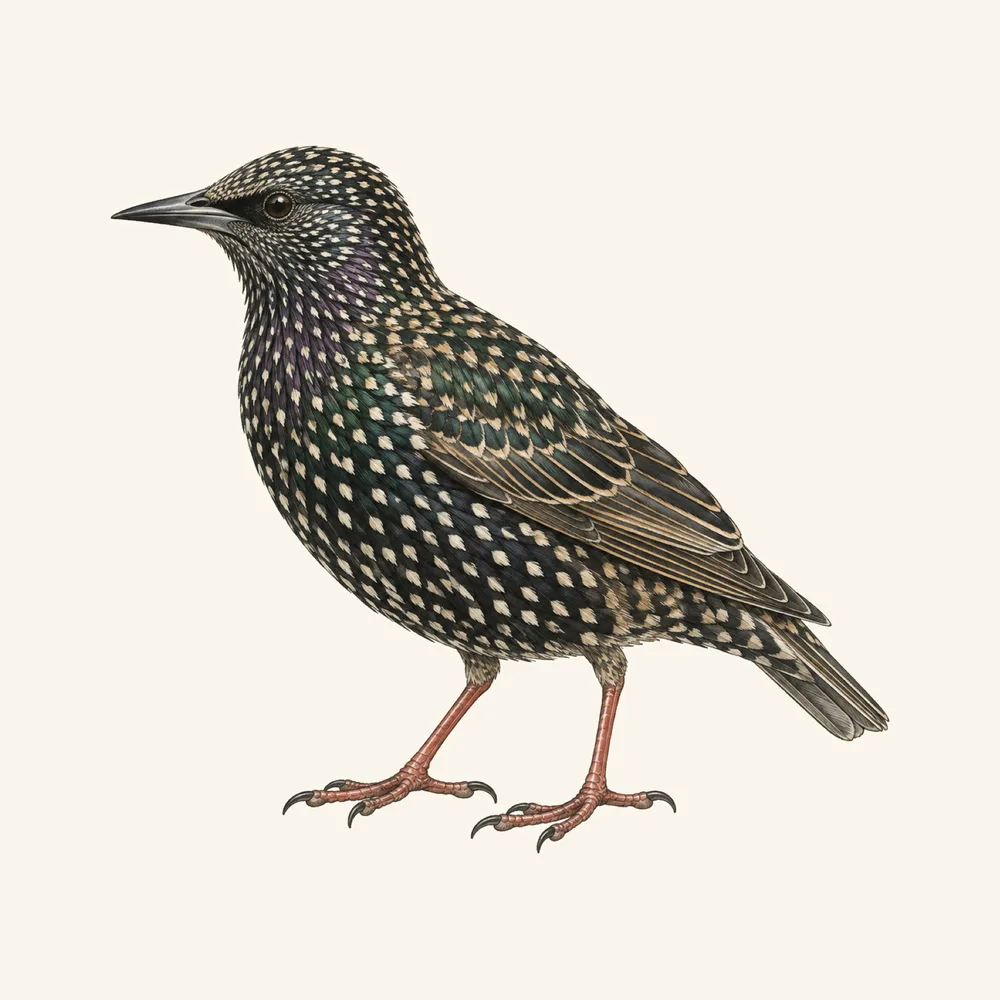
Starling
Sturnus vulgaris
Red-listed, down 61% since 1995, and still third in the Birdwatch. Its future turns on lawns and grubs, not on feeders.
In most gardens
Ranked third in the RSPB Big Garden Birdwatch 2026, up one place on the previous year. Still one of the commonest garden birds, and still Red-listed — the two facts sit together uncomfortably.
Red list
Of highest conservation concern in the UK.
Birds of Conservation Concern 5 records this species as “Red listed”, with a UK population trend of −61% (1995 to 2024). Source.
- Wildlife and Countryside Act 1981, section 1 — It is an offence to intentionally kill, injure or take any wild bird, or to take, damage or destroy the nest of any wild bird while that nest is in use or being built, or to take or destroy its eggs. law
At a glance
-
Size
Blackbird-sized at about 21cm, but shorter-tailed and more upright
-
Where you'll see it
Probing a short lawn, on rooftops and aerials, mobbing the fat feeder
-
What it eats
Leatherjackets and other soil grubs; fruit, suet and seed the rest of the year
-
When
Resident, all year, with continental birds swelling numbers in winter
-
Nests
In roof and wall cavities and old woodpecker holes; will use a large-hole box
-
Song
A rambling mix of whistles, clicks and rattles, with mimicry of other species
Not to be confused with
- Blackbird — Watch how it moves on the lawn. A starling walks, steadily and busily, and has a short triangular tail. A blackbird hops, pauses, cocks its long tail and listens. Close up the starling is spangled and glossy green-purple; a male blackbird is matt black with a yellow eye-ring. Starling or Blackbird?
- Juvenile Starling (often reported as an unknown brown bird) — Fresh juveniles are plain mouse-brown with a dark bill and look nothing like their parents. The giveaway is shape and company — short tail, upright walk, and always in a group with adult starlings. In late summer you will see half-moulted birds with a brown head on a spotted black body.
Through the year
Spring
Song from rooftops from February. Nesting gets underway in March in roof cavities, with noisy chicks audible from inside the eaves by April.
Summer
Brown juveniles flood onto lawns in June, often in larger numbers than the adults. Birds turn to fruit as the soil hardens.
Autumn
Moulted adults regain heavy buff spotting. Flocks build, and continental migrants start to arrive.
Winter
Large winter flocks on lawns and feeders; local birds gather at dusk roosts, sometimes in big numbers.
Feeding
Takes: suet blocks and fat balls, mealworms, sunflower hearts, windfall fruit, kitchen scraps of fat and cheese.
Starlings feed in groups and will empty a fat feeder in a session. A second feeding point, or ground-level scraps away from the hanging feeders, lets smaller birds get a turn without anyone going without.
The lawn is the habitat
Starlings probe short turf for leatherjackets — the larvae of craneflies — and for other soil invertebrates, and that is where the adults get the food that raises chicks. It explains why they favour closely mown grass, playing fields and verges, and why a garden can be full of feeders and still hold no starlings. If you want to help them, the lever is the lawn, not the feeder. Keep some grass short rather than turning all of it into a meadow, and stop treating the soil for grubs: a lawn kept free of leatherjackets is a lawn with nothing in it for a starling. Watering a lawn in a dry spring also keeps the ground soft enough to probe, which matters more than it sounds in a drought year.
Nest sites are the other half of it
Starlings nest in cavities — holes in roofs, gaps behind soffits and fascias, old woodpecker holes in trees. Modern roofing, plastic soffits and the routine sealing of eaves have removed a great many of those sites, and that loss is part of the story behind a 61% decline. Where a pair already nests in your roof, the honest advice is to leave the gap alone if the roof is otherwise sound, and to do any blocking work outside the breeding season, since damaging a nest in use or being built is an offence. A large-hole nest box is the usual alternative. We are not stating a hole diameter here: our one approved source for box dimensions, National Nest Box Week's small-entrance guide, does not cover starlings, and guessing a figure to three millimetres is how the wrong species ends up in the box.
Common and declining at the same time
Starlings came third in the 2026 Big Garden Birdwatch, and they are Red-listed. Both are true. A species can still appear in most gardens while its total population falls away, because the birds that remain concentrate where food is easy to find. It is the single best argument against judging a species by what you can see out of the window. Practically, it means a starling flock on your lawn is not evidence that all is well, and that turning the garden over to them costs you very little: they are on it for a few minutes at a time, they do no damage to turf, and the group moves on. The noise and the squabbling at the fat feeder are the whole inconvenience.
Plant this for it
Guides
How we checked this
- BirdFacts: Starling — BTO
- The Big Garden Birdwatch 2026 results are in — RSPB
- Wildlife and Countryside Act 1981, section 1 — legislation.gov.uk
Checked against the sources above. Reviewed on 2026-09-20. Legal position checked 2026-09-20.