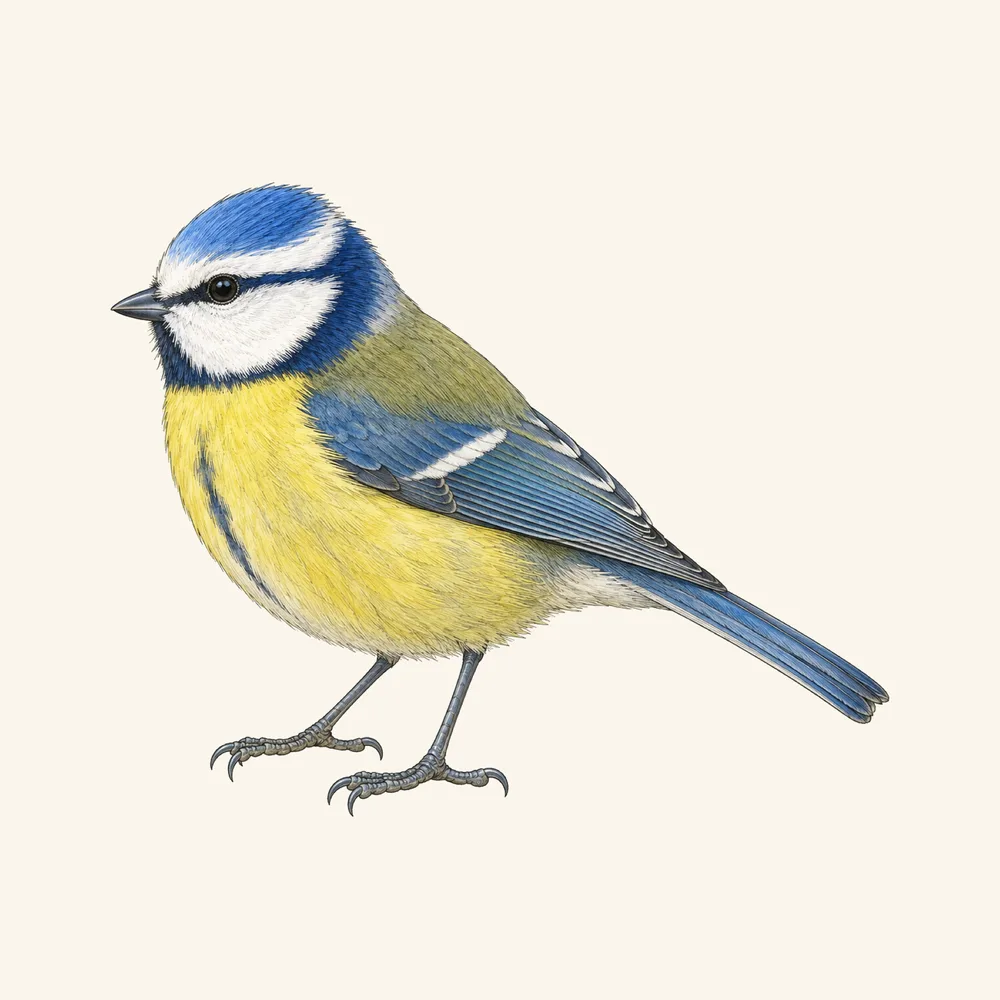
Blue Tit
Cyanistes caeruleus
Green-listed and doing well. The most useful thing you can give it is caterpillars in May, not more seed in January.
In most gardens
Ranked second in the RSPB Big Garden Birdwatch 2026, where it has held that position for several years. Present in almost any garden with a tree or a feeder.
Green list
Not currently of conservation concern in the UK.
Birds of Conservation Concern 5 records this species as “Green listed”, with a UK population trend of +20% (1967 to 2024). Source.
- Wildlife and Countryside Act 1981, section 1 — It is an offence to intentionally kill, injure or take any wild bird, or to take, damage or destroy the nest of any wild bird while that nest is in use or being built, or to take or destroy its eggs. law
At a glance
-
Size
Smaller than a robin at about 12cm — one of the smallest birds at most feeders
-
Where you'll see it
Feeders, the outer twigs of trees and shrubs, and any hole it can peer into
-
What it eats
Insects and caterpillars in summer; seeds, nuts and fat in winter
-
When
Resident, all twelve months
-
Nests
One brood a year in a 25mm-hole box, 1–5m up
-
Song
A thin see-see-see run into a fast silvery trill; also a scolding churr
Not to be confused with
- Great Tit — Look at the belly and the head. A great tit has a broad black stripe running down the centre of a yellow belly, and a glossy black head with clean white cheeks. A blue tit has an unbroken yellow belly and a blue cap, not a black one. The great tit is also noticeably bigger and blunter. Blue Tit or Great Tit?
- Coal Tit — The coal tit has a black head with a white patch on the nape — visible from behind — and is buff below with no yellow or blue anywhere. If the bird looks grey and dull rather than blue and yellow, it is a coal tit. Blue Tit or Coal Tit?
Through the year
Spring
Boxes are inspected from February and lined with moss and hair. Egg-laying starts between late March and early June, one brood only.
Summer
Chicks fledge after around 18–21 days. Family parties of dull, yellow-cheeked juveniles work through the shrubs in June and July.
Autumn
Roving mixed flocks with other tits move through gardens; feeder use climbs again as insects thin out.
Winter
Daily at feeders, and roosting in cavities and boxes on cold nights.
Feeding
Takes: sunflower hearts, peanuts in a mesh feeder, suet and fat blocks, nyjer, mealworms.
Blue tits take a single seed and fly off to wedge it somewhere before opening it, so they occupy a feeder port only briefly and a busy feeder still serves plenty of them.
Nest box
25mm entrance hole, 1–5m above ground with clear flight path to entrance. A 25mm hole is the point of the box. Widen it and great tits or house sparrows take it instead, so do not enlarge a worn entrance — fit a metal plate of the same size.
No perch below the hole — it is a handrail for predators. Hole size is from the BTO: National Nest Box Week.
The May problem no feeder solves
Blue tits time a single brood to hit the short peak of caterpillars on trees in late spring, and they need an extraordinary number of them — a nestful of chicks gets through caterpillars by the hundred every day. Seed and fat will not substitute: nestlings fed on hard seed do badly. So the most useful thing a garden can offer a blue tit is not a fuller feeder but foliage that caterpillars actually live on, and a willingness to leave those caterpillars alone in May and June. That means holding off insecticide on trees and shrubs at exactly the moment most gardeners reach for it, and accepting a chewed apple leaf or a stripped rose shoot as the price. A garden with one mature tree and no spraying feeds more blue tits than a garden with four feeders.
Getting the box right
The hole size is the whole decision. National Nest Box Week specifies a 25mm entrance for blue tits; at 28mm you are building a great tit box, and at 32mm a sparrow box. Fit it 1 to 5m above the ground with a clear flight path to the entrance, so no branch, trellis or fence rail lets a cat or a magpie sit at the door. Face it somewhere between north and east if you can, out of the midday sun and the prevailing wet. Do not add a perch below the hole — blue tits do not need one and it only helps predators hang on. One box per small garden is realistic: blue tits are territorial in the breeding season, and a second box a metre away will simply stand empty.
Why a green listing still matters
BTO BirdFacts records the blue tit as Green listed, and the long-term UK trend has been upward since the 1960s. It is genuinely one of the species that does not need rescuing, and it is worth saying so plainly rather than manufacturing a crisis. What blue tits do need is continuity: gardens that keep a few holes, a few caterpillars and some winter fat available year after year. The population moves with the weather — a cold, wet late spring that falls across the caterpillar peak produces a poor breeding year, and you will see it in fewer juveniles that July. That variation is normal. Leave the box up over winter rather than taking it down; birds roost in boxes on hard nights, and an empty box in January is still doing something.
Plant this for it
- apple An apple tree carries moth caterpillars in late spring, which is precisely what blue tits need to raise a brood — provided you are not spraying it at that moment.
- rose Blue tits work along rose shoots picking off aphids; leaving greenfly for a fortnight instead of spraying turns the plant into a feeding station.
Guides
- Binoculars for garden birdwatching: what the numbers mean, and how little you need to spend
- Bird boxes: hole size, height and which way to face — and why autumn is the time to put one up
- Birds flying into windows: why it happens and what stops it
- Feeders back on: what to put out from 1 November
- Squirrel-proof feeders: which designs work
How we checked this
- BirdFacts: Blue Tit — BTO
- Nestboxes for birds with small entrance holes — National Nest Box Week
- The Big Garden Birdwatch 2026 results are in — RSPB
- Wildlife and Countryside Act 1981, section 1 — legislation.gov.uk
Checked against the sources above. Reviewed on 2026-09-20. Legal position checked 2026-09-20.