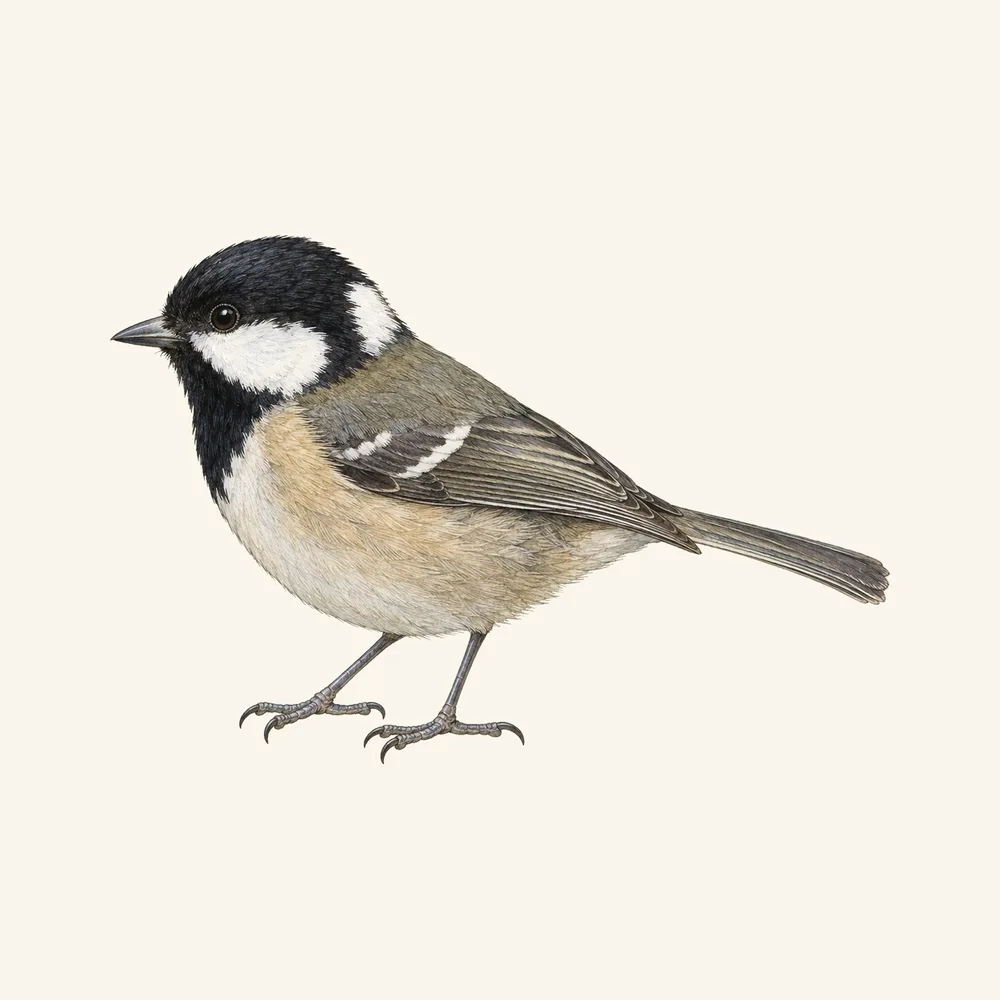
Coal Tit
Periparus ater
The smallest UK tit. Black cap and bib with a clean white patch on the nape — the one mark that separates it from a marsh tit.
In many gardens
Widespread and frequent in gardens, especially those near conifers, but easy to miss because it grabs a seed and leaves rather than staying to feed.
Green list
Not currently of conservation concern in the UK.
Birds of Conservation Concern 5 records this species as “Green listed”, with a UK population trend of +57% (1967 to 2024). Numbers have been fairly stable since the mid 1970s following an earlier rapid increase, and the breeding range expanded by 2.7% between the 1968-72 and 2008-11 atlases. Source.
- Wildlife and Countryside Act 1981, section 1 — It is an offence to intentionally kill, injure or take any wild bird, or to take, damage or destroy the nest of any wild bird while that nest is in use or being built, or to take or destroy its eggs. law
At a glance
-
Size
About 11cm — the smallest UK tit, clearly smaller than a blue tit and much smaller than a robin.
-
Where you'll see it
Briefly at feeders, and in conifers and tall trees; it seldom stays put for more than a second or two.
-
What it eats
Insects and spiders in summer, conifer seed in winter, plus sunflower hearts and peanut fragments it carries away.
-
When
Resident all year; most obvious in autumn and winter when it is actively hoarding food.
-
Nests
A hole nester. It will use a 25mm-hole box sited low down, 1m or less above ground.
-
Song
A fast, thin, high see-saw of two notes — like a great tit's teacher-teacher but smaller, quicker and sweeter.
Not to be confused with
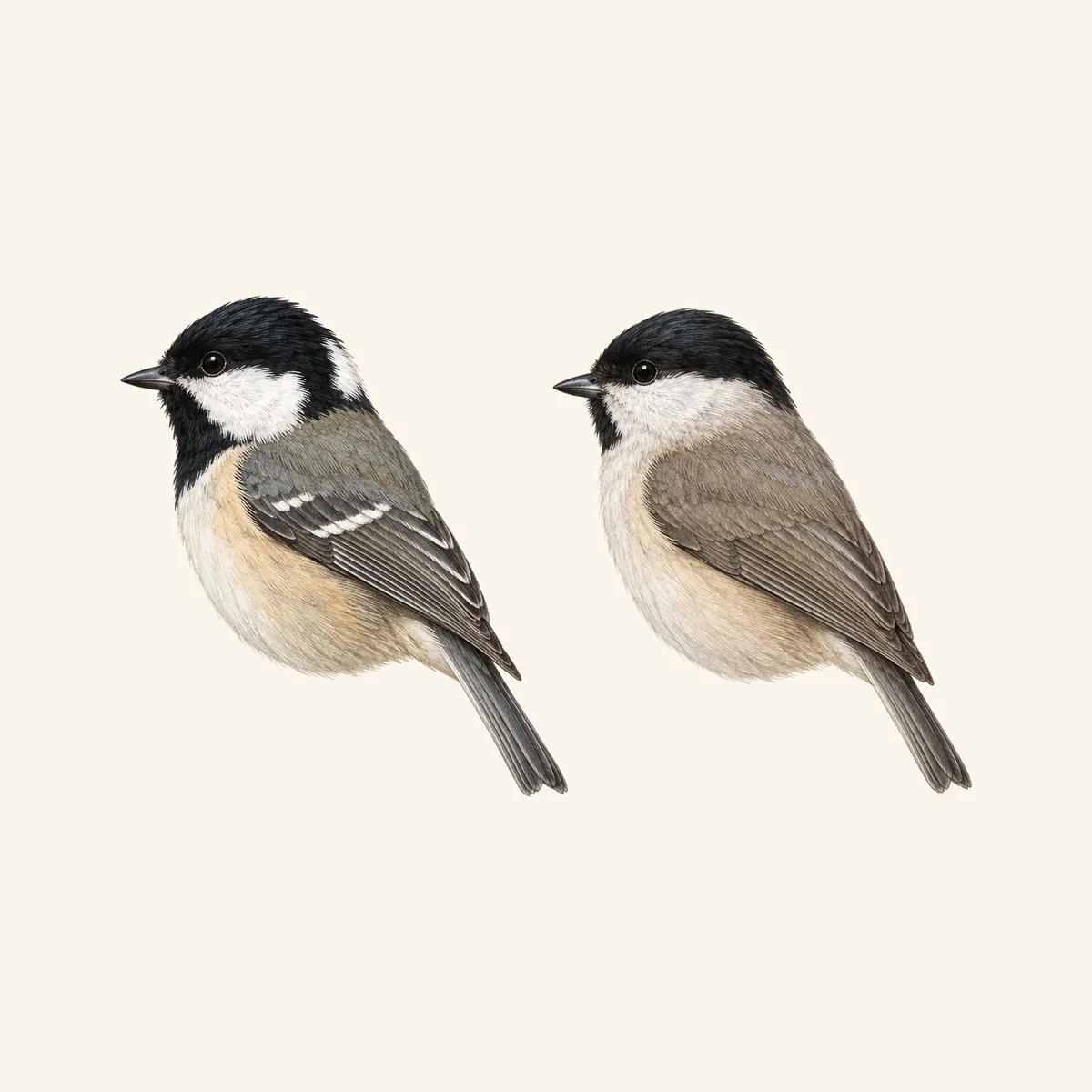
- Marsh Tit — The white nape patch is the separator. A coal tit has a clean white spot on the back of the head, running down from the black cap; a marsh tit's cap is solid black with no white behind it at all. Back it up with the wing: a coal tit shows two thin white wing bars, a marsh tit's wing is plain. A coal tit is also smaller, with a bigger-looking head and a much smaller, neater black bib.
- Willow Tit — Like the marsh tit, a willow tit has no white nape patch and no white wing bars, and it shows a pale panel on the wing and a more bull-necked look. Any small black-capped tit with a white spot on the nape is a coal tit.
- Blue Tit — A blue tit has a blue cap, blue wings and tail, and a yellow breast. A coal tit has none of those — black cap, olive-grey wings, buff underparts — and is visibly smaller. Coal Tit or Blue Tit?
- Great Tit — A great tit shares the black head and white cheeks, but it is much larger, has a bright yellow breast with a black stripe down the middle, and a green back. It also has no white nape patch. Coal Tit or Great Tit?
Through the year
Spring
Nesting from April in a low hole — a tree base, a wall cavity, a bank, sometimes a mouse hole. Put a low 25mm box up in autumn or winter, not in spring.
Summer
Feeding young almost entirely on caterpillars and spiders. Seed feeders are paused from 1 May anyway, and conifers and native trees do the work.
Autumn
Hoarding season. Coal tits cache seed intensively in bark crevices, moss and soil from September, which is when garden feeders look busiest with them.
Winter
Joins roving mixed flocks of tits, goldcrests and treecreepers moving through gardens. If your garden goes quiet for an hour then fills with small birds, that is the flock passing through.
Feeding
Takes: sunflower hearts, peanut granules, suet pellets, crushed peanuts from a mesh feeder.
Coal tits are subordinate to blue and great tits at a feeder and cope by snatching a single item and leaving, then caching it. That is why a feeder can look busy with coal tits without any of them apparently eating. Because they hoard, they empty a feeder faster than their numbers suggest — offer small amounts and let it run down rather than keeping it brimming. Follow the RSPB's seasonal rule: pause seed and peanuts from 1 May to 31 October, with only small amounts of suet, fat balls or mealworms in that window. Do not use a bird table, window feeder or tray.
Nest box
25mm entrance hole, Low down — National Nestbox Week gives 1m or less above ground level for this species, which is unusually low compared with most tit boxes.. A 25mm hole is the same size as a blue tit box, so a coal tit box will also admit blue tits; the low siting height is what makes it more likely to attract a coal tit. Site it against a wall, bank or tree base with cover nearby.
No perch below the hole — it is a handrail for predators. Hole size is from the BTO: National Nest Box Week.
The white spot on the back of the head
Coal tit, marsh tit and willow tit are all small, black-capped, white-cheeked and buff-bellied, and people separate them far less often than they think. One mark does the job. A coal tit has a clean white patch on the nape — the back of the head, immediately below the black cap — and neither marsh nor willow tit has anything there. It is easy to see whenever the bird turns away from you, which at a feeder is constantly. Two supporting marks make it certain: a coal tit shows two thin white wing bars across an olive-grey wing, where marsh and willow tits have plain wings, and its black bib is small and neat rather than broad. Size helps too — the coal tit is the smallest tit in the UK at around 11cm.
Why it never stays on the feeder
Watch a mixed group of tits at a hanging feeder and the coal tits behave differently from all of them. Blue and great tits settle and feed; a coal tit arrives, takes one item and is gone within a second, often before you have registered what it was. Two things drive this. It is the smallest and least dominant of the tits, so it avoids a contest it would lose. And it is a hoarder: coal tits cache food in bark crevices, moss and soil and come back to it later, which is a real advantage in a hard winter but means most of what leaves your feeder is not being eaten there. The practical consequence is that coal tits empty a feeder quickly. Keep portions small and let the feeder run down rather than refilling it full.
A conifer bird that adopted the garden
Coal tits are fundamentally birds of conifer woodland, with a fine bill suited to working between needles and extracting seed from cones. That heritage shows in garden behaviour: if you have a yew, a pine, a spruce or even a leylandii hedge, you will almost certainly have coal tits, and gardens near conifer plantations get them constantly. BTO records a 57% increase between 1967 and 2024, with numbers fairly stable since the mid 1970s following the earlier rapid rise, and a small expansion of breeding range. Part of that stability is down to conifer planting and part to garden feeding. It is one of the few garden birds where a much-maligned plant — the conifer hedge everyone wants to rip out — is a genuine asset, for food, shelter and winter roosting.
A box on the ground, not up a tree
Most people put a 25mm-hole box a couple of metres up a trunk and get blue tits. If you want coal tits, the difference is height. National Nestbox Week specifies that coal tits prefer a box low down, 1m or less above ground level, which reflects where they nest naturally: tree bases, root cavities, holes in banks and walls, sometimes abandoned mouse holes. The hole size stays at 25mm. Be honest about the odds — a 25mm hole admits blue tits too, and they are the more likely tenant, so a low box is a way of improving your chances rather than guaranteeing a result. Put it up in autumn or winter so the site is familiar before the season starts, tuck it against a bank or tree base with cover nearby, and leave it alone once occupied.
Plant this for it
Guides
How we checked this
- BTO BirdFacts: Coal Tit
- National Nestbox Week: Nestboxes — Small Entrance
- RSPB: Coal Tit
- RSPB: How to help garden birds — feed seasonally and safely
- Wildlife and Countryside Act 1981, section 1
Checked against the sources above. Reviewed on 2026-09-20. Legal position checked 2026-09-20.