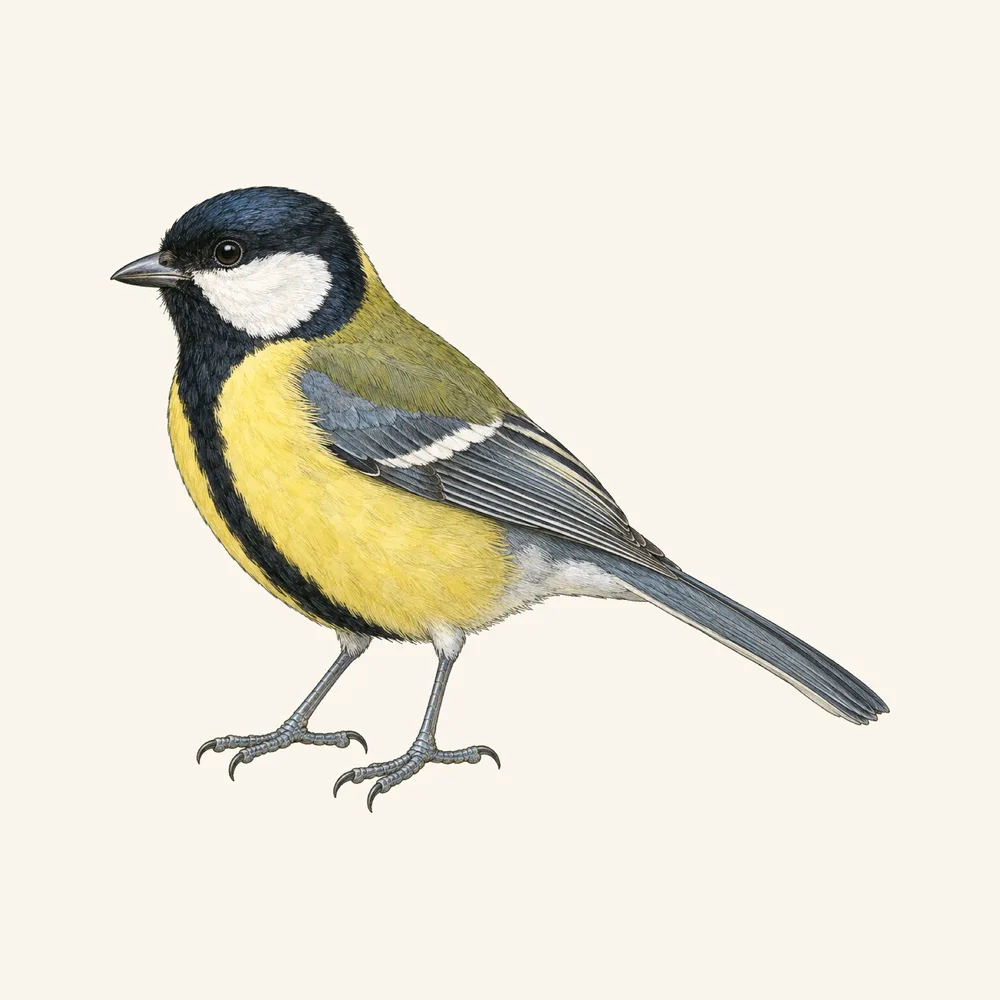
Great Tit
Parus major
The largest UK tit, and the bossiest bird on the feeder. Black head, white cheeks, and a black stripe straight down a yellow belly.
In most gardens
A garden fixture across Britain all year, and among the ten most recorded species in the RSPB Big Garden Birdwatch 2026. The UK breeding population has risen steadily for decades.
Green list
Not currently of conservation concern in the UK.
Birds of Conservation Concern 5 records this species as “Green listed”, with a UK population trend of +67% (1967 to 2024). Source.
- Wildlife and Countryside Act 1981, section 1 — It is an offence to intentionally kill, injure or take any wild bird, or to take, damage or destroy the nest of any wild bird while that nest is in use or being built, or to take or destroy its eggs. law
At a glance
-
Size
About robin-sized, but chunkier and longer-bodied — the biggest of the UK tits.
-
Where you'll see it
Feeders, hedges and tree canopy; drops to the lawn and to the bird bath.
-
What it eats
Caterpillars and insects in the breeding season; sunflower hearts, peanuts and suet the rest of the year.
-
When
Resident all year, most obvious at feeders from October to March.
-
Nests
Hole nester. Takes a nest box with a 28mm entrance hole, sited 1–5m up with a clear flight path.
-
Song
A ringing two-note 'tea-cher, tea-cher', repeated — often the first real song of the new year.
Not to be confused with
- Blue Tit — Blue tit has a blue cap and a dark line through the eye, and no black stripe down the belly. Great tit's head is solid glossy black with white cheeks, and that black belly stripe runs unbroken from throat to legs. Great Tit or Blue Tit?
- Coal Tit — Coal tit also has a black head and white cheeks, but look at the back of the head: it has a white patch on the nape that great tit never has. Coal tit is also much smaller, with buff — not yellow — underparts and no belly stripe. Great Tit or Coal Tit?
Through the year
Spring
Song peaks from late January through April. Boxes are chosen in February and March, with eggs from mid-April. Leave the box alone once a pair is carrying nest material.
Summer
Feeding young on caterpillars; adults look worn and scruffy by July. Newly fledged birds are washed-out and yellow-cheeked, and follow the adults about begging.
Autumn
Moults into fresh plumage and re-appears at feeders in numbers from about October. Starts joining mixed flocks with blue tits, coal tits and long-tailed tits.
Winter
Feeder visits peak. Cold snaps bring more birds in; a great tit may visit a feeder hundreds of times a day in hard weather.
Feeding
Takes: sunflower hearts, black sunflower seeds, peanuts (whole, in a mesh feeder), suet pellets and fat blocks, mealworms.
Great tits have the heaviest bill of the UK tits and can open seeds the smaller species cannot, so they do well on whole sunflower seed where blue tits prefer hearts. In late spring and early summer they switch almost entirely to caterpillars for their chicks.
Nest box
28mm entrance hole, 1-5m above ground with clear flight path to entrance. 28mm is the great tit size. A 25mm hole excludes them and admits blue and coal tits instead; 32mm lets house sparrows and starlings take the box over. Face the hole between north and east to keep the entrance out of strong sun and driving rain.
No perch below the hole — it is a handrail for predators. Hole size is from the BTO: National Nest Box Week.
The bird that tells you spring has started
Great tits are among the earliest singers of the year. From the first still, bright mornings in January you will hear a hard, ringing two-note phrase, usually written as 'tea-cher, tea-cher'. It carries further than it should for such a small bird, and it is the sound of a male claiming a territory he intends to nest in. What makes it worth knowing is the variation: individual males hold several different versions of the phrase and switch between them, partly to sound like more birds than there are. If you hear what seems to be two great tits duelling across a garden, listen for a minute before you assume there are two. Often there is one, changing its tune. Once you can pick the song out, you can map roughly how many territories your street holds, which is more interesting than counting birds at a feeder.
Getting the nest box right
Great tits need a 28mm entrance hole. This is not a detail to improvise: at 25mm you will get blue or coal tits instead, and at 32mm house sparrows and starlings can take the box over. Mount it between one and five metres up with a clear, unobstructed flight path to the hole — no branch or trellis immediately in front — and angle the face slightly downwards so rain runs off rather than in. Point the hole somewhere between north and east, which keeps it out of the hottest afternoon sun and away from the prevailing wet wind. Put boxes up in autumn or early winter rather than spring; birds use them as winter roosts and are far more likely to choose one they already know. Do not add nesting material yourself, and do not fit a perch below the hole — it offers nothing to the tits and everything to a predator.
Feed the caterpillars, not just the birds
In winter great tits will take almost anything oily you offer. In May and June they want something quite different: their chicks are raised almost entirely on caterpillars, and a single brood can get through thousands. That is a garden problem as much as a bird one, because caterpillars come from native trees and shrubs with a decent insect load — oak above all, but also birch, hawthorn, willow and old apple trees. A garden of ornamental evergreens and clipped hedging can be full of great tits in January and useless to them in May. If you want to help, the useful move is not another feeder. It is leaving one tree unsprayed, tolerating a chewed leaf or two, and accepting that the holes in your apple foliage in June are the reason there are young great tits in July.
Keeping the feeder honest
Great tits are dominant at feeders and will chase smaller tits off, so a single feeding station tends to be monopolised. Spreading two or three feeders well apart, out of sight of one another, lets blue tits, coal tits and finches feed without being displaced, and it also reduces the crowding that helps disease spread between birds. Clean feeders regularly with hot water and a mild detergent, rinse them thoroughly and let them dry before refilling, and move the feeder's position every few weeks so droppings do not build up on one patch of ground. If you see a bird that looks unwell, take the feeders down, clean them, and leave them down for a couple of weeks — reducing the number of birds crowding together in one spot is the single most useful thing a garden owner can do.
Plant this for it
Guides
How we checked this
- BTO BirdFacts: Great Tit
- National Nestbox Week: Nestboxes — Small Entrance
- Wildlife and Countryside Act 1981, section 1
- RSPB: Great Tit
Checked against the sources above. Reviewed on 2026-09-20. Legal position checked 2026-09-20.