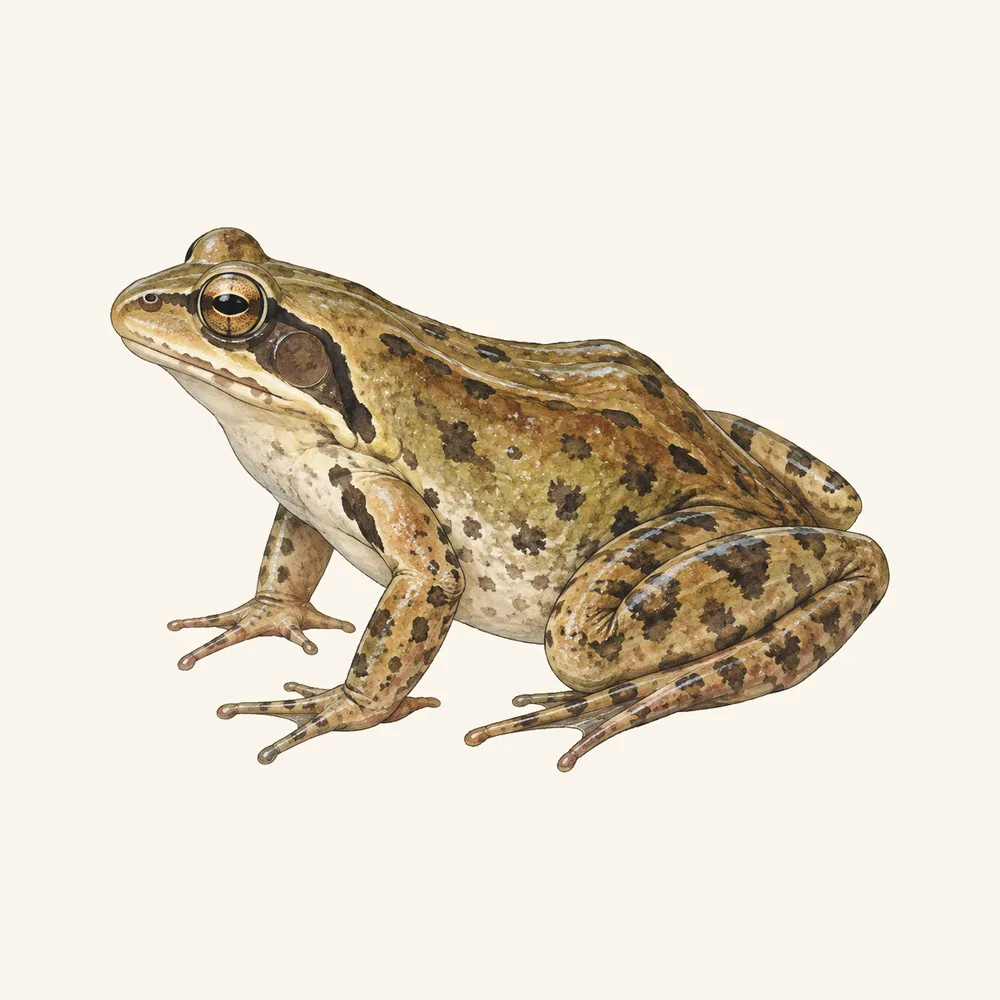
Common frog
Rana temporaria
Never move spawn between ponds — ranavirus has no cure. And the right pond is far shallower than you have been told.
In most gardens
The amphibian most likely to be in a UK garden, and one that takes to garden ponds readily. A new pond will usually be found within a season or two without any help at all.
Not assessed
No conservation assessment exists for this species. That is not the same as being fine.
No assessment scheme records this species as “No Great Britain Red List assessment verified for this species. Froglife's concern is with disease — chiefly ranavirus — rather than with a formal Red List category, and the two should not be conflated.”. Source.
- Wildlife and Countryside Act 1981, Schedule 5 (partial — section 9(5) only) — The common frog is listed on Schedule 5 "in respect of section 9(5) only". Section 9(5) makes it an offence to sell, offer or expose for sale, or possess or transport for the purpose of sale, any live or dead wild animal included in Schedule 5. This is protection against trade, and it is narrower than the full Schedule 5 protection often described elsewhere: the common frog is not listed in respect of section 9(1), the intentional killing and injuring offence. Do not tell a reader it is an offence to kill a frog under this Act, because on the face of the legislation it is not. law
At a glance
-
Size
About robin-sized in bulk — an adult is roughly 6-9cm from snout to vent, with long folded back legs.
-
Active when
Mainly at night and in damp weather, all year, though largely dormant in the coldest spells.
-
What it eats
Slugs, snails, worms, woodlice, beetles and flies, caught with the tongue. Tadpoles start on algae and move to animal food.
-
Where it shelters
Damp cover well away from water — log piles, long grass, compost heaps, under stones and in leaf litter.
-
Breeding season
Spawning is early, typically February to March, in shallow water. Spawn is laid in rounded clumps.
-
Status
No verified GB Red List assessment. The live conservation issue is ranavirus, for which Froglife says there is no cure.
Not to be confused with
- Common toad — The clincher is the skin and the gait. A frog has smooth, moist, often shiny skin and moves in long hops; a toad has dry, warty skin and walks or crawls, hopping only reluctantly. In the pond, the spawn settles it beyond argument: frogs lay clumps of jelly, toads lay long double strings wound through plant stems. Common frog or Common toad?
- Smooth newt — A newt keeps its tail for life and walks on four legs with a lizard-like body; a froglet leaving the pond has already absorbed its tail and hops. If it has a tail and it hops, look again — you are probably seeing a tadpole part-way through metamorphosis. Common frog or Smooth newt?
Through the year
Spring
Spawning is early, often February and into March, and a mass of frogs appears in the pond for a few days. Leave them to it. Do not net, move or 'rescue' spawn — including spawn that appears to be in a puddle.
Summer
Tadpoles develop and froglets leave the water from around June, often in numbers after rain. Mow high and slowly near the pond, or not at all for a few weeks, because this is when most mower casualties happen.
Autumn
Adults feed hard and move into damp cover. Leave leaf litter, build a log pile, and hold off cutting down the border until spring — this is where they will spend the winter.
Winter
Frogs overwinter in damp cover on land and some at the bottom of ponds. Keep a small area of a frozen pond open by standing a pan of hot water on the ice; never smash it, as the shockwave harms animals below.
The one absolute rule: never move spawn
This is the most commonly given piece of bad advice in British gardening, and it is worth being blunt about. Do not move frogspawn, tadpoles, adult frogs, pond plants, pond water, silt or gravel from one pond to another — not to help a friend start a pond, and not to rescue spawn you think is in the wrong place. The reason is ranavirus. Froglife's position is unambiguous: "despite years of research, there is no known cure or treatment for this disease, nor is one likely to be found in the near future", and their instruction follows from it — "do not move your frogs, spawn or pond plants to other ponds as this could potentially spread the disease." Ranavirus outbreaks can wipe out a garden population, and the movement of pond material by well-meaning people is a recognised route by which it spreads. A new pond will be colonised on its own within a season or two, and that wait is the whole of the price.
A pond built the way the evidence says
Most garden pond advice repeats a figure of 50-60cm minimum depth. Freshwater Habitats Trust, which studies ponds for a living, says the opposite for a wildlife pond: roughly 50% shallows, with the deepest area "not more than 30 cm". The logic is straightforward once stated. Shallow water warms quickly, grows submerged and emergent plants along most of its area, and supports far more invertebrate life than a deep, cold, shaded middle. Fill it with rainwater from a butt — "most tapwater is not fit to use in a pond because it's full of nutrients, which are toxic to wildlife" — and add no soil, no turf, no fish and no fish food. Fish and frogs are not compatible; fish eat spawn and tadpoles, and a pond with fish in it is an ornamental feature, not a wildlife pond. Resist stocking it with plants too: "there is no need to plant your pond: be patient and plants will naturally colonise your pond." One sloping, gently shelving edge matters more than depth, for everything that has to get out again.
Where frogs actually live
A frog spends a few days a year in your pond and the rest of it on land, which is why gardens with good ponds and bad land hold few frogs. The land habitat is unglamorous and free: a log pile in shade, a compost heap, long unmown grass, a border you do not cut back until spring, leaf litter left where it falls, and a few flat stones or a piece of old board on bare soil. Connect them. A frog crossing a mown lawn is exposed and dries out fast, so a continuous damp corridor — a rough grass strip along a fence, a planted border running from the pond to the log pile — is worth more than any single feature. The other half is what you stop doing. Slug pellets remove a frog's food supply; strimmers in long grass in summer kill froglets in numbers; and a steep-sided pond is a trap. None of this costs anything. Most of it is permission to be slightly less tidy.
Plant this for it
- hostaA block of hostas in damp shade gives frogs exactly the cool, humid ground cover they need between pond and log pile — and the slugs the hostas attract are what a frog is hunting.
- mintMint thrives in the damp ground around a pond margin and forms dense low cover, giving froglets leaving the water a shaded route away from open lawn. Grow it in a sunken pot unless you want it everywhere.
Guides
How we checked this
- Froglife: Disease — Ranavirus
- Freshwater Habitats Trust: Garden Pond Advice Hub
- Wildlife and Countryside Act 1981, Schedule 5
- Wildlife and Countryside Act 1981, section 9
Checked against the sources above. Reviewed on 2026-09-20. Legal position checked 2026-09-20.