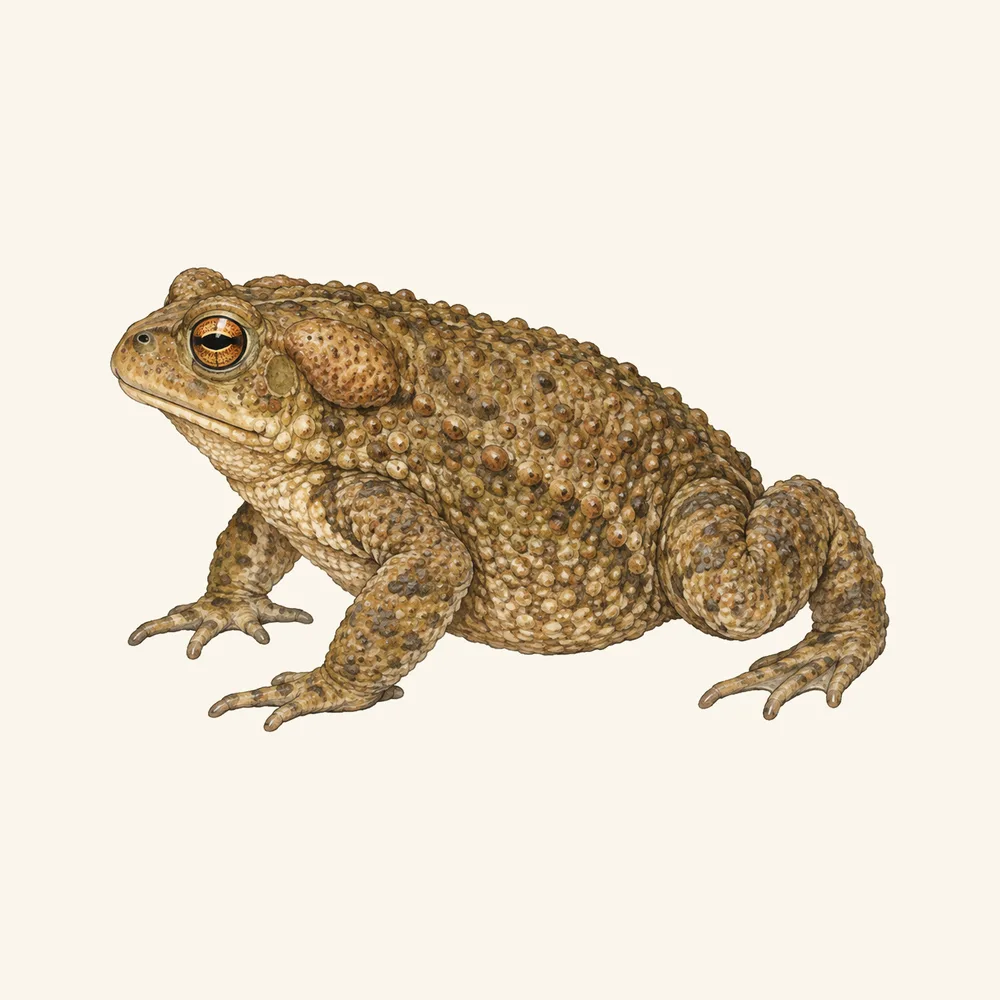
Common toad
Bufo bufo
Dry warty skin, a walking gait, and spawn in strings not clumps. Britain's best slug control, and it wants a log pile.
Occasional visitor
Widespread but noticeably less of a garden animal than the common frog. Toads breed in larger, deeper water bodies and return to traditional breeding sites, so a small new garden pond attracts frogs far sooner than toads.
Not assessed
No conservation assessment exists for this species. That is not the same as being fine.
No assessment scheme records this species as “No Great Britain Red List assessment verified for this species.”. Source.
- Wildlife and Countryside Act 1981, Schedule 5 (partial — section 9(5) only) — The common toad is listed on Schedule 5 "in respect of section 9(5) only". Section 9(5) makes it an offence to sell, offer or expose for sale, or possess or transport for the purpose of sale, any live or dead wild animal included in Schedule 5. As with the common frog, this is protection against trade: the common toad is not listed in respect of section 9(1), the intentional killing and injuring offence, and it would be wrong to tell a reader otherwise. law
At a glance
-
Size
Bigger and heavier than a frog, and bulkier than a robin — females commonly reach 8-13cm and are noticeably larger than males.
-
Active when
Nocturnal, and most visible on mild damp nights. Largely dormant in the coldest part of winter.
-
What it eats
Slugs, snails, worms, woodlice, ants and beetles — one of the most effective slug predators a garden can host.
-
Where it shelters
Dry, dark, undisturbed places on land: under log piles, paving slabs, sheds, stones and in compost heaps.
-
Breeding season
Spring, usually a few weeks later than frogs. Spawn is laid as long double strings wound around submerged plant stems.
-
Status
No verified Great Britain Red List assessment. Listed on Schedule 5 of the WCA 1981 in respect of sale only.
Not to be confused with
- Common frog — Skin and movement give it away every time. A toad's skin is dry, matt and warty and it walks; a frog's is smooth, moist and often shiny and it hops in long leaps. Add the eye — a toad's is coppery gold with a horizontal pupil — and the raised parotoid glands behind the toad's eyes, which a frog does not have. In the water, spawn is decisive: strings for toads, clumps for frogs. Common toad or Common frog?
- Natterjack toad — Very rare and confined to a handful of coastal and heathland sites, so almost never the right answer in a garden — but the clincher is worth knowing: a natterjack has a distinct yellow stripe running down the middle of its back, and runs rather than walks.
Through the year
Spring
Toads migrate to traditional breeding ponds on mild damp nights, often in numbers and often crossing roads to do it. Spawning follows a few weeks behind frogs; the spawn is in strings, not clumps. Leave it alone.
Summer
Toadlets leave the water in midsummer and disperse widely over land. Mow high and check long grass before strimming — a toad sits still rather than fleeing, which is exactly why it gets hit.
Autumn
Toads feed hard and move into winter quarters. Build or leave a log pile, hold off tidying the border, and leave leaf litter where it falls.
Winter
Spent dormant on land under logs, slabs, stones and compost, not in the pond. Lifting a slab or turning a heap in midwinter is the commonest way people disturb one — do it in spring instead if you can.
Telling a toad from a frog, for good
Four features settle it and you never need the rest. Skin: a toad's is dry, matt and covered in warty bumps, while a frog's is smooth, moist and often glossy. Movement: a toad walks or crawls and hops only reluctantly under threat, where a frog travels in long hops and dives for water. Eyes: a toad's iris is coppery or gold with a horizontal pupil; a frog's is brown-gold with a horizontal pupil but noticeably duller and the eye sits flatter in the head. Glands: a toad has prominent raised parotoid glands behind the eyes, which frogs lack entirely. Behaviour is the field shortcut — approach one and a frog leaps immediately while a toad sits absolutely still and trusts its camouflage. And in the pond, the spawn cannot be mistaken: toads lay long double strings wound round submerged stems, frogs lay rounded clumps of jelly. Those secretions from the parotoid glands are distasteful to predators, which is why dogs sometimes foam at the mouth after mouthing one.
Why you have frogs and not toads
It is a common and slightly deflating discovery: the new pond fills with frogspawn within two years and no toad ever appears. There are two reasons and neither is your fault. Toads prefer larger, deeper water bodies for breeding than frogs do — ponds, lakes and reservoirs rather than a four-foot liner in a back garden — and they show strong fidelity to traditional breeding sites, returning to the same water year after year and often migrating some distance to reach it. A brand new pond simply is not on the map. The useful consequence is that the way to have toads in a garden is not to build them a pond but to make the land worth living on, because toads spend the great majority of the year away from water. Dark, dry, undisturbed daytime shelter is the limiting factor in most gardens: log piles, slabs propped on bricks, stone piles, thick leaf litter, an undisturbed compost heap. Get that right and toads from a breeding site nearby will use the garden even if they never spawn in it.
The best slug control there is
A toad eats slugs, snails, worms, woodlice, ants and beetles, hunts at night through exactly the damp, planted, slightly messy ground where slugs are, and does it every night for years — toads are long-lived. No pellet, trap or copper ring competes with that on either effectiveness or cost. The trade is that a garden hospitable to a toad is one you tidy a little less: unmown grass in places, borders left standing over winter, leaf litter where it falls, and at least one log or stone pile in permanent shade that never gets moved. The other half is what you stop. Slug pellets remove the food supply, and a toad in a garden with no slugs has no reason to stay. Strimmers and mowers in long grass kill toads specifically because their defence is to freeze rather than run — check first, cut high, and go slowly. Steep-sided ponds and uncovered drains and gullies trap them; a sloping edge and a mesh grille solve both.
Plant this for it
- hostaHostas draw slugs and snails into damp shade, which is precisely where a toad hunts at night — the practical case for accepting some leaf damage rather than using pellets that remove its food.
- rhubarbA rhubarb crown makes a large patch of dense, cool, shaded ground cover with permanently damp soil underneath, and the undisturbed base of an established clump is a classic toad daytime refuge.
Guides
How we checked this
- Wildlife and Countryside Act 1981, Schedule 5
- Wildlife and Countryside Act 1981, section 9
- Freshwater Habitats Trust: Garden Pond Advice Hub
- Froglife: Disease — Ranavirus
Checked against the sources above. Reviewed on 2026-09-20. Legal position checked 2026-09-20.