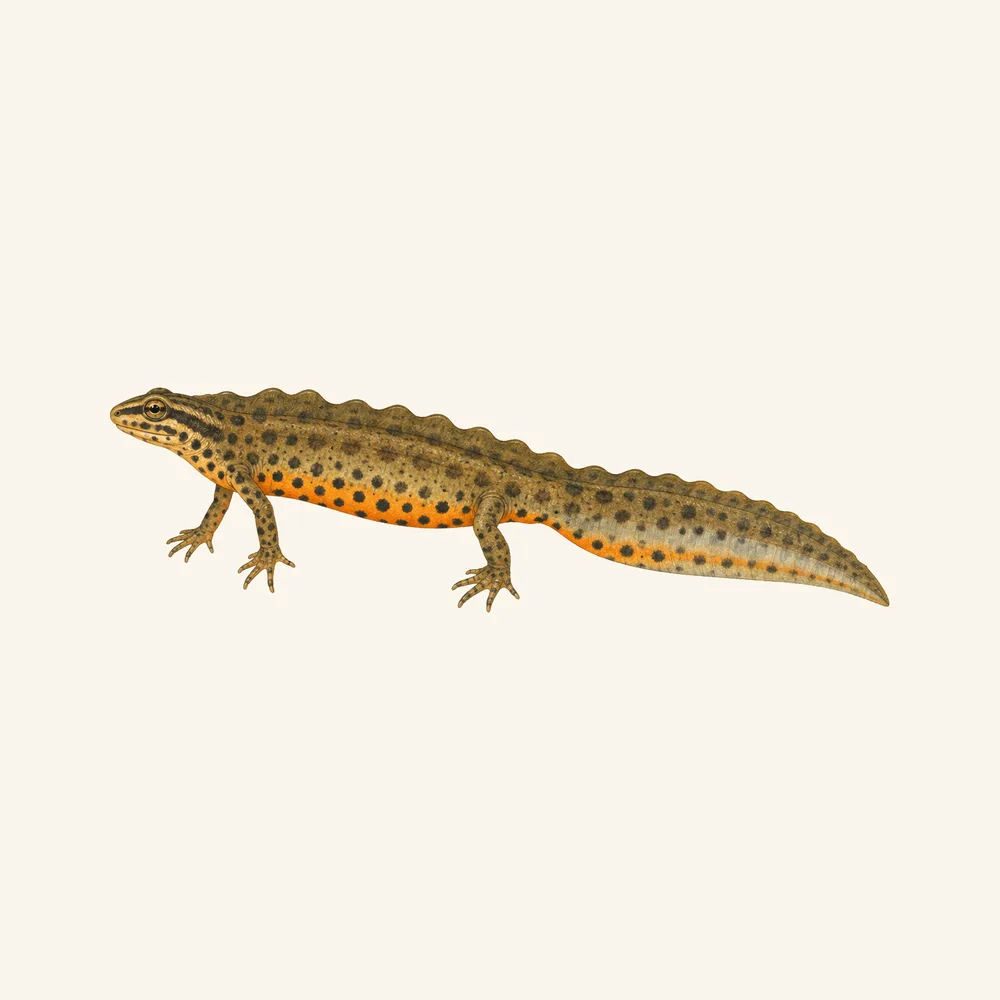
Smooth newt
Lissotriton vulgaris
The newt you almost certainly have. Up to 10cm, spotted throat, a wavy crest on the breeding male. Needs a pond in spring and damp cover all year.
In many gardens
Froglife describes the smooth newt as found throughout Britain and Ireland, and it is by far the newt most likely to turn up in a garden — usually under a log or a paving slab rather than in the water.
Not assessed
No conservation assessment exists for this species. That is not the same as being fine.
No assessment scheme records this species as “No Great Britain Red List assessment verified for this species. Froglife describes it as widespread throughout Britain and Ireland; we will not convert that into a Red List category we have not seen.”. Source.
- Wildlife and Countryside Act 1981, Schedule 5 (in respect of section 9(5) only) — Schedule 5 lists "Newt, Smooth" expressly "in respect of section 9(5) only". Section 9(5) makes it an offence if a person "sells, offers or exposes for sale, or has in his possession or transports for the purpose of sale, any live or dead wild animal included in Schedule 5", or advertises doing so. This is trade protection. The smooth newt is not listed for section 9(1), so the offence of intentionally killing, injuring or taking a Schedule 5 animal does not apply to it — a point widely got wrong online, and one we would rather state accurately than flatter. law
At a glance
-
Size
Adults up to 10cm nose to tail tip (Froglife) — far smaller than a robin, and slimmer than it looks in water.
-
Active when
Nocturnal on land for most of the year; in ponds by day and night from roughly February to June.
-
What it eats
A wide variety of invertebrates — worms, slugs, insect larvae, water fleas — and frog tadpoles in spring.
-
Where it shelters
Under logs, rocks, paving and in compost heaps; occasionally it overwinters in the pond itself.
-
Breeding season
Spring. Males court with a tail-fanning display, and each egg is laid singly, folded into a pond-plant leaf.
-
Status
Not assessed on any Great Britain Red List we could verify. Schedule 5 protection covers sale only.
Not to be confused with
- Great crested newt — Size settles it before anything else: a great crested newt reaches 15–16cm against the smooth newt's 10cm, and looks black and warty rather than olive-brown and smooth. If you need more, the belly is the clincher — a smooth newt has a pale orange belly with small round black spots, a great crested newt a bright orange belly with large irregular black blotches. The breeding male's crest is jagged with a break at the tail base, not a continuous wave. This distinction has legal consequences, so make it carefully. Smooth newt or Great crested newt?
- Palmate newt — The throat. A smooth newt's throat is spotted; a palmate newt's is pink or yellowish and unspotted. That one feature separates them reliably in either sex and at any time of year, which nothing else does. Palmate newts are also slightly smaller, at around 8–9cm, and the breeding male has webbed hind feet and a thin dark filament at the tail tip.
- Common lizard — People who have never seen a newt on land often report one as a lizard. A lizard has dry scaly skin, clawed toes and darts away at speed; a newt has moist smooth skin, no claws and walks slowly. A lizard basks in the open sun — a newt on land in daylight is almost always hiding under something you have just lifted.
Through the year
Spring
Adults migrate to ponds from February or March and breed through spring — leave the pond alone entirely, and do not net or dip it.
Summer
Adults leave the water from about June and go back to living on land; efts leave the pond later in summer. Check under slabs and logs before you move them.
Autumn
Newts feed up on land and start looking for frost-free hiding places — build a log pile now, and leave a corner of the garden untidy.
Winter
Sheltering under rocks, in compost heaps or buried in mud, occasionally in the pond. Do not turn the compost heap or clear the pond in hard weather.
What a newt actually needs from your pond
Most garden-pond advice quotes a depth of 50 to 60cm. Freshwater Habitats Trust, the UK charity whose whole remit is freshwater, advises the opposite for a wildlife pond: aim for "roughly 50% shallows, and the deep area is not more than 30 cm". Deep water is a fish-pond convention, and it is not needed in the British climate. Shallow, sun-warmed margins are where newts court, where their eggs develop and where the invertebrates they eat actually live. The Trust is equally clear about what to fill it with: most tap water is "not fit to use in a pond because it's full of nutrients", so wait for rain or use a water butt. And no fish. Fish eat newt eggs, larvae and the invertebrate food supply, and a pond with fish in it will not hold breeding newts however well it is planted.
Never move newts, eggs or pond material
The commonest well-meant mistake is to bring a bucket of spawn, weed or silt from a friend's pond to kick-start your own. Do not. Froglife's position is unambiguous: "We do not recommend introducing amphibians or their eggs to your pond as you can accidentally spread invasive plants, animals and diseases." Ranavirus is the reason that matters. It is transmitted in water and on pond material, it kills adult amphibians, and there is no cure. Invasive plants such as New Zealand pigmyweed travel the same way, as fragments in the same bucket. A newly dug pond filled with rainwater and left alone will be colonised by newts arriving overland on their own, usually within a couple of seasons. Patience is not just the safer option here; it is the only responsible one.
Finding one under a slab
Nine times out of ten a garden newt is found on land, in daylight, because you have just lifted the thing it was sleeping under. Froglife's advice is the whole of it: "Unless the animal is in danger you do not need to move it or do anything for it." Put the slab, log or pot back gently, offset slightly so you are not crushing the animal, and walk away. It does not need water, food, a container or rescuing. If it genuinely is in danger — you have exposed it in the middle of a patio you are about to lift, or a cat is watching — move it the shortest distance to cover in the same garden, with wet hands, and leave it there. If a newt is visibly injured, ring a local wildlife rescue or the RSPCA rather than attempting anything yourself.
The nine months nobody plans for
Gardeners think of newts as pond animals, but a smooth newt is in the pond for perhaps three months and on land for the rest of the year. It hunts at night among borders and long grass, and by day it is underneath something — a log, a paving slab, an upturned pot, the base of a compost heap. That terrestrial habitat is the part most gardens are missing, and it costs nothing: a pile of logs in shade, a few slabs laid flat in a damp corner, a compost heap you leave unturned through winter, and a border you cut down in spring rather than autumn. Keep the route between that cover and the pond free of vertical kerbs and sheer-sided drains, which newts cannot climb out of.
Guides
How we checked this
- Froglife: Smooth Newt
- Froglife: Newts — identification
- Froglife: Newts in my garden
- Freshwater Habitats Trust: Make a garden pond
- Wildlife and Countryside Act 1981, Schedule 5
- Wildlife and Countryside Act 1981, section 9
Checked against the sources above. Reviewed on 2026-09-20. Legal position checked 2026-09-20.