Great crested newt or Smooth newt?
These two get mixed up constantly. Here is what actually separates them, taken from each bird's own page.
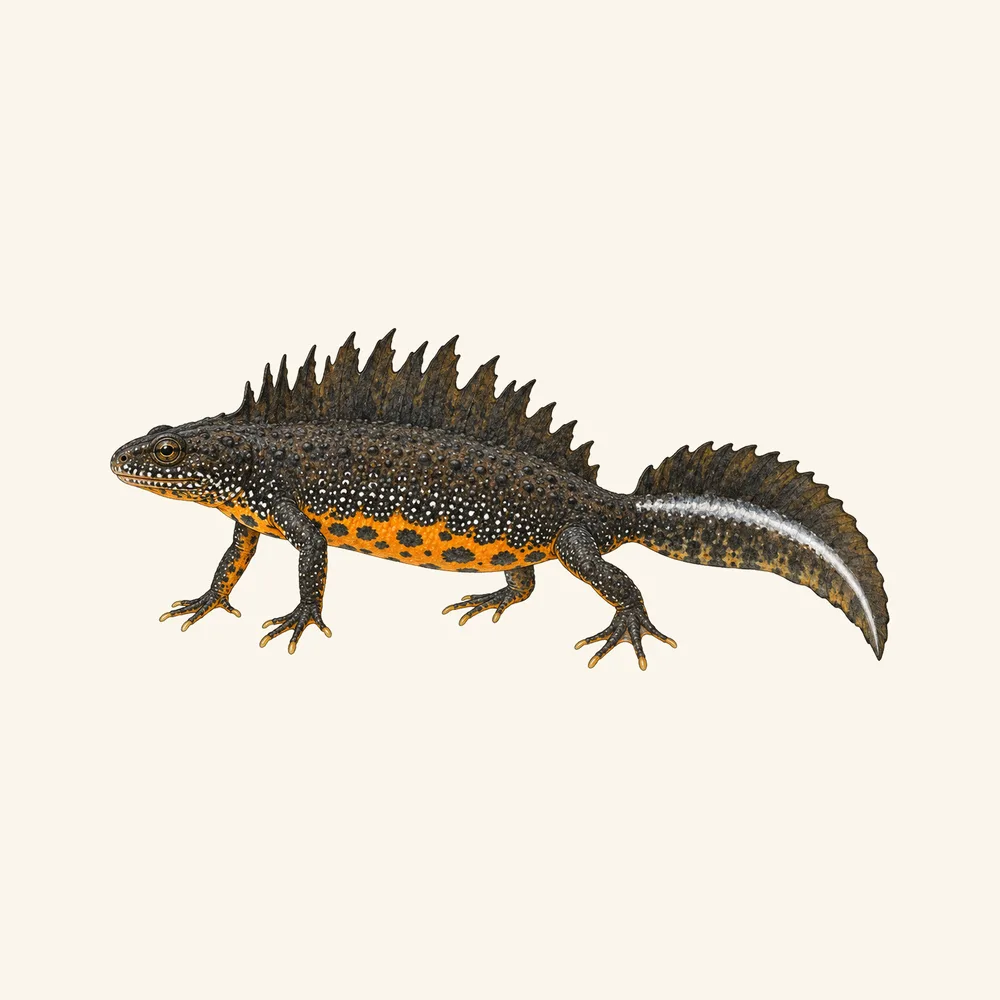
Great crested newt
Triturus cristatus
This is the identification that matters, so use more than one feature. Size: 15–16cm against 10cm — a great crested newt is obviously big, and people who find one usually say so unprompted. Skin: rough, black and warty, with white stippling along the flanks, against smooth olive-brown. Belly: bright orange with large irregular black blotches, against pale orange with small round black spots. Crest: on the breeding male, jagged and broken at the base of the tail, against a continuous wavy crest. If only one of those four points to a great crested newt, you probably have a large smooth newt.
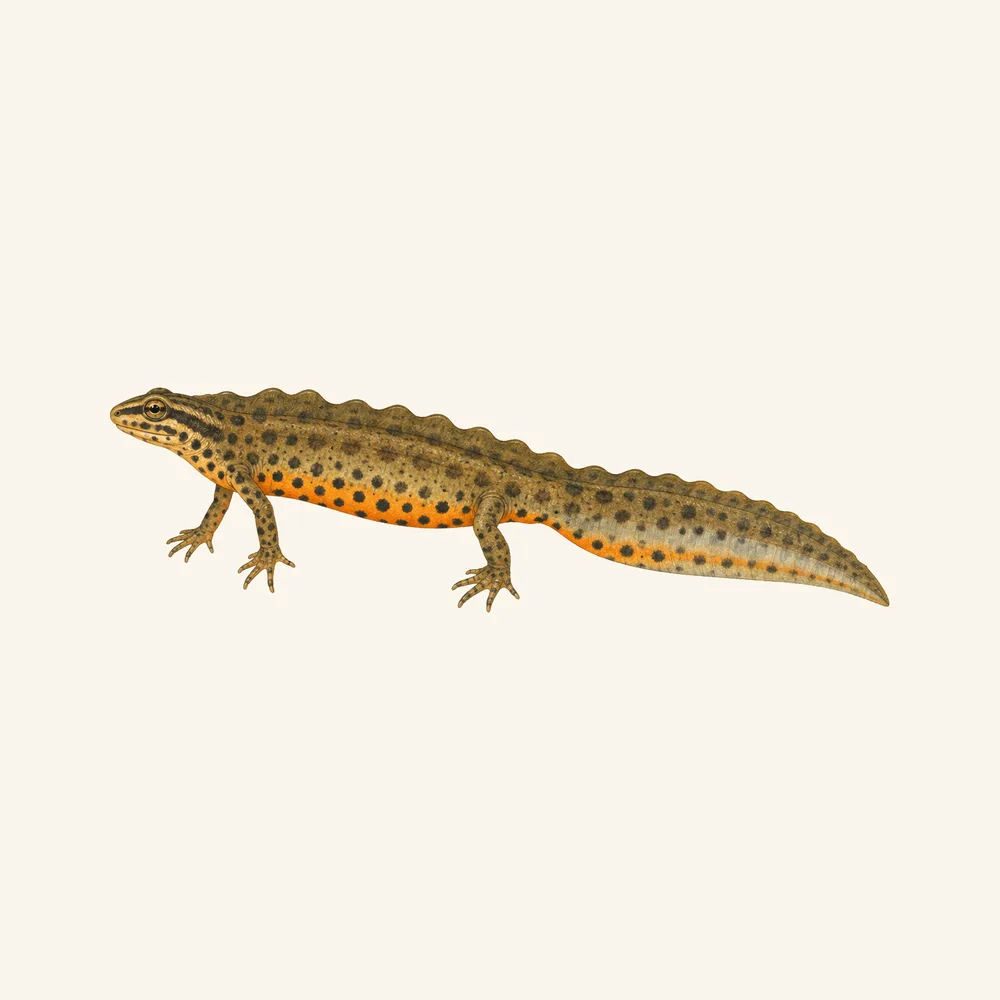
Smooth newt
Lissotriton vulgaris
Size settles it before anything else: a great crested newt reaches 15–16cm against the smooth newt's 10cm, and looks black and warty rather than olive-brown and smooth. If you need more, the belly is the clincher — a smooth newt has a pale orange belly with small round black spots, a great crested newt a bright orange belly with large irregular black blotches. The breeding male's crest is jagged with a break at the tail base, not a continuous wave. This distinction has legal consequences, so make it carefully.
Side by side
| Great crested newt | Smooth newt | |
|---|---|---|
| Size | Adults up to 15–16cm — half again as long as a smooth newt, and visibly heavier-bodied. | Adults up to 10cm nose to tail tip (Froglife) — far smaller than a robin, and slimmer than it looks in water. |
| What it eats | Mainly invertebrates and tadpoles, including smaller newts. A large predator by pond standards. | A wide variety of invertebrates — worms, slugs, insect larvae, water fleas — and frog tadpoles in spring. |
| Status | No Great Britain Red List assessment verified for this species. Its protection is legal rather than Red List based: it is a European Protected Species, and gov.uk notes populations "have declined" alongside the loss of ponds. We will not convert legal status into a Red List category. | No Great Britain Red List assessment verified for this species. Froglife describes it as widespread throughout Britain and Ireland; we will not convert that into a Red List category we have not seen. |
Still not sure? Describe what you saw and we will rank every garden bird against it — including these two.
Both descriptions are taken from the species pages, which cite the BTO and RSPB. Reviewed 2026-09-20.