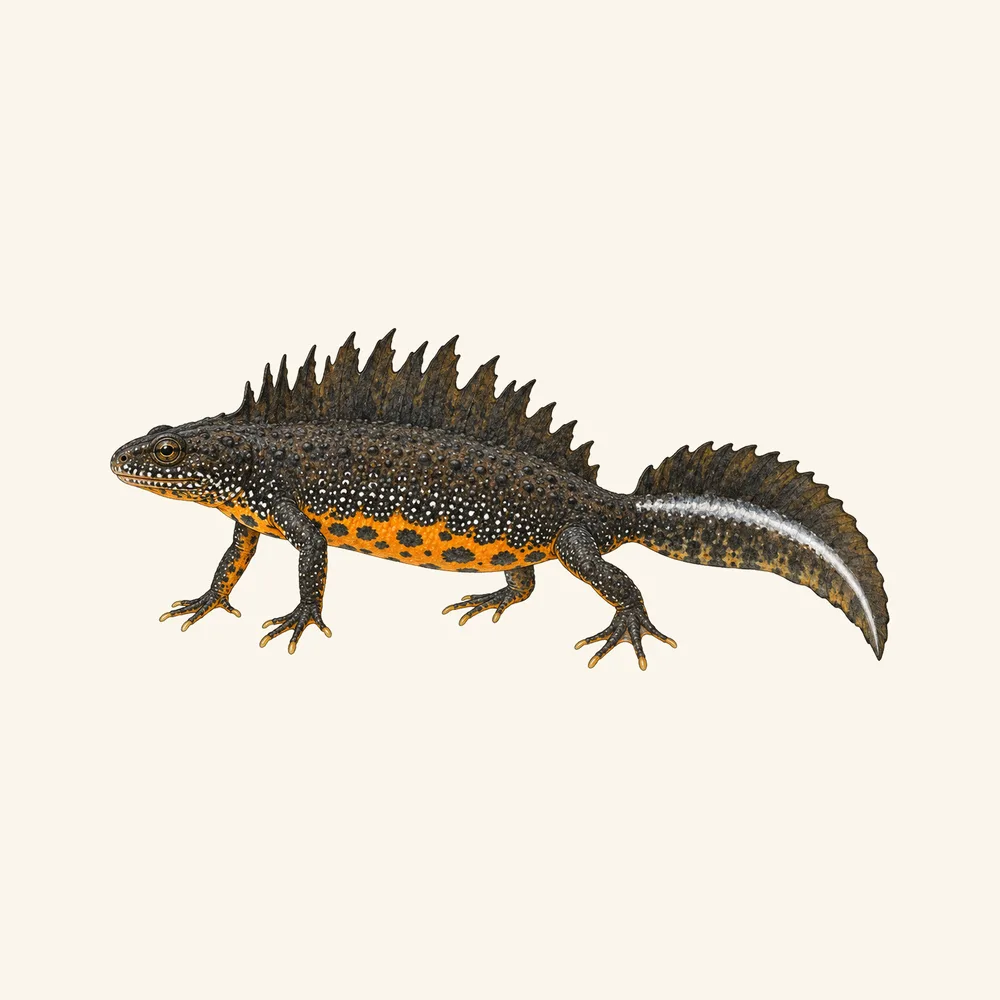
Great crested newt
Triturus cristatus
Britain's largest newt and a European Protected Species. Black and warty, orange belly, jagged crest. Handling one requires a licence.
Scarce in gardens
Genuinely uncommon in gardens. Most reported sightings turn out to be large smooth newts. It needs a big, weedy, fishless pond and undisturbed land around it, which few gardens offer — but it does occur in gardens near known populations.
Not assessed
No conservation assessment exists for this species. That is not the same as being fine.
No assessment scheme records this species as “No Great Britain Red List assessment verified for this species. Its protection is legal rather than Red List based: it is a European Protected Species, and gov.uk notes populations "have declined" alongside the loss of ponds. We will not convert legal status into a Red List category.”. Source.
- Conservation of Habitats and Species Regulations 2017, regulation 43 — The great crested newt is a European Protected Species. Regulation 43 makes it an offence if a person "deliberately captures, injures or kills any wild animal of a European protected species", "deliberately disturbs wild animals of any such species", "deliberately takes or destroys the eggs of such an animal", or "damages or destroys a breeding site or resting place of such an animal". The breeding-site and resting-place offence does not require the animal to be present. law
- Natural England licensing (gov.uk guidance) — gov.uk lists the offences as "capturing, killing, disturbing or injuring great crested newts deliberately", "damaging or destroying a breeding or resting place", "obstructing access to their resting or sheltering places", "possessing, selling, controlling or transporting live or dead newts, or parts of them" and "taking great crested newt eggs". Conviction can bring "an unlimited fine and up to 6 months in prison for each offence". Where an activity cannot avoid disturbing them, "you can apply for a mitigation licence from Natural England". In plain terms: you may not pick one up, net one, or move one, without a licence. law
- Wildlife and Countryside Act 1981, Schedule 5 (in respect of section 9(4)(b) and (c) and (5) only) — Domestic law adds a further layer. Schedule 5 lists "Newt, Great Crested or Warty" in respect of section 9(4)(b) and (c) and 9(5): it is an offence to disturb the animal "while it is occupying a structure or place which it uses for shelter or protection", to obstruct access to such a place, and to sell, possess for sale or advertise a live or dead specimen. law
At a glance
-
Size
Adults up to 15–16cm — half again as long as a smooth newt, and visibly heavier-bodied.
-
Active when
Nocturnal on land for most of the year; in the pond from roughly March to June.
-
What it eats
Mainly invertebrates and tadpoles, including smaller newts. A large predator by pond standards.
-
Where it shelters
Under rocks, logs and paving, in compost heaps or buried in mud, usually within a few hundred metres of its pond.
-
Breeding season
Spring, from March or April. Favours large ponds with abundant weed and no fish.
-
Status
European Protected Species. Handling requires a Natural England licence — no Great Britain Red List category verified.
Not to be confused with
- Smooth newt — This is the identification that matters, so use more than one feature. Size: 15–16cm against 10cm — a great crested newt is obviously big, and people who find one usually say so unprompted. Skin: rough, black and warty, with white stippling along the flanks, against smooth olive-brown. Belly: bright orange with large irregular black blotches, against pale orange with small round black spots. Crest: on the breeding male, jagged and broken at the base of the tail, against a continuous wavy crest. If only one of those four points to a great crested newt, you probably have a large smooth newt. Great crested newt or Smooth newt?
- Palmate newt — Not a serious confusion once size is taken into account — a palmate newt reaches only 8–9cm — but the throat is decisive either way: unspotted pink or yellowish in a palmate newt, and never the blotched orange of a great crested newt's underside.
Through the year
Spring
Adults are in the pond breeding from March or April — do not net, dip, clear or plant the pond at all while they are there.
Summer
Adults leave the water; young newts follow later in summer. Lift slabs and logs slowly and put them back, and mow long grass near a pond high and late.
Autumn
Newts are feeding up and moving to overwintering cover on land. Build log piles now rather than clearing them.
Winter
Sheltering under rocks, in compost heaps or buried in mud. gov.uk notes that certain pond management can be done in winter without a licence provided no newts are found — but if you find one, stop.
Why this one is different in law
Every other amphibian in a British garden has light-touch protection. The great crested newt does not. It is a European Protected Species under the Conservation of Habitats and Species Regulations 2017, and regulation 43 makes it an offence to deliberately capture, injure or kill one, to deliberately disturb it, to take or destroy its eggs, or to damage or destroy a breeding site or resting place. gov.uk states the penalty plainly: "an unlimited fine and up to 6 months in prison for each offence." Handling requires a licence from Natural England. That includes picking one up to look at it, netting one out of a pond, moving one somewhere you think is safer, or relocating a population from a pond you want to fill in. There is no informal version of this. gov.uk gives one narrow exception — "rescuing a great crested newt if it would die otherwise" — which covers the animal under your spade, not the one you fancy moving to a better pond. If you need to work where they are, you apply for a mitigation licence first.
What to actually do if you think you have one
Enjoy it, and do nothing. Look at it by torchlight from the bank, photograph it from outside the water, and leave it alone. Do not net it, do not lift it out for a better look, and do not move it to another pond. If you disturb one on land under a slab, replace the slab gently and step away. Then be aware of the second consequence, which nobody mentions: presence has planning implications. If you are thinking about an extension, a garden building, a driveway or anything else needing permission, a great crested newt population on or near the site is a material consideration, and a survey and possibly a licence may be required before work starts. That is far cheaper to discover now than halfway through a build, so tell your planning agent early rather than hoping it goes unnoticed.
The pond it actually wants
Froglife notes that great crested newts "favour large ponds with abundant weeds and no fish". The depth convention most gardening sites repeat — 50 to 60cm — comes from fish-keeping, not wildlife. Freshwater Habitats Trust advises "roughly 50% shallows, and the deep area is not more than 30 cm", because shallow, sun-warmed water is where the food and the breeding actually happen. Fill it with rainwater; the Trust warns that most tap water is "not fit to use in a pond because it's full of nutrients". Never introduce fish, and never bring in weed, silt or spawn from another pond, which is how ranavirus and invasive plants travel. Plant it with submerged and floating-leaved natives and let it mature. Then give it the other half of the habitat: rough grass, log piles and undisturbed cover on the land around it.
Telling it from a large smooth newt
Most great crested newt reports are smooth newts, so check before you act. Size is the first filter — 15 to 16cm against 10cm, and a great crested newt looks bulky rather than slender. Then the skin: rough, black and warty, often with white-tipped warts and a scatter of white stippling along the flanks, which a smooth newt never shows. Then the belly, the most reliable feature of all: bright orange with large, irregular black blotches, against a smooth newt's pale orange with small round spots. In spring the breeding male settles it outright — the crest is jagged, like a torn saw blade, and is broken at the base of the tail, where a smooth newt's runs in one continuous wave. Photograph, compare, and only then decide.
Guides
How we checked this
- GOV.UK: Great crested newts — protection, surveys and licences
- Conservation of Habitats and Species Regulations 2017, regulation 43
- Wildlife and Countryside Act 1981, Schedule 5
- Froglife: Great Crested Newt
- Froglife: Newts — identification
- Freshwater Habitats Trust: Make a garden pond
Checked against the sources above. Reviewed on 2026-09-20. Legal position checked 2026-09-20.