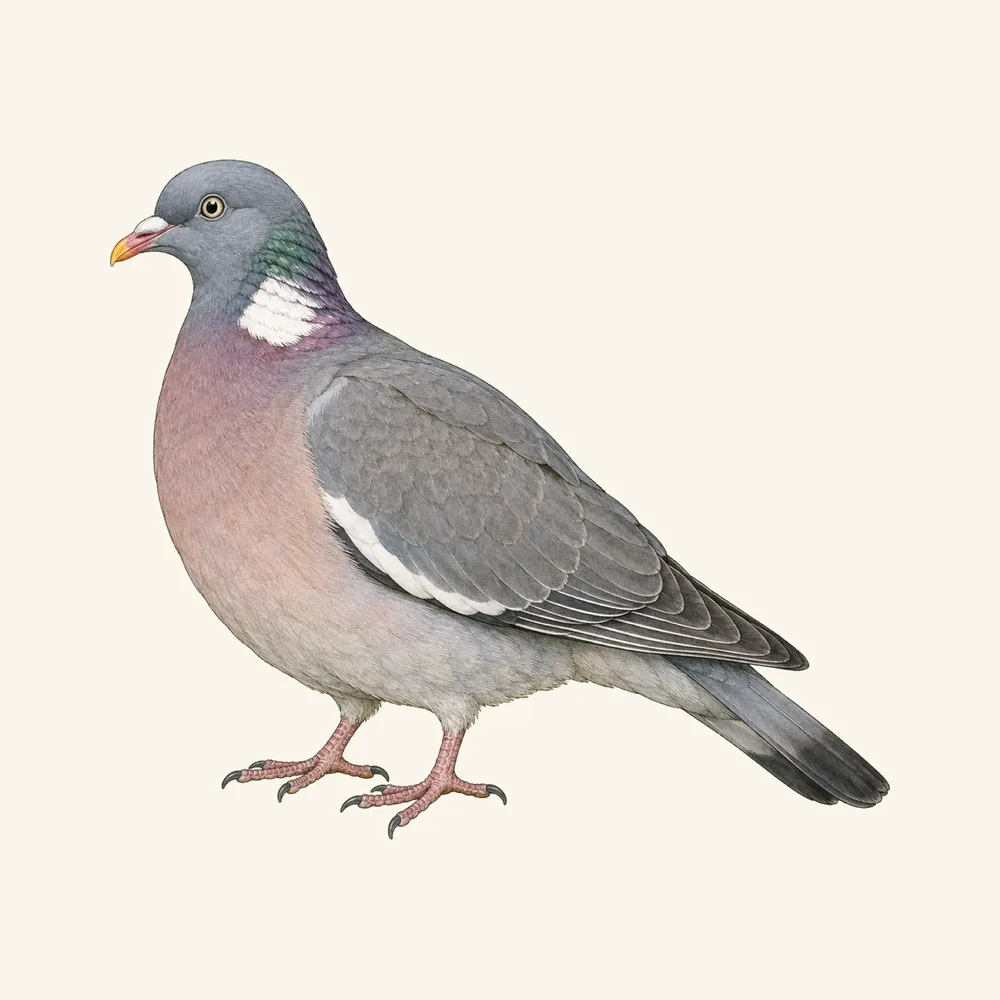
Woodpigeon
Columba palumbus
Up 152% since 1967 and now Amber-listed on BoCC5. It needs nothing from your garden, which is a useful thing to know.
In most gardens
Ranked fourth in the RSPB Big Garden Birdwatch 2026. Present in almost every garden in Britain, town or country, throughout the year.
Amber list
Of medium conservation concern in the UK.
Birds of Conservation Concern 5 records this species as “Amber listed”, with a UK population trend of +152% (1967 to 2024). There is a very shallow but statistically significant recent decline in England. Source.
- Wildlife and Countryside Act 1981, section 1 — It is an offence to intentionally kill, injure or take any wild bird, or to take, damage or destroy the nest of any wild bird while that nest is in use or being built, or to take or destroy its eggs. law
At a glance
-
Size
The biggest common garden bird at about 41cm — twice a blackbird
-
Where you'll see it
Lawns, tree canopies, roof ridges, and under feeders hoovering spillage
-
What it eats
Leaves, buds, seed, grain, berries — and brassicas, to a gardener's cost
-
When
Resident, all twelve months
-
Nests
A flimsy twig platform in a tree or thick climber; will not use a box
-
Song
A muffled five-note coo, roo-COO-coo, coo-coo, often trailing off mid-phrase
Not to be confused with
- Stock Dove — The white marks settle it. A woodpigeon has a white neck patch and a broad white bar across the wing in flight. A stock dove has neither — it is cleaner grey, with a glossy green neck patch and only short black bars on the folded wing. It is also visibly smaller and darker-eyed.
- Collared Dove — Much smaller, sandy-buff rather than grey and pink, with a thin black half-collar on the back of the neck and a long tail with white corners. Its call is a monotonous three-note coo-COO-cuk, not the woodpigeon's five. Woodpigeon or Collared Dove?
- Feral Pigeon — Feral pigeons vary wildly in colour — chequered, blue-grey, white, rusty — and have no white neck patch. Woodpigeons are all the same colour as each other, and look small-headed by comparison. Woodpigeon or Feral Pigeon?
Through the year
Spring
Display flights and cooing start early. Nests are built from March, though breeding can begin in any month.
Summer
Peak breeding, timed to ripening cereals and seed. Juveniles lacking the white neck patch appear from midsummer.
Autumn
The main breeding push often runs into September and October; flocks gather on stubble and ivy berries.
Winter
Large flocks on fields and in gardens; birds strip buds and brassica leaves when other food is short.
Feeding
Takes: spilt seed under feeders, grain and mixed corn, leaves and buds, berries and ivy fruit.
There is no need to feed woodpigeons deliberately. If they are dominating a feeder, a caged feeder or one with short perches will exclude them without excluding tits and finches.
The honest answer: it needs nothing
Almost every garden bird page ends with a list of things to buy or plant. For the woodpigeon the truthful answer is that it requires no help at all. BTO BirdFacts records a 152% rise in the UK breeding population between 1967 and 2024, driven largely by changes in farmland cropping rather than by anything gardeners have done. It feeds itself perfectly well on leaves, buds, seed and berries, and it will find your lawn without encouragement. There is no box to put up, no food to provide, and no shortage to make good. If you enjoy them, do nothing. If you would rather they were not emptying the feeders, the fix is mechanical — a cage or short perches — not a change of diet. Not every species is a conservation project, and pretending otherwise devalues the ones that are.
Why Amber, when the population has trebled
This is the detail most sites get wrong. The woodpigeon sits on the Amber list of Birds of Conservation Concern 5, having moved up from Green. An Amber listing does not mean the bird is scarce. The BoCC criteria take in recent trends as well as long ones, plus the UK's share of the European population and other factors, so a very abundant species can qualify — in this case, on a recent shallow decline set against a huge long-term increase. It is a useful reminder that a listing is a flag for attention, not a headcount. We take our status wording from the species' own BTO BirdFacts entry rather than from summary tables, which is why this page says Amber where some others still say Green.
Living with them in a productive garden
Woodpigeons are the main reason UK vegetable growers net their brassicas. A flock will strip cabbage, kale, sprouts and purple sprouting broccoli to the midribs in a winter afternoon, and they will also take peas, redcurrants and the buds of fruit trees in spring. Netting works if it is taut and held clear of the leaves on hoops, so birds cannot stand on it and peck through; loose netting laid on a crop is both ineffective and a snagging hazard for wildlife. Bird scarers, tapes and models work for a week or two at most. Remember that the bird itself is protected under the Wildlife and Countryside Act, and that its nest cannot lawfully be damaged while in use or being built — and woodpigeons nest in almost any month, including in thick climbers on house walls.
Guides
How we checked this
- BirdFacts: Woodpigeon — BTO
- Birds of Conservation Concern 5 — BTO/RSPB/JNCC summary
- The Big Garden Birdwatch 2026 results are in — RSPB
- Wildlife and Countryside Act 1981, section 1 — legislation.gov.uk
Checked against the sources above. Reviewed on 2026-09-20. Legal position checked 2026-09-20.