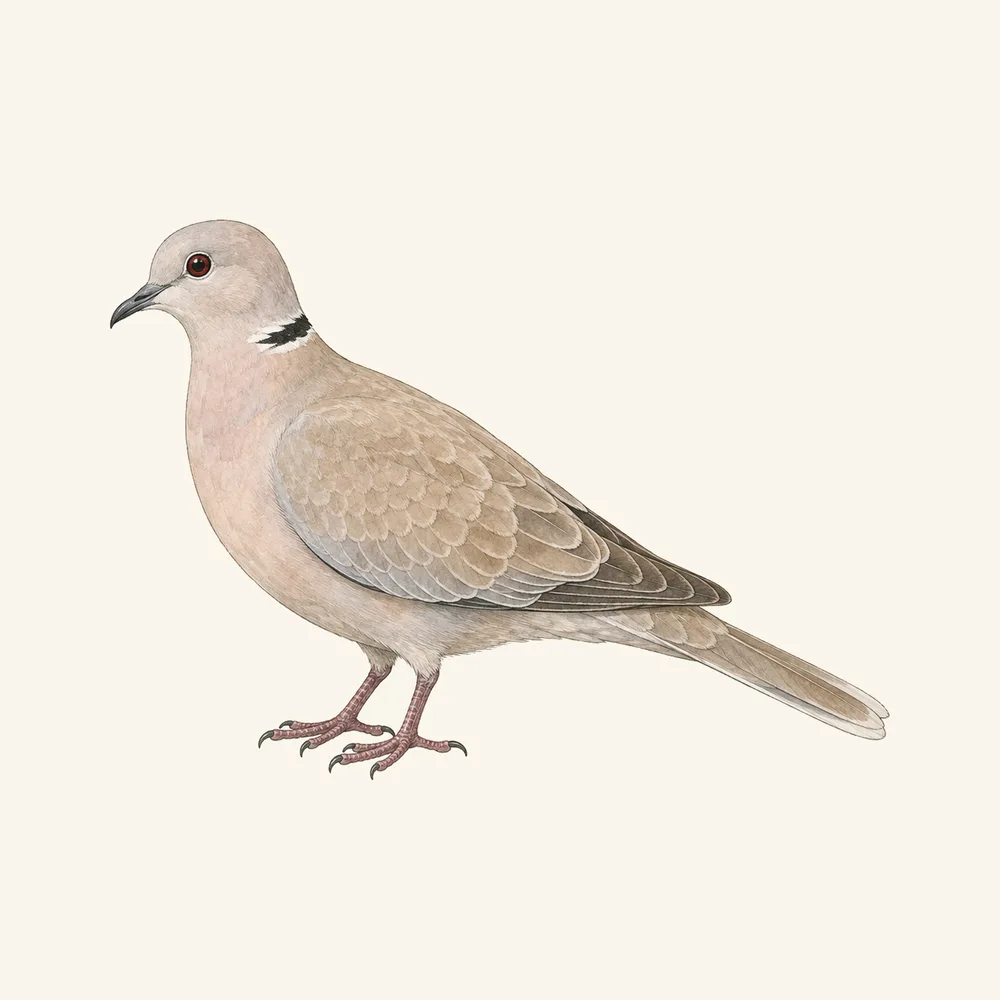
Collared Dove
Streptopelia decaocto
Pale sandy dove with a thin black half-collar. Unknown in Britain before 1955, now in almost every village and suburb.
In many gardens
Widespread in gardens, villages and suburbs across the UK, usually in ones and twos rather than flocks, though numbers have slipped back from their mid-1990s peak.
Green list
Not currently of conservation concern in the UK.
Birds of Conservation Concern 5 records this species as “Green listed”, with a UK population trend of +177% (1972 to 2024). The long-term increase reflects an extraordinarily rapid colonisation rather than current health: numbers peaked around the mid-1990s and a decline noted from 2005 onwards has been linked to the emergence and spread of finch trichomonosis, leaving current numbers similar to mid-1990s levels. Source.
- Wildlife and Countryside Act 1981, section 1 — It is an offence to intentionally kill, injure or take any wild bird, or to take, damage or destroy the nest of any wild bird while that nest is in use or being built, or to take or destroy its eggs. law
At a glance
-
Size
About 32cm — clearly smaller and much slimmer than a woodpigeon, with a longer tail.
-
Where you'll see it
On rooftops, aerials and wires, and on the ground below feeders; often two together.
-
What it eats
Seeds and grain taken from the ground, plus some buds, shoots and berries.
-
When
Resident all year; BTO notes that given favourable weather it may nest in any month of the year.
-
Nests
A flimsy platform of twigs in a tree, hedge or on a building ledge. It will not use a nest box.
-
Song
A flat, insistent three-note coo, the middle note stressed, repeated for minutes on end.
Not to be confused with
- Woodpigeon — The neck mark decides it. A collared dove has a thin black half-collar across the back of the neck only; a woodpigeon has a bold white patch on the side of the neck with a green and purple gloss. A woodpigeon is also far bulkier, greyer, and shows a broad white band across the wing in flight, which a collared dove never does. Collared Dove or Woodpigeon?
- Turtle Dove — A turtle dove has a black-and-white striped neck patch rather than a plain half-collar, bright orange-and-black chequered wings, and a purring song. It is a scarce summer migrant that almost never visits gardens; collared doves are resident and everywhere.
- Feral Pigeon — Feral pigeons are heavily built and endlessly variable — grey, black, white, chequered, russet — with a short tail and no neck collar. A collared dove is always the same pale sandy colour with a long white-cornered tail. Collared Dove or Feral Pigeon?
- Stock Dove — A stock dove is compact and blue-grey with a small iridescent green neck patch and two short black wing bars, and it has no collar. A collared dove is paler, sandier and longer-tailed.
Through the year
Spring
Display flights and constant cooing from February. Nesting is under way, but BTO notes that given favourable weather conditions collared doves may nest in any month of the year.
Summer
Repeated broods on a flimsy twig platform, often in a conifer or thick climber close to a house. Check climbers and hedges before cutting, in any month.
Autumn
Small loose groups gather on stubble, farmyards and garden lawns. Natural seed is abundant, so garden numbers can drop away.
Winter
Back at gardens for spilled seed and grain. Winter is also when feeding stations concentrate birds and disease, so weekly cleaning matters most.
Feeding
Takes: mixed seed and grain from the ground, sunflower hearts spilled beneath feeders, wheat and cereal grain.
Collared doves feed on the ground and take what falls. Nothing extra needs putting out for them. Hygiene is the point worth making here: Garden Wildlife Health lists pigeons and doves, including collared doves, among the species affected by trichomonosis, the disease implicated in the collared dove decline from 2005 onwards. Sweep the ground under feeders, follow the RSPB's advice to clean feeders and baths thoroughly every week, and pause seed and peanuts from 1 May to 31 October. Do not use a bird table or tray feeder — the RSPB no longer recommends flat feeding surfaces because of disease risk.
A bird that was not here in 1954
Almost no British bird has a history like this. BTO records that the collared dove only began its colonisation of Britain in the 1950s, with the first documented Norfolk record in 1955. From four birds that year the population reached a conservative 15,000 to 25,000 pairs by 1970, and the species is now in practically every village and suburb in the country. It was not introduced and not released; it spread north-west across Europe from the Balkans under its own power in one of the fastest natural range expansions ever recorded. The BTO trend figure of a 177% increase between 1972 and 2024 is a measurement of that colonisation rather than a statement about current health, and anyone who remembers Britain before 1960 remembers a country without this bird in it.
Which is why the recent decline matters
The long-term line is up, but the recent line is not. BTO records that collared dove numbers peaked around the mid-1990s and that a decline was noted from 2005 onwards, likely linked to the emergence and spread of finch trichomonosis, leaving current numbers similar to mid-1990s levels. That date will be familiar: 2005 is when trichomonosis swept through greenfinches and chaffinches. The parasite is not only a finch problem. Garden Wildlife Health lists pigeons and doves in the UK, including collared doves, among the species affected, and doves were carrying the organism long before the finch outbreak. It is a useful correction to a common assumption. Feeder hygiene is not a finch issue with doves as bystanders; the doves on your lawn are part of the same picture.
Telling it from a woodpigeon
These are the two doves most gardens have, and people mix them constantly. Go to the neck. A collared dove has one thin black half-collar edged with white across the back of the neck, and nothing else. A woodpigeon has a bold white oval on the side of the neck above a patch of green and purple gloss. Size and build confirm it: a woodpigeon is a heavy, deep-chested, small-headed grey bird, a collared dove is slim, pale sandy-buff and long-tailed. In flight the difference is unmistakable — a woodpigeon shows a broad white bar right across each wing, a collared dove shows none, just dark wingtips and white corners to a long tail. Voice separates them at distance: woodpigeon coos five notes, collared dove three.
The three-note coo, and the nest that looks unfinished
The collared dove's song is a flat, insistent three-note phrase with the middle note stressed, repeated from a roof ridge or aerial for minutes at a time, and it is one of the defining sounds of a British summer suburb. People also report a harsh nasal call given on landing, which is normal and not a bird in distress. The nest is the other thing worth knowing: a thin, untidy platform of twigs, often so sparse you can see the eggs through it from below, built in a conifer, a thick climber or on a ledge. It looks abandoned and half-built when it is neither. Because collared doves may nest in any month given favourable weather, there is no safe window for cutting a hedge or climber. Check before you cut, every time.
Guides
How we checked this
- BTO BirdFacts: Collared Dove
- Garden Wildlife Health: Trichomonosis in Garden Birds
- RSPB: Keep your garden birds healthy
- RSPB: How to help garden birds — feed seasonally and safely
- Wildlife and Countryside Act 1981, section 1
Checked against the sources above. Reviewed on 2026-09-20. Legal position checked 2026-09-20.