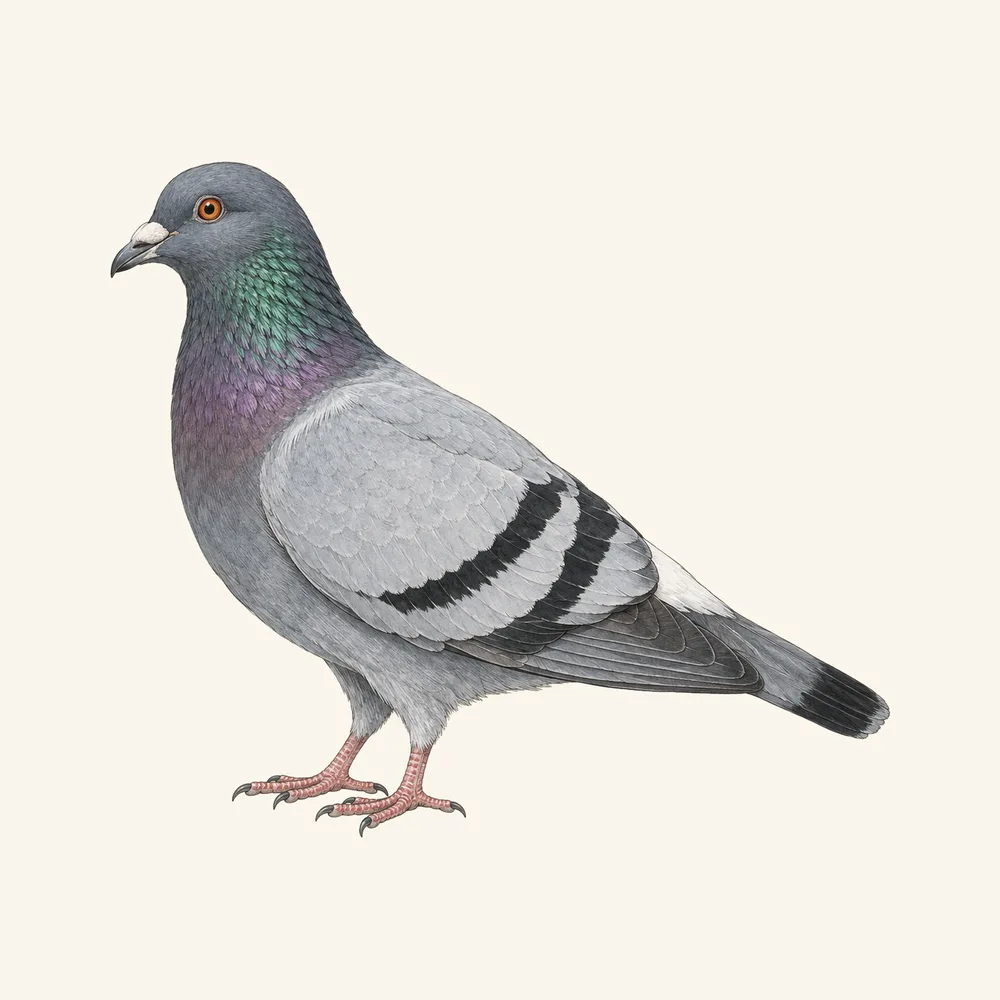
Feral Pigeon
Columba livia
The town pigeon — a rock dove gone urban, in every plumage from pale grey to chocolate. A wild bird in law, like any other.
In many gardens
Abundant in towns and cities and around buildings, much scarcer in rural gardens. BTO covers it under Rock Dove, noting that pure rock doves are restricted to remote coasts in northern and western Scotland and northern Ireland, while feral pigeons are widespread across the rest of the UK.
Not assessed
No conservation assessment exists for this species. That is not the same as being fine.
No assessment scheme records this species as “Not assessed as a separate species. BTO BirdFacts covers Feral Pigeon under Rock Dove (Columba livia), which is "Green listed" on UK Birds of Conservation Concern and "Least Concern" on the IUCN Red List.”. BTO gives no separate figure for feral birds. BBS data for Columba livia show a moderate but not statistically significant decline, and BTO cautions that breeding range figures combine the two forms because feral and wild birds cannot reliably be told apart in the field. Source.
- Wildlife and Countryside Act 1981, section 1 — It is an offence to intentionally kill, injure or take any wild bird, or to take, damage or destroy the nest of any wild bird while that nest is in use or being built, or to take or destroy its eggs. Feral pigeons are wild birds for these purposes and the section applies to them as it does to a robin. law
- General licence GL41 (England), to kill or take certain wild birds to preserve public health or public safety — Feral pigeon is one of four species named on this general licence. It permits an authorised person — the owner or occupier of the land, or someone authorised by them — to kill or take birds, take, damage or destroy nests and take or destroy eggs, by specified methods, only for the licensed purpose and only where the licence's conditions are met. It is a defined exception to the section 1 offence, not a general permission. law
At a glance
-
Size
Around 32cm, noticeably smaller and neater than a woodpigeon, with a shorter tail and a more compact head.
-
Where you'll see it
Roofs, ledges, walls, gutters, paving and lawns, and under feeders picking up spilt seed.
-
What it eats
Seeds, grain and scraps taken from the ground; spilt sunflower hearts and dropped bread in towns.
-
When
Resident all year, and one of very few UK birds that can raise young in any month if food is steady.
-
Nests
A sparse platform on a ledge, in eaves, under a bridge or in an open outbuilding. Will not use a nestbox.
-
Song
A rolling, moaning 'oo-roo-coo' from a ledge, plus a loud wing-clap on take-off.
Not to be confused with
- Woodpigeon — The neck settles it. An adult woodpigeon has a bold white patch on each side of the neck and a broad white band across the wing, obvious in flight. A feral pigeon has no white neck patch and no white wing band; if it shows white at all it is on the lower back. A woodpigeon is also distinctly bigger, rounder and heavier-headed. Feral Pigeon or Woodpigeon?
- Collared Dove — A collared dove is much slimmer, uniformly pale sandy-buff, with a narrow black half-collar on the back of the neck and a long tail with broad white corners. A feral pigeon is stockier, grey-based, and never shows that thin black neck line. Feral Pigeon or Collared Dove?
- Stock Dove — The one genuinely tricky look-alike. A stock dove resembles a plain grey feral pigeon, but it has only short, broken black wing bars rather than two long solid ones, a dark eye rather than an orange-red one, and no white on the lower back. Stock doves are also birds of parkland and farmland, not town centres.
Through the year
Spring
Breeding, as in most other months. Check eaves, open outbuildings and flat ledges before any roof or gutter work — an occupied nest is protected whatever the date.
Summer
Still breeding, often on a second or third brood. Squabs stay in the nest for around a month, so a ledge that looks abandoned may not be.
Autumn
Flocks build around reliable food. A good time to sweep up spilt seed and move feeders if numbers beneath them are climbing.
Winter
Roosting communally in sheltered structures. Keep water available and unfrozen, and keep hard standing under feeders clear.
Feeding
Takes: spilt seed beneath hanging feeders, grain and cereals, sunflower hearts from the ground.
Feral pigeons are ground feeders and take what falls. There is no need to feed them and no benefit in doing so: large gatherings concentrate droppings and raise disease risk for every bird using the same ground. If you want fewer beneath a feeder, the honest answers are practical ones — a seed catch tray fitted beneath a hanging feeder, sweeping spillage up, and following RSPB hygiene guidance to move feeders to a different spot each week and clean them weekly. Never put food out on a bird table, window feeder or tray: the RSPB advises against flat feeding surfaces because of the higher risk of disease spreading on them.
Where it came from
The feral pigeon is not a separate species and not an introduced one in the usual sense. It is Columba livia, the rock dove, the same bird that nests on sea cliffs, descended from birds kept for food and for racing that went back to the wild over centuries. BTO covers the two together for that reason, noting that pure rock doves are now thought to be restricted to remote coastlines of northern and western Scotland and northern Ireland, while across the rest of the UK feral pigeons are widespread. That ancestry explains the behaviour. A cliff-nesting bird reads a building as a cliff: ledges are ledges, a gutter is a crevice, a bridge underside is an overhang. Nothing about a town pigeon is out of place — it is simply using the habitat we built in the shape it already knew.
Why no two look the same
Centuries of domestication produced colour forms that no wild population would carry, and they have all gone back into the same gene pool. So a single flock can hold pale grey birds with two crisp black wing bars, near-black birds, chocolate ones, pied ones and near-white ones, all interbreeding freely. This is the identification problem in a nutshell: there is no single feral pigeon plumage to learn. What holds across all of them is structure and habit — a compact, short-tailed pigeon with a red eye, pinkish-red legs, a white fleshy patch above the bill, iridescent green and purple on the neck, and a habit of nesting on built structures rather than in trees. Get the shape and the eye, and the colour stops mattering.
The legal position, stated plainly
Feral pigeons are wild birds under the Wildlife and Countryside Act 1981, and section 1 applies to them exactly as it applies to a robin: it is an offence to intentionally kill, injure or take one, to damage or destroy a nest in use or being built, or to take or destroy eggs. Separately, feral pigeon is one of four species named on general licence GL41 in England, which allows an authorised person — the owner or occupier of the land, or somebody they authorise — to act for the licensed purpose of preserving public health or public safety, by specified methods and subject to the licence's conditions. That is a narrow, conditional exception, not a general permission, and it is not garden advice. This page gives no control instructions. If pigeons are causing a genuine problem with a building, that is a matter for the property owner and a professional, working to the licence terms.
Living with them in a garden
Most garden complaints about feral pigeons are really complaints about spilt seed. A flock beneath a feeder is a flock that has found a reliable supply of dropped sunflower hearts, and the remedy is tidiness rather than anything aimed at the birds. Fit a catch tray beneath hanging feeders so less reaches the ground, sweep hard standing regularly, and follow the RSPB's hygiene guidance of cleaning feeders and baths at least weekly and moving feeders to a different spot each week — which also breaks up the habit. Do not use a bird table or tray feeder to try to contain the mess; the RSPB advises against flat feeding surfaces altogether because of the higher risk of disease spreading on them. And keep the bird bath topped up: town pigeons struggle for clean water more than for food.
How we checked this
- BTO BirdFacts: Rock Dove (covering Feral Pigeon)
- Wildlife and Countryside Act 1981, section 1
- GOV.UK: GL41 general licence to kill or take certain species of wild birds to preserve public health or public safety
- RSPB: Our latest guidance on what and when to feed garden birds
Checked against the sources above. Reviewed on 2026-09-20. Legal position checked 2026-09-20.