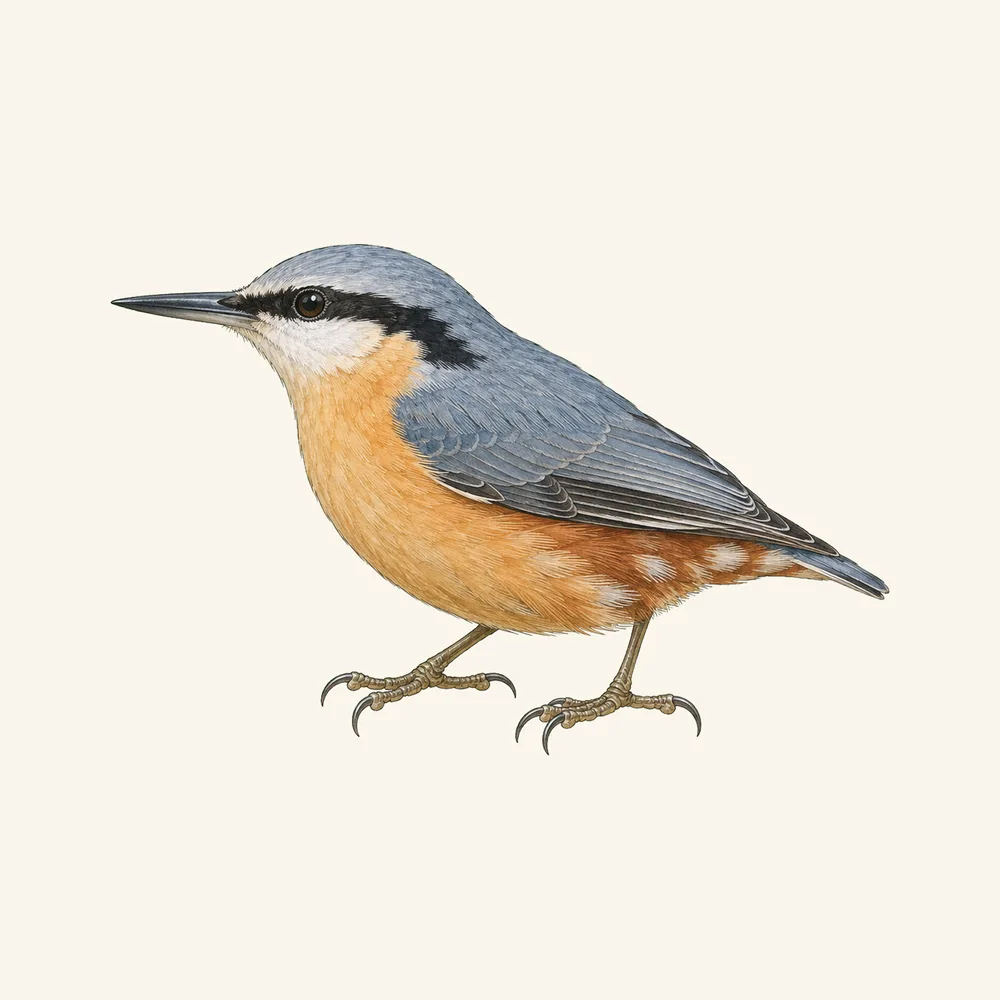
Nuthatch
Sitta europaea
A compact blue-grey woodland bird with a black eye-stripe, and the only UK bird that climbs head-first down a tree trunk.
Occasional visitor
A woodland bird that visits gardens with mature trees nearby, mostly in autumn and winter. Widespread in England and Wales and now into southern Scotland, but absent from Ireland, so a great many UK gardens will never see one.
Green list
Not currently of conservation concern in the UK.
Birds of Conservation Concern 5 records this species as “Green listed”, with a UK population trend of +280% (1967 to 2024). BTO describes a rapid increase in UK abundance since the mid-1970s alongside a range expansion into northern England and southern Scotland, and attributes the rise to more fledglings per breeding attempt, larger broods and fewer nest failures. Source.
- Wildlife and Countryside Act 1981, section 1 — It is an offence to intentionally kill, injure or take any wild bird, or to take, damage or destroy the nest of any wild bird while that nest is in use or being built, or to take or destroy its eggs. law
At a glance
-
Size
About the same length as a robin but stockier and shorter-tailed — roughly great tit sized, with a woodpecker's outline.
-
Where you'll see it
On the trunks and thick limbs of mature trees, and on peanut and sunflower feeders hung near them.
-
What it eats
Insects and spiders prised from bark in summer; hazelnuts, acorns, beech mast, sunflower hearts and peanuts from autumn onward.
-
When
Resident all year, but far more likely in a garden between October and March when woodland food runs short.
-
Nests
In a tree hole or a 32mm hole-fronted box over 3m up, with the entrance plastered down to size with mud.
-
Song
Loud, ringing, repeated whistles — a clear 'pew-pew-pew' or a fast trill, carrying much further than the bird's size suggests.
Not to be confused with
- Treecreeper — Both work tree trunks, but direction settles it instantly. A treecreeper only ever spirals upwards, then flies down to the base of the next tree to start again; a nuthatch walks head-first down. A treecreeper is also mottled brown above, silvery-white below, with a thin down-curved bill and a stiff tail pressed against the bark for support.
- Great Spotted Woodpecker — A woodpecker is black and white with bold white shoulder patches and a red vent, and props itself upright on its stiff tail. A nuthatch is plain blue-grey above with no black-and-white pattern at all, and holds itself horizontally or head-down against the trunk with no tail support. Nuthatch or Great Spotted Woodpecker?
- Coal Tit — Coal tits also snatch a single seed and fly off to cache it, which is the behaviour people muddle. But a coal tit has a black head with white cheeks and a white stripe up the back of the neck, and is noticeably smaller and rounder. A nuthatch's head is blue-grey with a single black line through the eye. Nuthatch or Coal Tit?
Through the year
Spring
Pairs claim tree holes from February and March and plaster the entrance with mud. Leave standing deadwood and any hole-bearing limb that is safe to keep — this is the limiting resource.
Summer
Feeding young on bark insects and largely out of gardens. Nothing is needed from you beyond leaving mature trees and their loose bark undisturbed.
Autumn
Caching season. Nuts and beech mast are hidden in bark crevices across the territory, and garden feeders start to be worked hard from October.
Winter
The best months to see one. Keep peanuts and sunflower hearts going near mature trees, and clean the feeders weekly.
Feeding
Takes: peanuts in a mesh feeder, sunflower hearts, suet pellets and fat blocks, hazelnuts and other whole nuts.
Nuthatches are natural cachers: they take one item, fly to a tree, wedge it into a crack in the bark and hammer it open, then come back for another. That is why a nuthatch on a feeder looks like several nuthatches. Follow the RSPB's current guidance and pause seeds and peanuts between 1 May and 31 October, offering only small amounts of suet or mealworms over the summer; the nuthatch's garden season is the winter half of the year anyway. Hang feeders from a branch or a bracket on a mature tree rather than in the open — a nuthatch will rarely cross a bare lawn to reach one.
Nest box
32mm entrance hole, Over 3m above ground, with a clear flight path to the entrance.. National Nestbox Week gives a 32mm hole for nuthatch — the same diameter as a house sparrow box, but sited much higher. Expect the occupant to plaster mud around the entrance until the hole fits it exactly; that mud collar is the surest sign a nuthatch has taken the box, and it should be left alone.
No perch below the hole — it is a handrail for predators. Hole size is from the BTO: National Nest Box Week.
The bird that walks downwards
There is one field mark you never need to doubt. Treecreepers spiral up a trunk and woodpeckers hitch upwards, both braced on stiff tail feathers. A nuthatch is the only British bird that comes down a tree head-first, gripping the bark with an oversized hind claw and using no tail support at all. This is not a trick; it is a feeding strategy. Coming down the trunk face-on lets a nuthatch see into crevices from an angle the upward-climbers never get, so it finds insects and tucked-away seeds they have already passed over. The movement is distinctive too — short, jerky runs with abrupt stops, more like a mouse than a bird. If you see something small and grey working a trunk downwards, you have a nuthatch, and no further checking is required.
Mud, and why the hole shrinks
Nuthatches nest in natural tree holes and old woodpecker holes, and they are the only UK garden bird that remodels the entrance. Having chosen a cavity, the female plasters mud around the hole until it is just wide enough for her and no wider, which keeps starlings and grey squirrels out. She will do the same to a nestbox, so a box that had a clean 32mm hole in February can have a rough mud collar by April. National Nestbox Week gives 32mm as the diameter and over 3m as the height, with a clear flight path in. Do not scrape the mud off, do not widen the hole, and do not be alarmed when the box also ends up lined with flakes of bark rather than moss — that is normal nuthatch furnishing, not a fault.
What a garden has to offer one
Being honest: most gardens cannot hold a nuthatch, and no amount of feeding will change that. They need mature broadleaved trees — oak, beech, sycamore, lime — within the territory, ideally with some dead or decaying limbs. If your garden backs onto a park, a churchyard, a big old garden or a wood, you have a realistic chance; if it is a new estate with young ornamentals, you probably do not. Where the trees are there, the useful things are small: hang peanut and sunflower feeders close to the trunk rather than out in the open, leave loose bark and standing deadwood in place where it is safe to do so, and resist the urge to fell or tidy every hollow limb. Nest sites, not food, are what limits them.
Listening for it
Nuthatches are heard far more often than they are seen, because they spend most of their time high in the canopy. The vocabulary is small and loud: a ringing, repeated 'pew pew pew' that carries right across a garden, a fast dry trill in spring, and a sharp 'tsit' contact note. It sounds far too big for the bird making it, which is why people scan the treetops for something the size of a thrush and miss the nuthatch entirely. Learn that whistle and your sightings will multiply, particularly from February to April when males call persistently from a high perch. The call is also the best way to know whether nuthatches are in range of your garden before you spend money on feeders they may never find.
Plant this for it
- apple An old apple tree is the most realistic nuthatch habitat a garden can actually grow: mature bark full of invertebrates, and in time the natural cavities and hollow limbs nuthatches nest in.
- clematis Clematis grown up a mature trunk adds cover and invertebrates at the bark surface where nuthatches forage, without competing with the tree for the crevices they hunt in.
Guides
How we checked this
- BTO BirdFacts: Nuthatch
- RSPB: Nuthatch
- National Nestbox Week: Nestboxes — Small Entrance
- RSPB: Our latest guidance on what and when to feed garden birds
- Wildlife and Countryside Act 1981, section 1
Checked against the sources above. Reviewed on 2026-09-20. Legal position checked 2026-09-20.