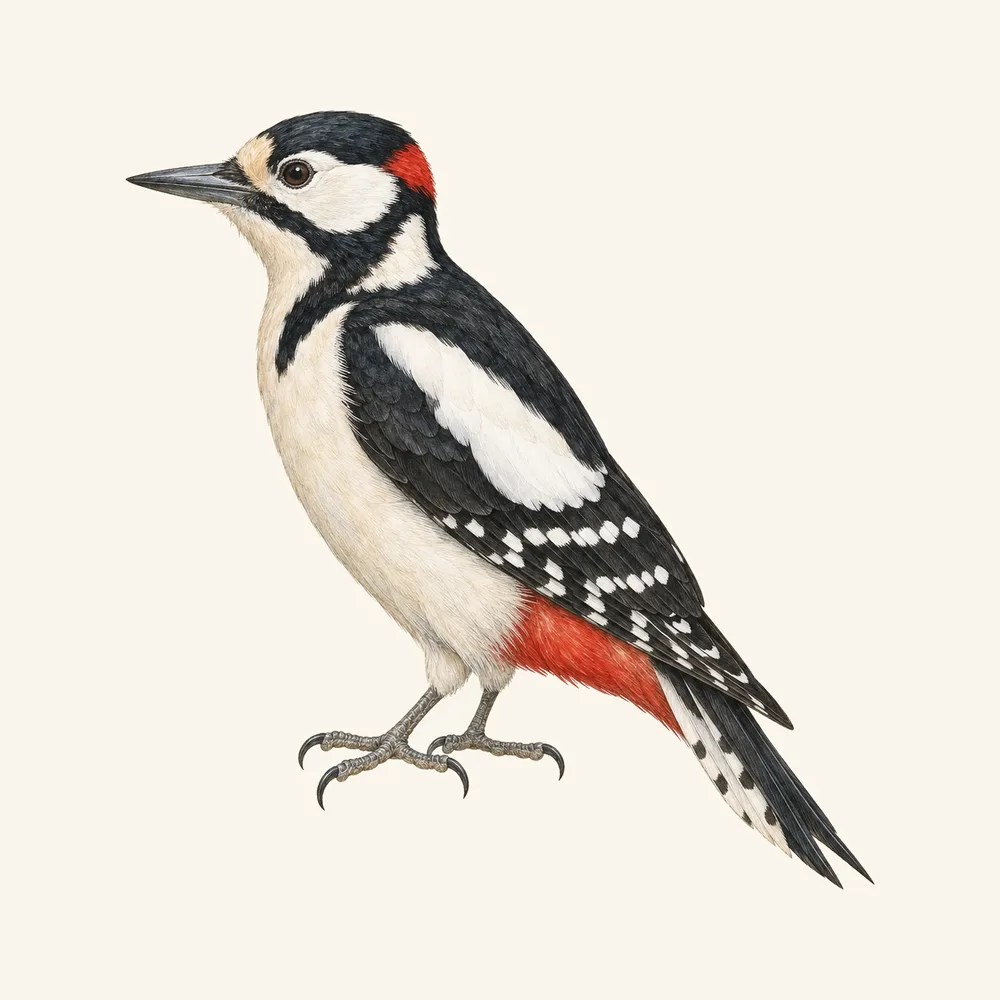
Great Spotted Woodpecker
Dendrocopos major
Blackbird-sized, pied, with red under the tail. Male has a red nape patch; the juvenile's whole crown is red, which fools everyone.
In many gardens
Widespread and increasing across England, Wales and Scotland, and a regular but usually brief visitor to garden peanut and suet feeders, most often in winter.
Green list
Not currently of conservation concern in the UK.
Birds of Conservation Concern 5 records this species as “Green listed”, with a UK population trend of +373% (1967 to 2024). Numbers increased rapidly in the 1970s and again in the late 1990s and 2000s, and the species colonised Ireland from 2008; the rise has been linked to greater dead wood availability, reduced competition for nest holes from declining Starlings, and the growth of garden feeding. Source.
- Wildlife and Countryside Act 1981, section 1 — It is an offence to intentionally kill, injure or take any wild bird, or to take, damage or destroy the nest of any wild bird while that nest is in use or being built, or to take or destroy its eggs. law
At a glance
-
Size
About blackbird-sized, roughly 23cm, but broader-shouldered and heavier-looking.
-
Where you'll see it
On tree trunks and large branches, and clinging to peanut or suet feeders, usually briefly.
-
What it eats
Wood-boring insect larvae, tree seeds, and — in the breeding season — the eggs and nestlings of hole-nesting birds.
-
When
Resident all year; drumming from January to May and boldest at feeders in winter.
-
Nests
Excavates a fresh hole in a tree each year. National Nestbox Week publishes no hole diameter for it.
-
Song
No song — a sharp explosive kik, and a mechanical drum roll lasting under a second, repeated.
Not to be confused with
- Juvenile Great Spotted Woodpecker — This is the mistake people make constantly, and it is worth getting right before anything else. A juvenile has a complete red crown — the whole top of the head — and is regularly reported as a lesser spotted woodpecker or as an unknown species. An adult male has only a small red patch on the nape, at the back of the head, and an adult female has no red on the head at all. So: red on top of the head means a young bird of this species, not a different one. All three show the same crimson vent under the tail and the same oval white shoulder patches.
- Lesser Spotted Woodpecker — Size settles it. A lesser spotted woodpecker is sparrow-sized, barely half the length of a great spotted, and has a barred black-and-white back with no oval white shoulder patches and no red under the tail. It is also genuinely scarce, Red listed and very rarely seen in gardens, so a garden pied woodpecker is almost always a great spotted.
- Green Woodpecker — A green woodpecker is larger, green above with a yellow rump and a red crown, and spends most of its time on the ground eating ants rather than on trunks. Its call is a loud laughing yaffle, nothing like the great spotted's sharp kik.
- Nuthatch — A nuthatch also works tree trunks and comes to feeders, but it is blue-grey above and orange-buff below with a black eye-stripe, and it is the only garden bird that walks head-first down a trunk. A great spotted woodpecker only ever goes up. Great Spotted Woodpecker or Nuthatch?
Through the year
Spring
Drumming peaks from February to April, then pairs excavate a fresh hole and raise one brood. This is also when nest boxes are most at risk from woodpeckers.
Summer
Juveniles with full red crowns appear at feeders from June, often noisier and less wary than the adults. Seed and peanuts are paused from 1 May under RSPB guidance.
Autumn
Birds disperse and become quieter. Tree seed and insect larvae in dead wood carry them through, so standing deadwood is worth leaving where it is safe to.
Winter
Boldest at garden feeders now, especially for suet and peanuts. Drumming starts again on still January mornings as territories are re-established.
Feeding
Takes: peanuts from a mesh feeder, suet blocks, pellets and fat, sunflower hearts, insect larvae from dead wood.
Great spotted woodpeckers cling and are best served by a mesh peanut feeder or a suet block holder fixed firmly enough not to swing. Follow the RSPB's seasonal rule: pause seed and peanuts from 1 May to 31 October, offering only small amounts of suet, fat balls or mealworms in that window — which conveniently coincides with the period when woodpeckers are most likely to raid nest boxes, so a feeder is not drawing them past your boxes at the worst time. Do not use a bird table, window feeder or tray; the RSPB no longer recommends flat feeding surfaces because of disease risk.
Red nape, red crown: the mistake everyone makes
More garden woodpecker reports go wrong on this one point than on anything else. Male, female and juvenile all look broadly the same — black and white, oval white shoulder patches, crimson under the tail — and the differences are all on the head. The RSPB puts it directly: the male has a bright red patch on the back of the head, and young birds have a red crown. The female has no red on the head at all. So a bird with red on the very top of its head is not a rarity and not a different species; it is a juvenile great spotted woodpecker, and they appear at feeders from June. A bird with a small red patch at the back of the neck is an adult male. A bird with a plain black cap is an adult female.
One of the great British bird success stories
BTO records a 373% increase between 1967 and 2024, with rapid rises in the 1970s and again from the late 1990s through the 2000s, and the species reached Ireland from 2008 — a country that had no resident woodpeckers at all. Three things are thought to lie behind it. Dutch elm disease left huge quantities of standing dead wood in the 1970s, which is nest and larder in one. Starlings declined steeply, reducing competition for excavated nest holes, which starlings routinely take over. And garden feeding expanded enormously, giving woodpeckers a reliable winter food source they did not previously have. It is a rare case where three separate changes, two of them accidental and one of them deliberate, all pushed the same way.
Drumming is not feeding
The drum roll people hear from January onwards is not a bird hammering out a grub. It is territorial signalling — the woodpecker equivalent of song — and it is produced by striking a carefully selected resonant surface, usually a dead branch, sometimes a metal pole, an aerial or a plastic gutter, which makes suburban drumming sound strangely artificial. Both sexes drum. A burst lasts well under a second, contains something like ten to twenty strikes, accelerates and fades at the end, and is repeated at intervals. Feeding sounds completely different: slower, irregular tapping with pauses. Drumming peaks from February to April and fades by June. If you hear it in December or January, that is normal and early territory establishment, not a bird confused by the weather.
Nest boxes, and the hole size we will not give you
Great spotted woodpeckers excavate a fresh hole in a living or dead tree each year, and this is the one honest disappointment in this profile: National Nestbox Week does not publish an entrance hole diameter for the species, so we do not publish one either. There is a related problem worth knowing about. Woodpeckers will attack occupied tit boxes in spring, enlarging the hole to reach the chicks, and a wooden box is no obstacle to a bill built for excavation. The usual answers are a metal hole plate fitted around the entrance, a woodcrete box, or siting boxes away from the trunk on a post or wall where a woodpecker is less comfortable working. None of this justifies deterring the bird itself — it is protected like any other, and the sensible response is to protect the box.
Plant this for it
Guides
How we checked this
- BTO BirdFacts: Great Spotted Woodpecker
- RSPB: Great Spotted Woodpecker
- National Nestbox Week: Nestboxes — Small Entrance
- RSPB: How to help garden birds — feed seasonally and safely
- Wildlife and Countryside Act 1981, section 1
Checked against the sources above. Reviewed on 2026-09-20. Legal position checked 2026-09-20.