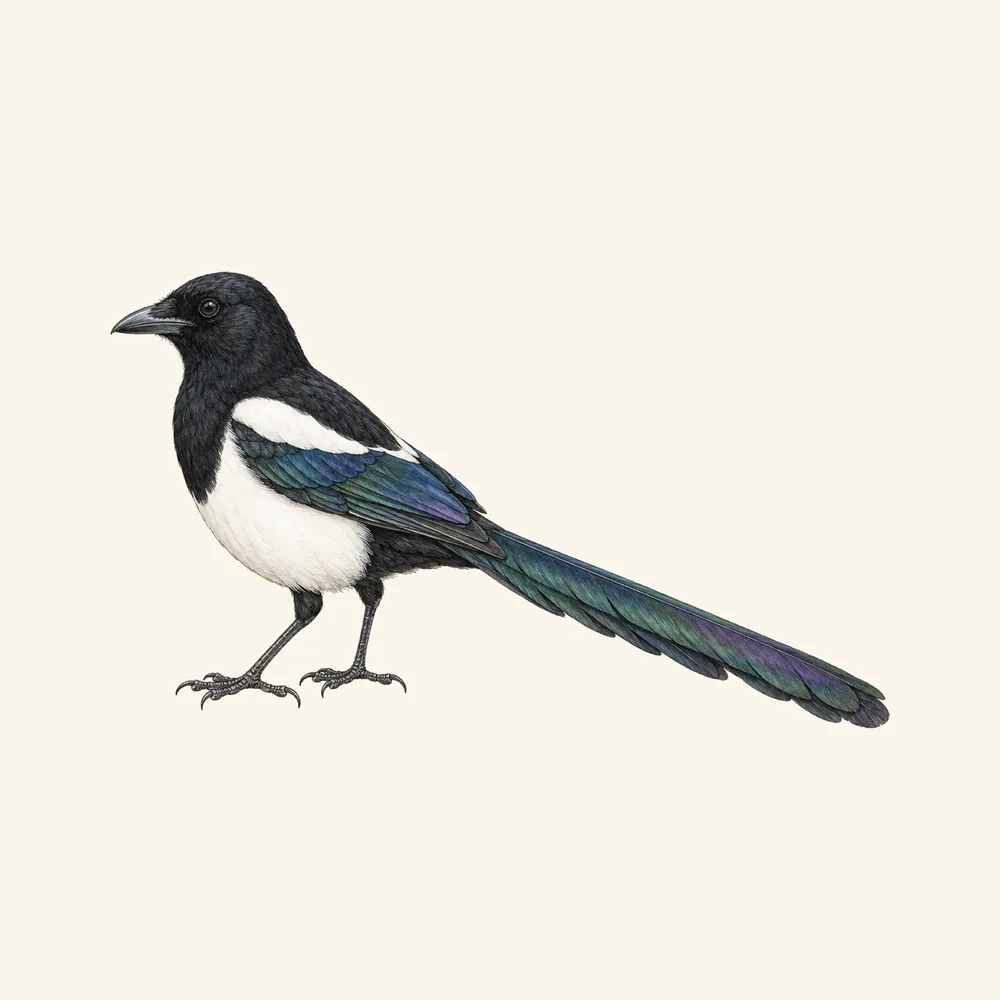
Magpie
Pica pica
Black and white, long-tailed and loudly opinionated. A clever, much-maligned crow that is doing rather better than its reputation.
In most gardens
A resident of gardens, parks and roadsides across most of Britain, and among the ten most recorded species in the RSPB Big Garden Birdwatch 2026. Largely absent from the far north-west of Scotland.
Green list
Not currently of conservation concern in the UK.
Birds of Conservation Concern 5 records this species as “Green listed”, with a UK population trend of +104% (1967 to 2024). Numbers have been broadly stable since the late 1980s. Source.
- Wildlife and Countryside Act 1981, section 1 — Magpies are wild birds and are protected like any other. It is an offence to intentionally kill, injure or take a magpie, or to take, damage or destroy its nest while that nest is in use or being built, or to take or destroy its eggs. law
- General licence GL42 (England) — to kill or take certain wild birds to prevent serious damage — Magpie is one of the species listed on GL42, but the licence is narrow. It authorises action only to prevent serious damage to livestock, foodstuffs for livestock, crops, vegetables, fruit, or fisheries and inland waters. It expressly does not cover mere nuisance, minor damage or normal business risk, and it does not cover protecting garden songbirds. Anyone acting under it must first make reasonable endeavours to achieve the purpose by other lawful methods. In an ordinary domestic garden none of the licensed purposes applies, so the general licence does not authorise action there. law
At a glance
-
Size
Bigger than a pigeon in total length, though much of that is tail — roughly 45cm nose to tail.
-
Where you'll see it
Lawns, rooftops, tall trees and roadsides; raids feeders and fat blocks.
-
What it eats
Beetles, leatherjackets and worms, carrion, scraps, fruit and grain — plus eggs and chicks in spring.
-
When
Resident all year; most conspicuous in late winter when groups display.
-
Nests
No nest box. Builds a large domed stick nest with a roof, high in a tree or thick hedge.
-
Song
No real song — a loud, dry, machine-gun chatter, 'chak-chak-chak-chak'.
Not to be confused with
- Jay — Both are noisy, medium-large crows that raid nests, and both flash white. But a jay is pinkish-brown, not black and white, and the white is a bright square rump patch that flares as it flies away from you. It also carries a small panel of sky-blue, black-barred feathers on the wing. If you see a bold white rump on a warm brown bird, it is a jay; a magpie is stark black and white with a tail half as long again. Magpie or Jay?
- Pied Wagtail — Sometimes mistaken for a magpie at distance on a roof or car park because it is black and white with a long tail — but it is tiny, no bigger than a sparrow, runs rather than hops, and pumps its tail constantly up and down. A magpie is the size of a pigeon. Magpie or Pied Wagtail?
Through the year
Spring
Nest-building from March: a bulky stick structure with a domed roof, often the most visible nest in a leafless tree. This is also when magpies take eggs and chicks.
Summer
Family parties move about together; fledged young have shorter tails than the adults and beg loudly for weeks.
Autumn
Caching behaviour is obvious — watch one push food into the lawn and cover it with a leaf or a pinch of grass.
Winter
Groups of non-breeding birds gather and display noisily in late winter, sometimes a dozen or more in one tree. This is display, not aggression.
Feeding
Takes: kitchen scraps and carrion, suet blocks and fat balls, peanuts, windfall fruit, invertebrates taken from short grass.
Magpies are omnivores and take whatever is going. Most of the year that means beetles, leatherjackets, worms, fruit, grain and roadside carrion; eggs and nestlings are a seasonal addition in spring, not a staple. If you would rather they did not dominate a feeding station, use feeders with a cage guard that small birds can pass through and stop leaving scraps on an open table.
The songbird question, answered properly
This is the thing people actually want to know, so it is worth being straight about it. Magpies do take eggs and nestlings in spring — nobody disputes that, and watching it happen in your own garden is genuinely upsetting. What the evidence does not support is the step from there to blaming magpies for songbird declines. The BTO's position is explicit: 'there is evidence that predation of eggs and young does not have population level effects on songbirds and therefore wider control measures would not be appropriate for this purpose'. Songbird numbers are driven mainly by how many birds survive the winter and how much habitat and food there is, not by nest losses, which are heavy from all causes and always have been. Magpie numbers, meanwhile, have been broadly stable since the late 1980s while many songbirds carried on declining — the two curves simply do not track each other.
Where the law stands
Magpies are wild birds and are protected under section 1 of the Wildlife and Countryside Act 1981 in exactly the same way as a robin: it is an offence to intentionally kill, injure or take one, or to damage or destroy a nest in use or being built. General licences do exist — in England, GL42 lists magpie — but they are narrowly drawn and widely misunderstood. GL42 covers only the prevention of serious damage to livestock, livestock foodstuffs, crops, vegetables, fruit, or fisheries and inland waters. It does not cover nuisance, minor damage, or protecting garden songbirds, and anyone relying on it must first have made reasonable efforts to solve the problem by other lawful means. In a domestic garden, none of the licensed purposes is in play, which means the general licence does not authorise anything there. Licences also differ between England, Scotland, Wales and Northern Ireland.
What actually helps the small birds
If you want fewer nests lost in your garden, the useful lever is cover, not the magpie. Magpies hunt nests by searching visually from above and from open perches, so nests in thin, open or recently cut vegetation are the ones that get found. Dense, thorny, un-manicured structure is what defeats them: a hedge allowed to thicken rather than clipped tight, a bramble corner, a mature climber on a wall, a shrub rose left unpruned. Two or three metres of untidy depth does more than any amount of intervention. Beyond that, keep nest boxes away from obvious perching branches and rails that give a magpie a platform, keep cats indoors at dawn and dusk in spring, and resist tidying hedges between March and August — which you are required to check for active nests before doing in any case.
Worth watching rather than resenting
Magpies are among the most intelligent birds in Britain and reward five minutes of attention. Watch one on a lawn in autumn and you will often see it cache: it probes a patch of turf, pushes something into the hole, then deliberately covers the spot with a leaf or a tuft of grass before walking away — and it remembers where. In late winter you may see a dozen gathered in one tree, chattering and flicking their tails in an upright display; this is a social gathering of non-breeding birds, not the fight it looks like. And the black is not black. In decent light the wings throw a deep purple-blue and the long tail a metallic green, which is worth knowing because it is the quickest way to persuade someone that a magpie is a handsome bird.
Plant this for it
- rose A dense, thorny shrub rose left unpruned gives small birds the kind of impenetrable nesting cover a magpie cannot easily search — the practical answer to nest predation.
- apple Windfall apples left on the ground in autumn are readily taken by magpies, along with the leatherjackets and beetles they probe for in the grass beneath.
How we checked this
- BTO BirdFacts: Magpie
- BTO Garden BirdWatch: Magpie
- GL42: general licence to kill or take certain species of wild birds to prevent serious damage (GOV.UK)
- Wildlife and Countryside Act 1981, section 1
Checked against the sources above. Reviewed on 2026-09-20. Legal position checked 2026-09-20.