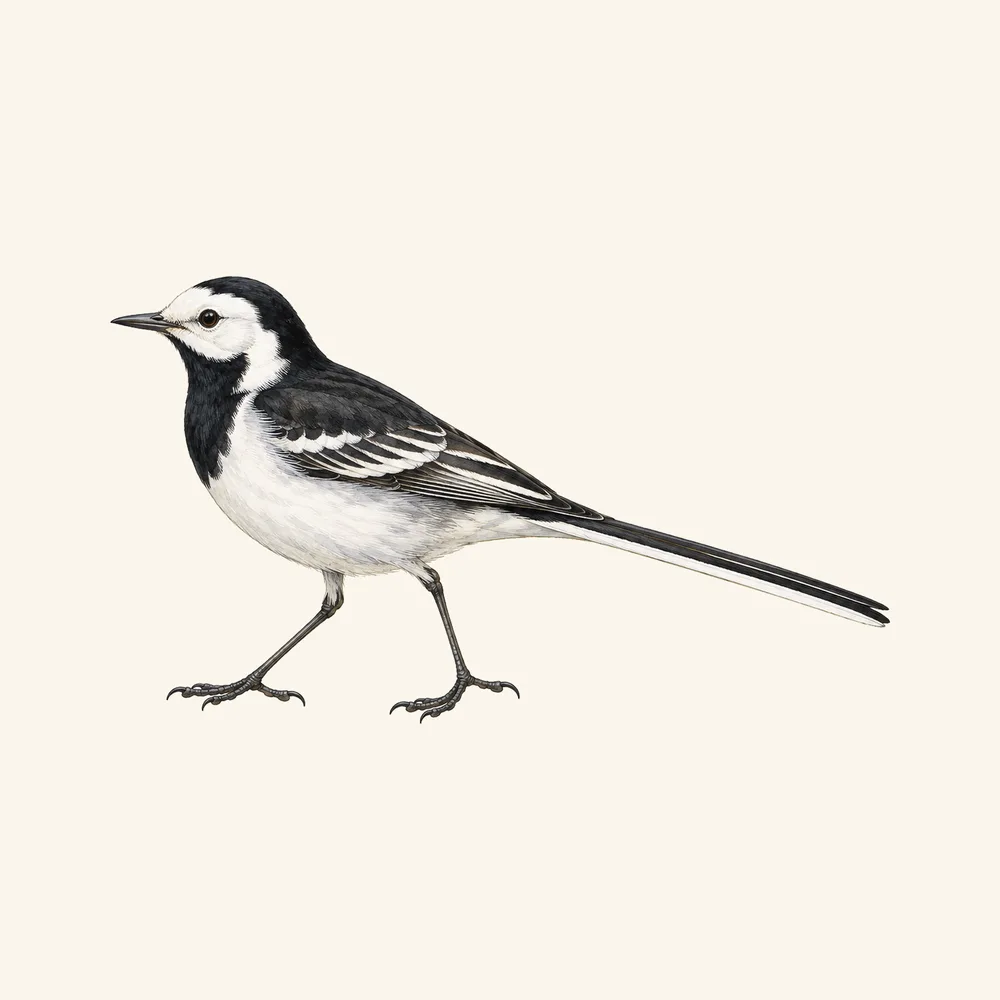
Pied Wagtail
Motacilla alba
A slim black-and-white bird that walks rather than hops, wagging its tail constantly, usually on a lawn, path, drive or flat roof.
In many gardens
Widespread across the UK and a regular garden bird wherever there is short grass, paving or a flat roof. Numbers in gardens rise in winter, when birds gather at large communal roosts in town centres and commute out to feed by day.
Green list
Not currently of conservation concern in the UK.
Birds of Conservation Concern 5 records this species as “Green listed”, with a UK population trend of +28% (1967 to 2024). BTO describes strong growth through the mid-1970s followed by conflicting signals: CBC/BBS indices show little overall change since, while waterway monitoring indicates rapid decline along rivers. Regional analysis between 1994–96 and 2007–09 found decreases in the Scottish uplands, English and Welsh uplands and urban areas, with gains in Northern Ireland and on western coasts. Source.
- Wildlife and Countryside Act 1981, section 1 — It is an offence to intentionally kill, injure or take any wild bird, or to take, damage or destroy the nest of any wild bird while that nest is in use or being built, or to take or destroy its eggs. law
At a glance
-
Size
Robin length in the body, but the long tail makes it look bigger — around 18cm overall, and far slimmer.
-
Where you'll see it
Short grass, paths, drives, car parks, flat roofs and the edges of ponds and puddles. Not on hanging feeders.
-
What it eats
Insects, particularly flies, taken from open ground or caught in short fluttering chases; some seed in hard weather.
-
When
Resident all year. In winter birds feed alone by day and gather in large communal roosts at dusk.
-
Nests
In a wall cavity, ivy, woodpile or open-fronted box. National Nestbox Week gives a nest height up to 5m above ground.
-
Song
A brisk, chirpy twitter, but the flight call is what you learn: a sharp, cheerful 'chis-ick' from overhead.
Not to be confused with
- Grey Wagtail — The name misleads everyone. A grey wagtail has a bright lemon-yellow belly and undertail and a grey back, and an even longer tail. A pied wagtail has no yellow at all. Any wagtail showing yellow underneath is a grey wagtail, however grey its back looks.
- White Wagtail — The continental race of the same species, seen on passage in spring and autumn. Its back is a clean pale grey clearly contrasting with the black cap; the British pied wagtail's back is sooty black or very dark grey, merging with the cap. Back tone is the only reliable mark, and it needs good light.
- Coal Tit — Reported as a small black-and-white bird, but a coal tit is short-tailed and round, feeds in trees and on hanging feeders, and hops. A pied wagtail is long, slim, long-tailed, feeds on open ground and walks. Behaviour separates them before plumage does. Pied Wagtail or Coal Tit?
Through the year
Spring
Nesting from April in wall cavities, ivy, woodpiles and open-fronted boxes. Check any such cavity before repointing, clearing or repairing it.
Summer
Feeding young on flies from lawns and paving. Leave a patch of grass mown short and keep insecticides off it.
Autumn
Family parties and loose flocks work lawns, playing fields and car parks. Communal roosts begin to form.
Winter
Birds feed alone by day and gather at dusk in large roosts, often in town-centre trees or on industrial buildings. Keep water unfrozen.
Feeding
Takes: flies and other small insects from short grass and paving, insects taken at the edge of a pond or puddle, small amounts of finely grated suet or crumbs from the ground in hard weather.
Pied wagtails are insect hunters that work open ground, so they take almost nothing from a hanging feeder and do not need one. What helps them is habitat: an area of closely mown lawn, a damp margin or pond edge, and paving left unswept of the small insects that gather on it. Avoid insecticides on lawns and paths — that is where a wagtail's entire food supply lives. In prolonged frost some birds will take finely grated fat or crumbs from the ground; keep the amounts small, clear anything uneaten within a day, and follow RSPB hygiene guidance on cleaning and moving feeding spots weekly.
It walks, and that is the whole identification
Almost every small bird in a British garden hops: two feet together, a little bounce forward. Pied wagtails walk, placing one foot in front of the other, and break into a genuine run when chasing a fly. Combined with the constantly pumping tail and the long, slim, low-slung body, that gait identifies the bird at any distance and in any light, before colour is even in question. It reflects what the bird does for a living — it hunts flying insects on open flat ground, and walking lets it stalk and then sprint. Once you have the movement fixed, you will pick pied wagtails out of supermarket car parks, school playing fields and flat roofs everywhere, which is where most people first realise how common they actually are.
The roost nobody notices
In winter pied wagtails feed alone or in loose scatterings by day, then gather at dusk into communal roosts that can run to hundreds or, occasionally, thousands of birds. The classic sites are urban and warm: town-centre trees, supermarket car parks, hospital and factory roofs, glasshouses, sewage works. The birds commute in from several miles around, arriving in a steady trickle in the half-hour after sunset, and the noise is considerable. If a line of small trees on a high street chatters at dusk in January, this is what it is. It is one of the more remarkable wildlife spectacles available in an ordinary British town, it requires nothing from a gardener at all, and it is almost entirely overlooked because it happens in the dark above people leaving work.
Nesting in the awkward places
Pied wagtails nest in cavities, and their taste runs to things that look like building faults: a gap behind loose mortar, a hole in a wall, a space under roof tiles, ivy against brickwork, a stacked woodpile, a shelf in an open shed, machinery left standing. They will also use an open-fronted box, and National Nestbox Week lists pied wagtail among the open-front species, giving a nest height of up to 5m above ground. No hole diameter applies, because there is no hole — an open-fronted design is what to put up, sited in cover on a wall or fence. The practical consequence is a habit rather than a purchase: between March and August, look before you repoint a wall, clear a woodpile or strip a roof. A nest in use is protected whatever the date, and these are exactly the nests that get destroyed by accident.
What actually helps: short grass and no spray
This is an unusual garden bird in that the best thing you can do is mow. Pied wagtails hunt by sight on open, flat, short surfaces — closely cut lawn, paving, gravel, a drive — and long grass and dense planting are useless to them. A garden managed entirely for meadow and wilderness, excellent for many things, offers a wagtail nothing to feed on. A mown strip or a small area kept short alongside the wilder parts is the answer, and it costs nothing. The second thing is negative: keep insecticides off lawns, paths and paving, because the flies and small insects that gather there are the bird's entire diet. A damp margin, a pond edge or even a puddle that persists after rain will pull wagtails in more reliably than any food you could put out.
Plant this for it
How we checked this
- BTO BirdFacts: Pied/White Wagtail
- National Nestbox Week: Nestboxes — Open Front
- RSPB: Our latest guidance on what and when to feed garden birds
- Wildlife and Countryside Act 1981, section 1
Checked against the sources above. Reviewed on 2026-09-20. Legal position checked 2026-09-20.