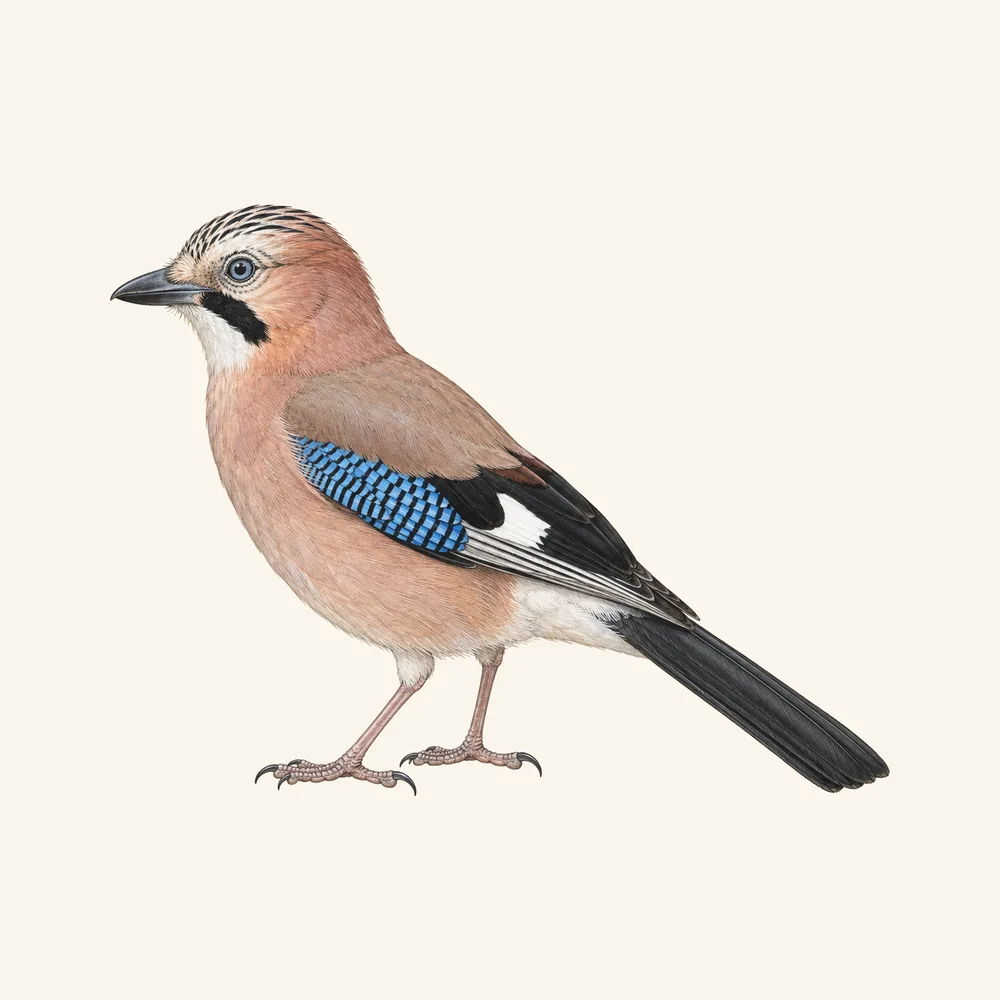
Jay
Garrulus glandarius
The woodland crow in pink and blue. Shy, harsh-voiced, and the reason oak trees appear where nobody planted one.
Occasional visitor
A woodland bird that uses gardens near mature trees, most obviously in autumn when it is moving acorns. Widespread across England and Wales, thinner in Scotland, and far more often heard than seen.
Green list
Not currently of conservation concern in the UK.
Birds of Conservation Concern 5 records this species as “Green listed”. BTO gives no headline percentage: numbers were stable until a decline from the late 1980s, and the losses since the 1980s have now been regained, leaving the long-term trend broadly stable. Breeding range expanded by 17.5% between 1968–72 and 2008–11, and winter range by 19.4% between 1981–84 and 2007–11. Source.
- Wildlife and Countryside Act 1981, section 1 — It is an offence to intentionally kill, injure or take any wild bird, or to take, damage or destroy the nest of any wild bird while that nest is in use or being built, or to take or destroy its eggs. law
At a glance
-
Size
About 35cm with a 55cm wingspan — bigger than a blackbird, slimmer and longer-tailed than a woodpigeon.
-
Where you'll see it
Working along a treeline, or briefly on a lawn burying acorns in October before dashing back to cover.
-
What it eats
Acorns above all, plus insects, seeds and fruit, and sometimes eggs and nestlings in spring.
-
When
Resident all year, but overwhelmingly most visible in September and October during the acorn harvest.
-
Nests
A twig platform hidden in a tree fork or dense shrub. Does not use a nestbox.
-
Song
No real song — a harsh, tearing 'skaaaak' screech, and a surprisingly good mimic of buzzards and other birds.
Not to be confused with
- Magpie — Both are showy corvids with a white flash, but a magpie is black and white with an iridescent green-blue sheen and a tail longer than its body. A jay is pinkish-brown with a short black tail, and the white is confined to the rump. In flight the magpie's tail streams behind it; the jay looks stubby and blunt. Jay or Magpie?
- Jackdaw — A jackdaw is uniformly grey-black with a pale grey nape and a striking pale grey-white eye, and it walks about confidently on lawns and roofs in noisy groups. A jay is pink-bodied, shy, usually alone or in twos, and shows the white rump and blue wing patch a jackdaw never has. Jay or Jackdaw?
- Green Woodpecker — People report a jay's undulating flight and loud call as a green woodpecker and the reverse. The clincher is colour: a green woodpecker is green above with a yellow rump and a red crown. A jay's rump is pure white, and the wing carries a blue and black barred patch no woodpecker has.
Through the year
Spring
Nesting quietly in dense cover and unusually silent for a corvid. Check trees and thick shrubs before any cutting — the nest is well hidden and easily wrecked.
Summer
Feeding young on caterpillars and insects. Largely invisible; this is the season jays are least likely to be noticed at all.
Autumn
The acorn harvest, and the one time of year jays are conspicuous. A single bird may bury thousands of acorns across September and October.
Winter
Living off the autumn caches, which it relocates with remarkable accuracy. Will come to peanuts and fat put out under cover in hard weather.
Feeding
Takes: acorns, hazelnuts and beech mast, peanuts, suet and fat blocks, windfall fruit.
Jays are wary and will usually take food from the ground under cover rather than from a hanging feeder, dropping in, snatching and leaving within seconds. Follow current RSPB guidance and pause seeds and peanuts from 1 May to 31 October, keeping suet to small amounts over the summer. Nothing needs to be done to attract one: a jay in your garden in autumn is almost always there because of acorns, either from your trees or passing through with someone else's.
The bird that plants oak woods
In autumn a jay's whole life is acorns. It carries several at a time — some in the throat, one in the bill — flies out from the oak, and buries them singly in short grass, leaf litter and bare soil, often hundreds of metres from the parent tree and sometimes much further. The Woodland Trust describes this as caching, and notes the consequence plainly: not all the acorns are found again, so some are left to grow into oak trees. That is the whole mechanism by which oak, a heavy seed that cannot blow anywhere, spreads uphill and across open ground. When an oak seedling appears in the middle of your lawn or in a border you never planted, a jay put it there. The bird is doing an ecological job no other British animal does at that scale.
Loud, shy, and mostly invisible
Jays are among the most brightly coloured British birds and among the hardest to get a decent look at. They are birds of woodland interiors that cross open ground reluctantly, with a heavy, flappy, hesitant flight low between trees. Most garden sightings are three seconds of white rump disappearing over a fence. The screech comes first: a harsh, tearing 'skaaaak', usually repeated, which is the sound of a jay that has seen you. They also mimic — buzzard calls are a favourite, and a convincing buzzard mewing from inside a suburban hedge is far more likely to be a jay. If you want to watch one, sit still near a treeline in October and wait; approaching one never works.
The awkward bit about eggs
Jays take eggs and nestlings in spring, alongside insects, and the Woodland Trust lists young birds, eggs and small mammals in their diet. This upsets people who have watched a nest in their own hedge. It is worth being clear about what this does and does not mean. Nest predation by native corvids is a normal part of a functioning woodland system and the birds it takes from have evolved alongside it; it is not what has driven British songbird declines, which are overwhelmingly matters of habitat and food supply. Jays are protected under the Wildlife and Countryside Act 1981 like every other wild bird. The useful response in a garden is to give nesting birds better cover — dense, thorny, multi-layered hedging that a jay cannot easily search.
A garden a jay will actually use
Jays need mature trees, so the realistic question is whether your garden sits within reach of some. If it does, three things make it worth their while. Oaks, obviously, if there is room for one, or a neighbour's within flight range. Dense cover — a thick hedge, a large shrub, a stand of holly — so a jay can drop in without crossing open lawn. And short grass or bare soil in autumn, which is where they prefer to bury acorns; a lawn kept a little shorter in October will pull jays down within view. Beyond that, leave them alone. They are not a feeder bird, they do not need managing, and the most interesting thing they will do in your garden costs you nothing to allow.
Plant this for it
How we checked this
- BTO BirdFacts: Jay
- Woodland Trust: Jay
- RSPB: Our latest guidance on what and when to feed garden birds
- Wildlife and Countryside Act 1981, section 1
Checked against the sources above. Reviewed on 2026-09-20. Legal position checked 2026-09-20.