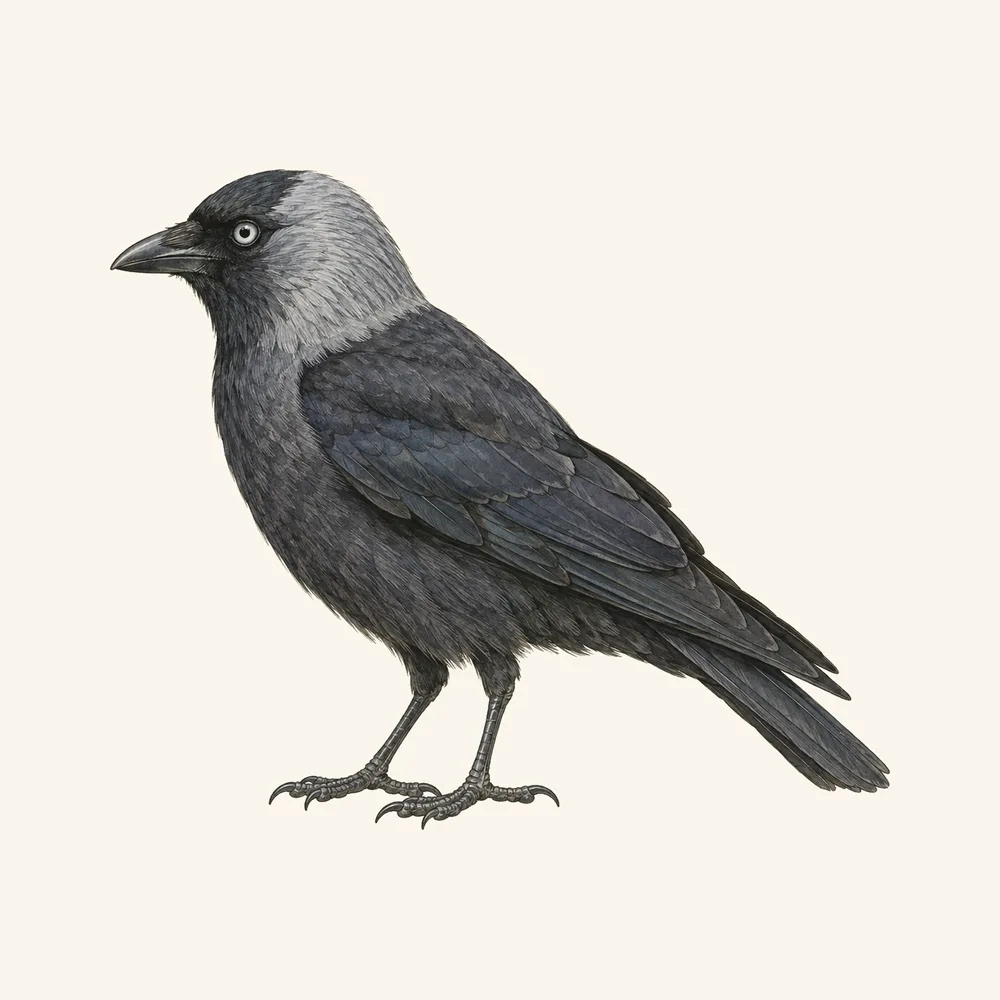
Jackdaw
Coloeus monedula
The small crow with pale silver eyes and a grey hood. Nests in chimneys, calls its own name, and pairs for life.
In many gardens
Widespread in gardens, villages and towns across the UK, usually in pairs or small parties and gathering in large flocks to roost in winter.
Green list
Not currently of conservation concern in the UK.
Birds of Conservation Concern 5 records this species as “Green listed”, with a UK population trend of +139% (1967 to 2024). The increase continues across most of the UK, though the trend in Wales has been more stable than growing. Source.
- Wildlife and Countryside Act 1981, section 1 — It is an offence to intentionally kill, injure or take any wild bird, or to take, damage or destroy the nest of any wild bird while that nest is in use or being built, or to take or destroy its eggs. law
At a glance
-
Size
About 34cm — clearly smaller than a carrion crow or rook, roughly woodpigeon-sized but slimmer.
-
Where you'll see it
On chimneys, roof ridges and lawns, and dropping in on feeders and scraps.
-
What it eats
Omnivorous — insects, worms, seeds, grain, fruit, eggs, scraps and whatever a lawn or bin yields.
-
When
Resident all year, most conspicuous in late winter when pairs start prospecting chimneys.
-
Nests
A cavity nester. National Nestbox Week gives a box with an entrance of at least 150mm, sited at least 5m up.
-
Song
No true song — a sharp, abrupt, high chack-chack, and a longer drawn kyow, given constantly in flight.
Not to be confused with
- Carrion Crow — A carrion crow is entirely black, including the head and eye, and is noticeably bigger and heavier with a thick, powerful bill. A jackdaw is smaller, has a pale silver-grey hood over the nape and cheeks, and a pale silver eye you can see across a garden. Jackdaw or Carrion Crow?
- Rook — A rook is crow-sized with a bare greyish-white patch of skin at the base of a long, pointed, pale bill, and loose shaggy feathering over the thighs. A jackdaw is much smaller, short-billed, and grey-naped. They often feed in the same field, and the size difference is the quickest cue.
- Magpie — A magpie is black and white with a long graduated tail half its total length. A jackdaw is short-tailed and black and grey, with no white on it at all. Jackdaw or Magpie?
- Starling — Starlings flock on roofs and lawns too, but they are far smaller, glossy and spangled with pale spots, short-tailed and pointed-billed, and walk with a rapid waddle. A jackdaw is more than three times the bulk. Jackdaw or Starling?
Through the year
Spring
Pairs nest from April in chimneys, church towers, holes in trees and large boxes, filling the cavity with sticks. A blocked chimney discovered now may hold an active nest.
Summer
Family parties tour lawns together, adults still feeding noisy, begging juveniles. Juveniles are told by their blue-grey eyes rather than the adults' silver-white.
Autumn
Flocks build, often mixed with rooks, working stubble and pasture by day and streaming to communal roosts at dusk.
Winter
Large roosts form, sometimes in the thousands, and the chack-chack of flocks overhead at dusk is one of the most reliable sounds of a British winter afternoon.
Feeding
Takes: suet pellets and fat, peanuts, kitchen scraps and fat from the ground, insects and worms from lawns, windfall fruit.
Jackdaws need nothing put out for them and will find whatever is available. If they are emptying a feeder meant for smaller birds, the answer is a caged or guardian-style hanging feeder rather than excluding food altogether. Follow the RSPB's seasonal rule: pause seed and peanuts from 1 May to 31 October, with only small amounts of suet, fat balls or mealworms in that window. Do not use a bird table or tray feeder — the RSPB no longer recommends flat feeding surfaces because of disease risk, and flat surfaces are also what make a feeding station easiest for corvids to dominate.
Nest box
150mm entrance hole, At least 5m above ground — National Nestbox Week advises as high as possible.. This species nests colonially, so fit boxes in twos and threes — a single box is unlikely to attract a pair. This is a large chimney-style box rather than a conventional garden nest box, and jackdaws nest in loose colonies, so several pairs may use the same building. Fitting one is a genuine alternative for anyone with a chimney being capped.
No perch below the hole — it is a handrail for predators. Hole size is from the BTO: National Nest Box Week.
The chimney problem, and the lawful way round it
Jackdaws are cavity nesters, and a domestic chimney is a perfect cavity. The method is to drop sticks in until enough of them jam to form a platform, which means a nest can involve a remarkable volume of material and can genuinely block a flue. The legal position is unambiguous and catches people out: under the Wildlife and Countryside Act 1981 it is an offence to take, damage or destroy the nest of any wild bird while it is in use or being built. Once jackdaws have started, you must wait. The lawful sequence is to deal with it outside the nesting season — have the flue swept and a purpose-made chimney cowl or cap fitted in autumn or early winter, before prospecting starts again in late winter. Fit the cowl first, then consider putting up a box.
A box instead of your chimney
If you cap a chimney you remove a nest site, and there is a straightforward way to give it back. National Nestbox Week lists the jackdaw among large hole-nesting birds, specifying an entrance of at least 150mm and siting at least 5m above ground, as high as possible. This is a substantial box, closer to a small tawny owl box than a tit box, and it needs a solid fixing on a wall, gable or mature tree. Jackdaws nest in loose colonies, so more than one pair may settle on the same building — which is a feature rather than a fault if you like them. Put it up in autumn or winter, well before pairs begin prospecting in February, and expect stock doves or tawny owls to be interested in it too.
Silver eyes and lifelong pairs
Get a decent look at a jackdaw's face and the pale silver-white iris is startling, and it is the quickest identification cue in the garden — no other British corvid has it. Juveniles have blue-grey eyes that lighten through their first year, which is a reliable way to separate this year's birds from their parents in a late-summer family party. Jackdaws pair for life and the pair stays together within the flock, feeding side by side, flying in step, preening one another. Research on their eyes has suggested the pale iris itself may function as a signal to other jackdaws about whether a nest cavity is occupied. Watch a flock on a lawn for five minutes and the structure becomes visible: it is not a crowd, it is a set of couples.
What they do to a garden, honestly
Jackdaws take eggs and small nestlings, and people who have watched one raid a blackbird's nest tend not to forget it. Two things are worth saying plainly. First, it is legal to do nothing else — all wild birds, corvids included, are protected under section 1 of the Wildlife and Countryside Act 1981, and killing or taking one is an offence. Second, the evidence does not support the intuition that corvid predation drives songbird declines; the losses in species like song thrush and greenfinch trace to habitat, farming change and disease. The practical response is to make nests harder to find rather than to resent the jackdaw: dense thorny hedging, thick climbers and well-concealed nest boxes do far more good than anything aimed at the predator.
Plant this for it
How we checked this
- BTO BirdFacts: Jackdaw
- National Nestbox Week: Large hole nesting birds
- Wildlife and Countryside Act 1981, section 1
- RSPB: What Does the Wildlife and Countryside Act 1981 do?
- RSPB: How to help garden birds — feed seasonally and safely
Checked against the sources above. Reviewed on 2026-09-20. Legal position checked 2026-09-20.