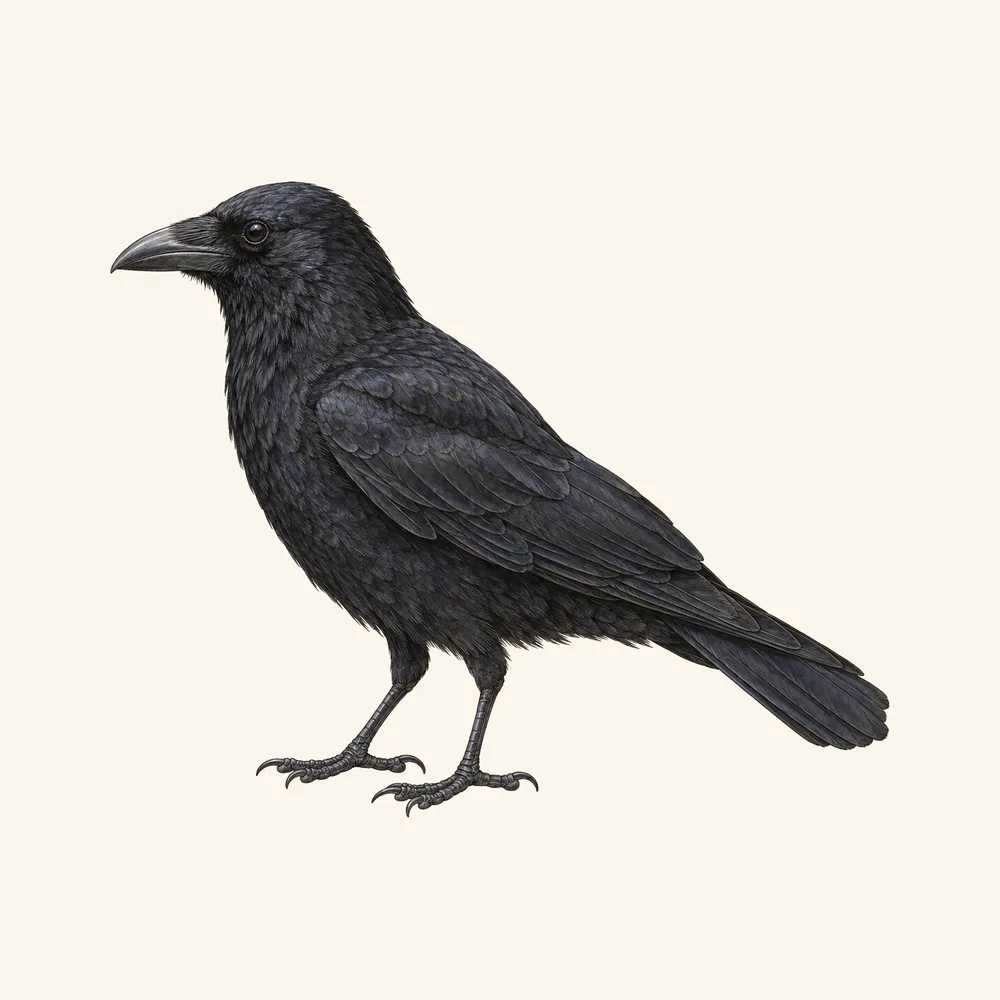
Carrion Crow
Corvus corone
All-black, heavy-billed and usually alone or in twos. The crow that is not a rook: face feathered, bill thick, flight steady.
In many gardens
Found in almost every UK garden and open space south and east of the Great Glen, typically as a resident pair rather than a flock.
Green list
Not currently of conservation concern in the UK.
Birds of Conservation Concern 5 records this species as “Green listed”, with a UK population trend of +15% (1995 to 2024). Numbers rose from the early 1970s to the early 2000s and have been fairly stable since, with England showing a shallow ongoing increase while Scotland has been stable or slightly declining since 2000. Source.
- Wildlife and Countryside Act 1981, section 1 — It is an offence to intentionally kill, injure or take any wild bird, or to take, damage or destroy the nest of any wild bird while that nest is in use or being built, or to take or destroy its eggs. law
At a glance
-
Size
About 47cm — bigger than a woodpigeon, and clearly larger and heavier than a jackdaw.
-
Where you'll see it
On lawns, playing fields, roof ridges and tall trees; commonly a single bird or a pair.
-
What it eats
Anything — carrion, worms, insects, grain, fruit, eggs, nestlings, scraps and roadkill.
-
When
Resident all year, holding the same territory for years at a time.
-
Nests
A bulky stick nest high in a tree fork, built alone rather than in a colony. It will not use a nest box.
-
Song
No song — a hard, flat, grating caw, usually delivered three or four times in a row.
Not to be confused with
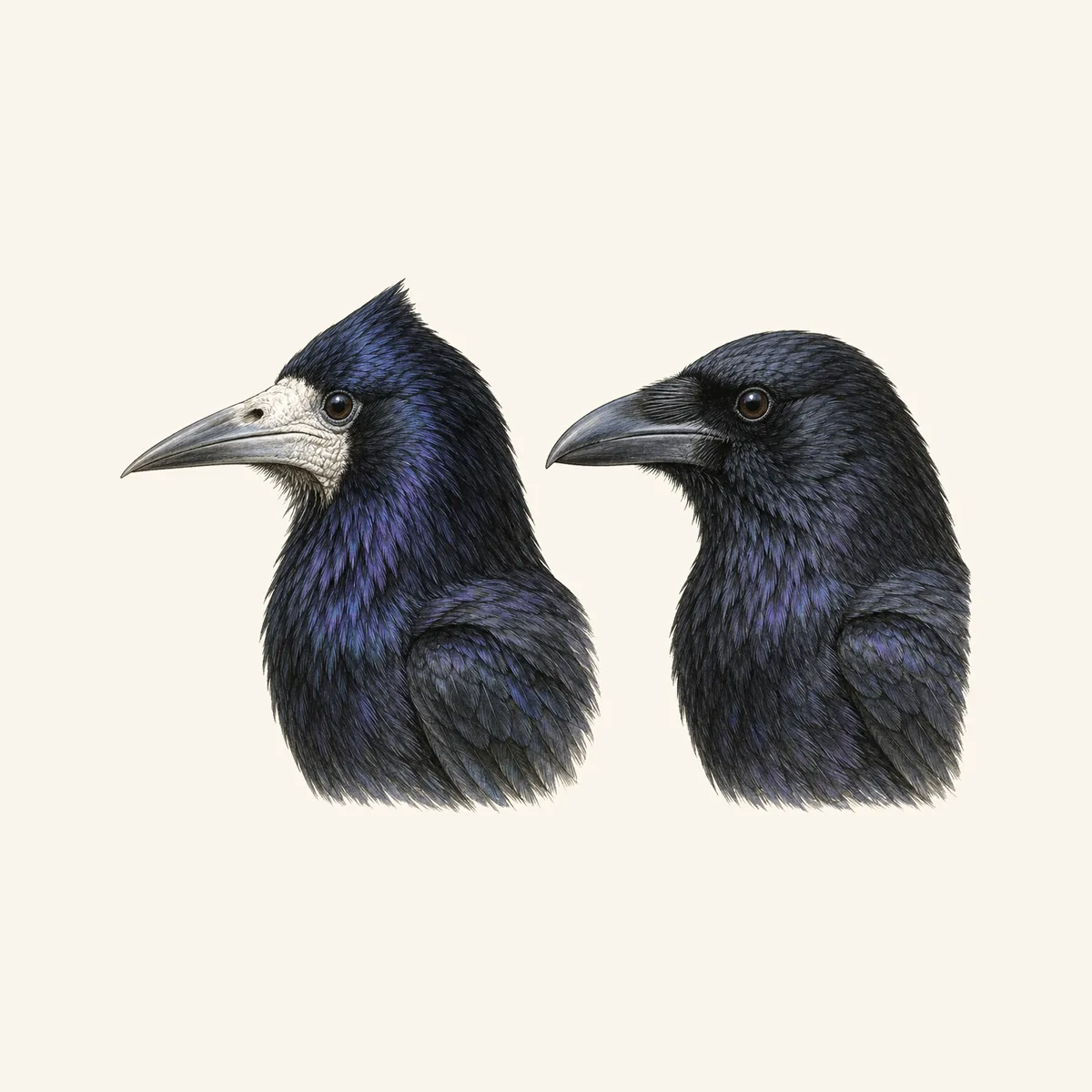
- Rook — The face is the clincher. An adult rook has a bare, greyish-white patch of skin around the base of a long, straight, pointed bill; a carrion crow's bill base is covered in black bristly feathers and the bill is shorter, thicker and more curved. A rook also has loose, shaggy feathering over the thighs like baggy trousers, and a peaked crown. Numbers give it away too: rooks are colonial and almost always in groups, while a carrion crow is typically alone or in a pair. The old country rule holds — a rook on its own is a crow, and a crowd of crows are rooks.
- Jackdaw — A jackdaw is much smaller, has a pale silver-grey nape and cheeks, a pale silver-white eye and a short neat bill. A carrion crow is all black including the eye, with a heavy bill. Carrion Crow or Jackdaw?
- Raven — A raven is far bigger, with a massive bill, shaggy throat feathers and a wedge-shaped tail that is obvious in flight; a carrion crow's tail is square-ended. A raven's call is a deep resonant cronk rather than a flat caw.
- Hooded Crow — A hooded crow has a pale ash-grey back and belly contrasting with a black head, wings and tail. It replaces the carrion crow in north-west Scotland, Ireland and the Isle of Man, where the two overlap and hybridise.
Through the year
Spring
Pairs rebuild a bulky stick nest high in a tree from March. This is also when crows are most persistent at other birds' nests, so dense cover matters for your songbirds.
Summer
One brood. Fledged young beg loudly and follow their parents around lawns well into the summer, sounding hoarse and unfinished compared with the adults.
Autumn
Caching season. Crows hide surplus food and remember where; a crow repeatedly poking the same patch of lawn is often retrieving rather than hunting.
Winter
Pairs hold territory all year rather than dispersing, so the crow on your lawn in January is almost certainly the same bird as in June.
Feeding
Takes: kitchen scraps and fat, peanuts, suet, windfall fruit, worms and leatherjackets from lawns.
Nothing needs putting out for a carrion crow, and there is no benefit in doing so. If a pair is monopolising food meant for smaller birds, use a caged or guardian-style hanging feeder rather than stopping feeding. Follow the RSPB's seasonal rule: pause seed and peanuts from 1 May to 31 October, with only small amounts of suet, fat balls or mealworms in that window. Do not use a bird table or tray feeder — the RSPB no longer recommends flat feeding surfaces because of disease risk, and open flat surfaces are the easiest of all for a crow to clear in one visit.
Crow or rook: the one look that settles it
This is the commonest corvid confusion in Britain and it takes about two seconds to resolve once you know where to look. Go to the base of the bill. An adult rook has a bare patch of greyish-white skin there, and its bill is long, straight and pointed. A carrion crow's bill base is covered in stiff black bristly feathers, and the bill itself is shorter, thicker and more obviously curved. Two more cues confirm it: a rook has loose shaggy feathering over the thighs that looks like baggy trousers, where a crow's legs are trim, and a rook's crown is peaked while a crow's is flatter. Behaviour is the shortcut: rooks are colonial and nearly always in groups, carrion crows are nearly always alone or in a pair. One caution — juvenile rooks have feathered bill bases and genuinely do look like crows.
Genuinely clever, and testable in your garden
Carrion crows are among the most cognitively capable birds in the world, and you can watch the evidence from a kitchen window. They cache surplus food and return to it later, which is why you will see one probing the same square metre of lawn repeatedly with no apparent reward. They drop hard-shelled items onto paving or roads to break them open, and choose harder surfaces when the first attempt fails. They watch other birds cache and remember where. Crows also recognise individual human faces and hold the association for years, which is why a crow that has been chased off a particular garden behaves differently there than next door. None of this needs encouraging or discouraging. It is simply one of the most interesting things happening in an ordinary garden, and it is free to watch.
The predation question, answered honestly
Crows take eggs and nestlings. If you watch garden birds you will eventually see it happen, and it is unpleasant. But the two things people most often conclude from it are both wrong. First, it is not lawful to act against the bird: every wild bird in the UK, corvids included, is protected under section 1 of the Wildlife and Countryside Act 1981, making it an offence to intentionally kill, injure or take one. Second, the evidence does not support the idea that corvid predation is driving songbird declines. The species in trouble in this library — song thrush, greenfinch, dunnock — are in trouble because of habitat loss, agricultural change and disease. The response that actually works is structural: thorny hedging, thick climbers and well-hidden nest boxes make nests harder for a crow to find.
A stable population, and what that means
BTO records a 15% increase between 1995 and 2024, with numbers having risen from the early 1970s to the early 2000s and been fairly stable since — a shallow ongoing increase in England set against stability or slight decline in Scotland. It is Green listed. That stability is worth stating clearly because carrion crows attract a lot of unevidenced blame, and a bird that is neither booming nor collapsing is a poor candidate for either panic or persecution. In garden terms a carrion crow is a fixture: pairs hold the same territory year-round and for years on end, so you are watching individuals rather than a passing population. Learn your local pair's habits and you will find them far more interesting than the generic idea of a crow suggests.
Plant this for it
How we checked this
- BTO BirdFacts: Carrion Crow
- Wildlife and Countryside Act 1981, section 1
- RSPB: What Does the Wildlife and Countryside Act 1981 do?
- RSPB: How to help garden birds — feed seasonally and safely
- RSPB: Keep your garden birds healthy
Checked against the sources above. Reviewed on 2026-09-20. Legal position checked 2026-09-20.