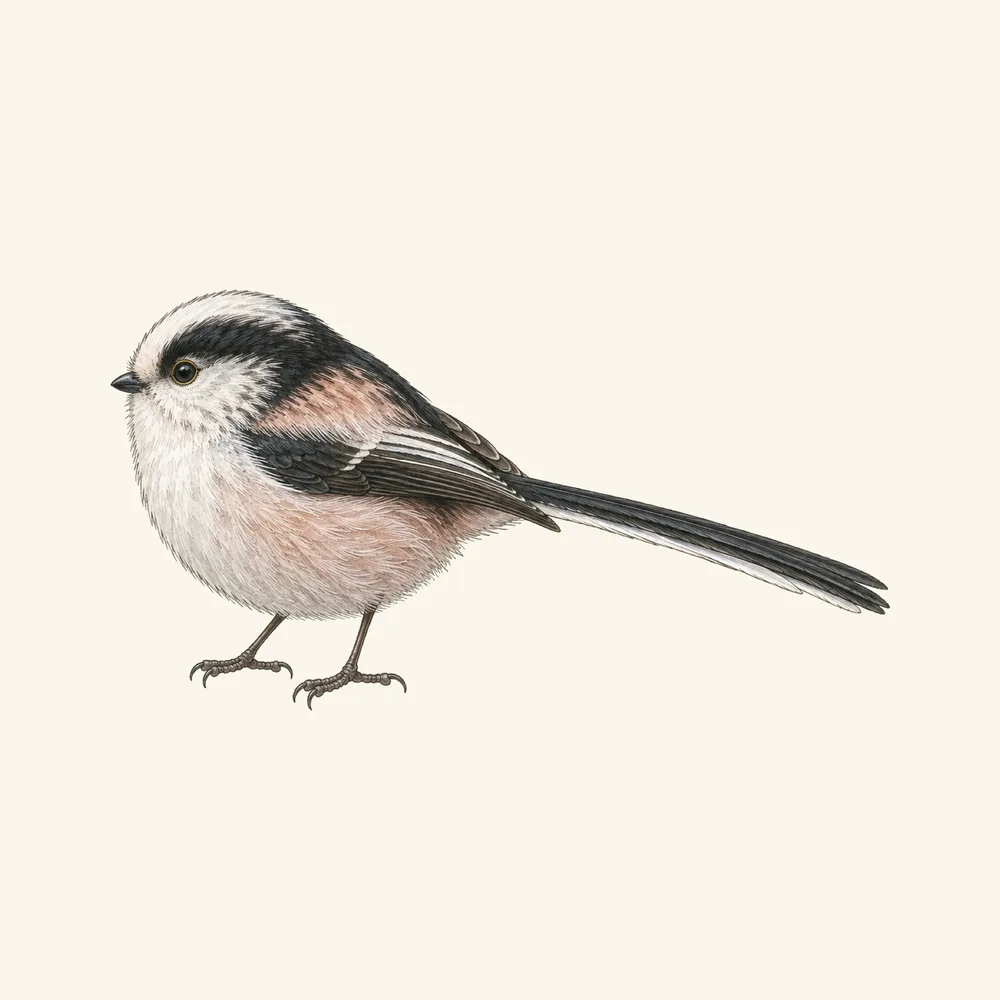
Long-tailed Tit
Aegithalos caudatus
A pink-and-black ball of feathers with a tail longer than its body, arriving in excitable flocks and gone again in a minute.
In many gardens
Resident across most of Britain and among the ten most recorded species in the RSPB Big Garden Birdwatch 2026 — though it arrives as a flock, briefly, rather than sitting about like a robin.
Green list
Not currently of conservation concern in the UK.
Birds of Conservation Concern 5 records this species as “Green listed”, with a UK population trend of +16% (1995 to 2024). Abundance has risen progressively since the early 1980s. Source.
- Wildlife and Countryside Act 1981, section 1 — It is an offence to intentionally kill, injure or take any wild bird, or to take, damage or destroy the nest of any wild bird while that nest is in use or being built, or to take or destroy its eggs. law
At a glance
-
Size
One of Britain's smallest birds — about 14cm total, but over half of that is tail, and the body weighs under 10g.
-
Where you'll see it
Suet and sunflower feeders, hedges and the outer twigs of trees; almost never on the ground.
-
What it eats
Insects, spiders and moth and butterfly eggs; increasingly suet and sunflower hearts in winter.
-
When
All year, but flock visits to gardens peak from October to March.
-
Nests
No nest box, ever. Builds a domed elastic purse of moss, lichen, spider silk and feathers in thorny scrub.
-
Song
No real song — a rolling, conversational 'srih-srih-srih' and a dry 'tsirrup' that announces the flock before you see it.
Not to be confused with
- Nothing, really — it looks like a flying teaspoon — This is the rare bird with no real confusion species. At a glance most people do not register a bird at all: a lollipop, a bumblebee with a stick, a feathered teaspoon crossing a gap. The tail being longer than the body settles it instantly, and no other small British bird is built that way. If you have seen one, you have identified it.
- Blue Tit flock at distance — The honest confusion is not the bird but the flock — a party working along a hedge sounds and moves like tits, and long-tailed tits do travel with them. Look at the silhouette rather than the colour: a blue tit is a compact blob with a stub of tail, a long-tailed tit trails a tail as long as the rest of it, and it is white-headed with a black eye stripe rather than blue-capped. Long-tailed Tit or Blue Tit flock at distance?
- Pied Wagtail — Also small, black and white and long-tailed, but a wagtail is a ground bird with long legs that runs across lawns and car parks and pumps its tail. Long-tailed tits are canopy and hedge birds that hang from twigs and scarcely ever touch the ground. Long-tailed Tit or Pied Wagtail?
Through the year
Spring
Nest-building from late February, taking up to three weeks. Failed breeders often stay on to help feed a relative's brood — one of the clearest cases of cooperative breeding in a British bird.
Summer
Family parties form the core of the autumn flock. Juveniles are duller, with browner faces and shorter tails.
Autumn
Flocks reassemble and start roaming. This is when they begin turning up in gardens, working along hedges and fences in single file.
Winter
Highly vulnerable to hard frost, and flocks roost pressed together in a line along a sheltered branch. A severe winter can cut numbers sharply; mild ones let them bounce back fast.
Feeding
Takes: suet pellets, fat blocks and fat balls, sunflower hearts, insects, spiders and moth eggs gleaned from twigs and bark.
Garden feeding is a recent habit for this species and fat-based food is what brings them in. Because a flock arrives all at once, a single small feeder is quickly mobbed; two or three fat blocks spaced apart let more of the party feed. Use fat blocks in a cage rather than nylon-netted fat balls, which can trap feet and tongues.
The most extraordinary nest in Britain
Long-tailed tits build a domed, oval purse of moss bound together with spider silk, camouflaged on the outside with flakes of lichen, and lined inside with feathers — often well over a thousand of them. The spider silk is the clever part: it is elastic, so as the chicks grow the nest stretches to hold them rather than splitting. A pair spends up to three weeks building it, usually low down in a thorny tangle of gorse, bramble or blackthorn, or higher in a fork against a tree trunk. This is why they will never use a nest box, and why nobody should sell you one for them. It also explains what they actually need from a garden: not a box, but lichen-crusted old bark, a spider population you have not sprayed out of existence, and a scruffy thorny corner nobody tidies.
Why they arrive all at once
Long-tailed tits do not really visit gardens as individuals; they arrive as a flock of roughly eight to twenty, work through in two or three minutes, and leave together. The flock is usually an extended family — parents, young and unpaired relatives — that stays together from late summer through winter, and the constant thin 'srih-srih' calling is how they keep contact in dense cover. Two practical things follow. First, you will hear them before you see them, so learn the call and you will notice them far more often. Second, a single small feeder is instantly mobbed and most of the party gets nothing. Two or three fat blocks spaced well apart, ideally in different parts of the garden, let a whole flock feed at once and cut down the crowding that helps disease pass between birds.
Cold is the thing that hurts them
A long-tailed tit weighs less than a two-pence piece, and that tiny body loses heat fast. Hard winters are the one thing that genuinely knocks this species back — numbers can fall steeply after a severe frost spell and then recover within a few seasons of mild weather. Their answer is to roost communally, the whole flock pressed into a tight row along a sheltered branch, shuffling for the warm middle positions. What a garden can offer is shelter: dense evergreen cover, an ivy-clad wall, a thick hedge, a conifer left unclipped. That matters more in January than food does. Do not attempt to intervene with individual birds in cold weather — the useful contribution is structural, made in advance, and it is cover plus reliable fat-based food, left out consistently rather than sporadically.
Does it need your help?
Mostly, no — and it is worth saying so plainly. The long-tailed tit is green listed, and BTO figures show a 16% increase in the UK breeding population between 1995 and 2024, with abundance rising progressively since the early 1980s. This is a species doing well, probably helped by a run of milder winters and by the spread of garden fat feeding. So the honest advice is not a rescue plan. It is restraint: leave a thorny corner uncut, do not clear the lichen off old branches, keep spiders alive by not spraying, and let a hedge grow thick rather than clipping it to a box. Add a fat block in winter if you want the pleasure of watching a flock come through. That is genuinely the whole of it, and pretending otherwise would be selling you something.
Plant this for it
- rose A dense, thorny shrub rose left unpruned is exactly the kind of tangle long-tailed tits build their domed nest inside, safe from larger birds.
- apple Old apple bark carries the lichen they use to camouflage the outside of the nest, and the tree's twigs hold the spiders, moth eggs and small insects they feed on.
Guides
How we checked this
- BTO BirdFacts: Long-tailed Tit
- Woodland Trust: Long-tailed tit
- RSPB: Long-tailed Tit
- Wildlife and Countryside Act 1981, section 1
Checked against the sources above. Reviewed on 2026-09-20. Legal position checked 2026-09-20.