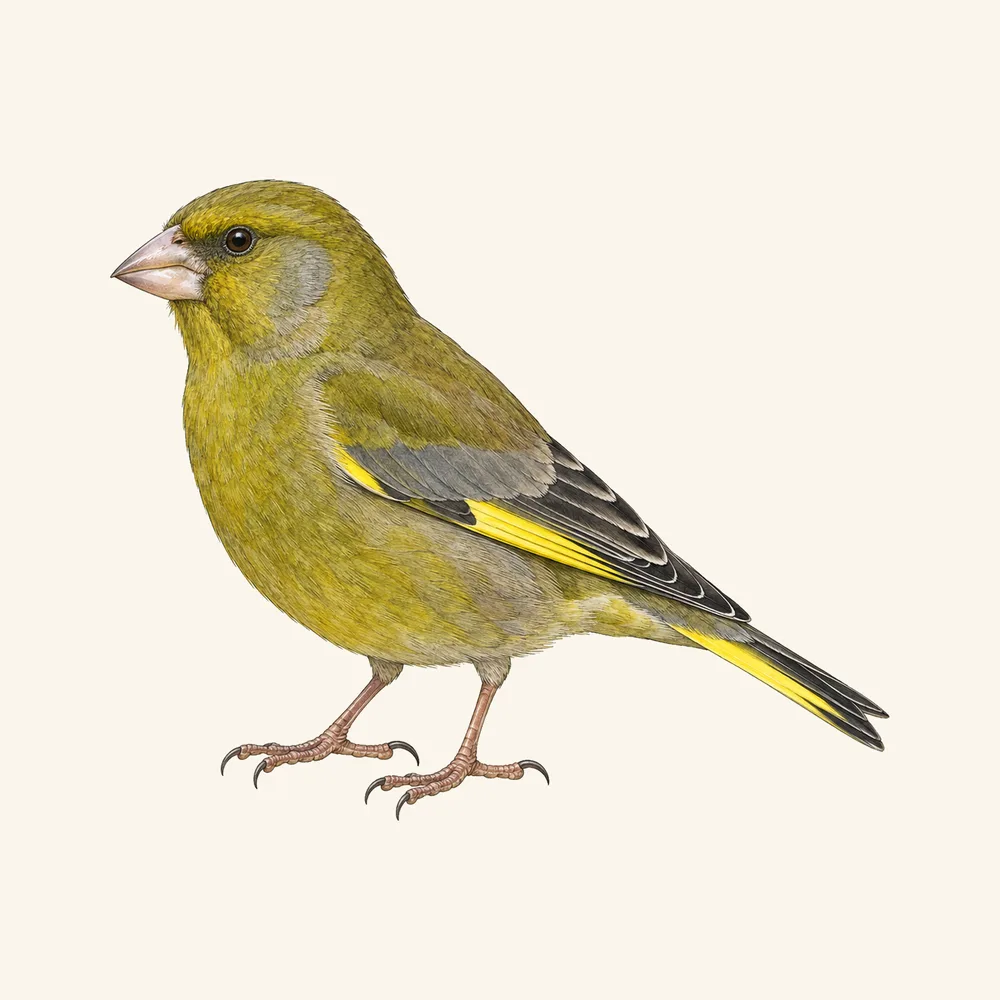
Greenfinch
Chloris chloris
Red listed since 2021 after a disease outbreak halved it. A heavy olive-green finch with yellow wing flashes and a thick pale bill.
In many gardens
Still widespread and still a garden bird, but far scarcer than a decade ago: many gardens that had greenfinches daily in the 2000s now see none for months.
Red list
Of highest conservation concern in the UK.
Birds of Conservation Concern 5 records this species as “Red listed”, with a UK population trend of −66% (1967 to 2024). The Greenfinch was moved to the UK Red List in 2021, one of six species red-listed that year due to worsening declines in breeding populations; BTO attributes the sudden sharp fall that began in 2005 to a widespread and severe outbreak of trichomonosis, a disease which affects the upper digestive tract, and integrated population modelling shows that changes in survival have been the strongest contributor to annual population change. Source.
- Wildlife and Countryside Act 1981, section 1 — It is an offence to intentionally kill, injure or take any wild bird, or to take, damage or destroy the nest of any wild bird while that nest is in use or being built, or to take or destroy its eggs. law
At a glance
-
Size
About 15cm — robin-length but noticeably chunkier and heavier-headed, with a big pale bill.
-
Where you'll see it
On hanging seed feeders, in treetops, and on the ground beneath; a bold, dominant feeder bird.
-
What it eats
Large seeds it can crack — sunflower, rose hips, hawthorn, and in gardens sunflower hearts above all.
-
When
Resident all year, most obvious from late winter into spring when males start singing.
-
Nests
A bulky twig cup in a dense shrub or conifer, often in loose groups. It will not use a nest box.
-
Song
Fast metallic twittering broken by a long, harsh, rising wheeze — the sound most people know it by.
Not to be confused with
- Siskin — Both are green and yellow, but a siskin is much smaller and finer, has a thin sharp bill rather than a thick pale one, and is heavily streaked on the flanks. A male siskin also has a black cap and black chin, which a greenfinch never has.
- Female House Sparrow — A female greenfinch is dull enough to pass for a sparrow at a glance, but she still carries a bright yellow stripe along the edge of the closed wing and yellow in the tail. No sparrow has any yellow at all. Greenfinch or Female House Sparrow?
- Female Chaffinch — A female chaffinch shows two clean white wing bars across the wing; a female greenfinch shows a single yellow stripe along the wing edge. The greenfinch is also bulkier with a far heavier bill. Greenfinch or Female Chaffinch?
- Yellowhammer — A yellowhammer is yellower and much longer-tailed, with a chestnut rump and a slim bill. It is a bird of hedgerows and stubble and only rarely comes to garden feeders, where greenfinches are routine.
Through the year
Spring
Males sing and perform a slow circling song flight from March, and pairs nest in dense evergreens, often several close together. Clean feeders weekly as birds start congregating.
Summer
Two or three broods, fed largely on seed rather than insects — unusual among garden birds. Seed feeders should be down from 1 May under RSPB seasonal guidance.
Autumn
Flocks move onto hips, haws and hedgerow seed. Leave rose hips uncut: they are a natural food that carries none of the disease risk a feeder does.
Winter
Feeder use peaks, and so does disease transmission. Weekly cleaning, small quantities and a watchful eye for a fluffed-up bird that will not fly matter more now than at any other time.
Feeding
Takes: sunflower hearts, black sunflower seeds, peanuts from a mesh feeder, nyjer seed.
Greenfinches are heavy-billed seed specialists and take sunflower hearts more readily than anything else, which is exactly why hygiene matters so much for this species: they feed in numbers at the same few ports for long periods. The RSPB advises a thorough clean of feeders and baths every week, and Garden Wildlife Health advises filling feeders with only enough food to last 24 to 48 hours. Follow the seasonal rule — pause seed and peanuts from 1 May to 31 October, with only small amounts of suet, fat balls or mealworms in that window. Never use a bird table, window feeder or tray feeder: the RSPB states it no longer recommends bird tables and offering food on other flat surfaces due to the high risk of disease transmission.
Why this bird is on the Red List
The Greenfinch was moved to the UK Red List in 2021, one of six species red-listed that year because of worsening declines in breeding populations. BTO's figure is a 66% fall between 1967 and 2024. What makes it unusual is that this was not a slow squeeze from farming change or lost habitat. It was sudden. BTO records that the sharp fall beginning in 2005 was induced by a widespread and severe outbreak of trichomonosis, a disease which affects the upper digestive tract, and integrated population modelling shows that changes in survival have been the strongest contributor to annual population change. In other words, adult birds stopped surviving. A common, confident, thoroughly ordinary garden finch went from being everywhere to being a species of the highest conservation concern inside about fifteen years, and it happened largely at garden feeders.
Trichomonosis, honestly
Trichomonosis is caused by a parasite that lives in the upper digestive tract. Garden Wildlife Health lists greenfinch and chaffinch as the species most frequently affected, alongside pigeons and doves. The signs it describes are lethargy and fluffed-up plumage; affected birds may drool saliva, regurgitate food, have difficulty in swallowing or show laboured breathing. A bird that sits puffed up at a feeder, reluctant to fly, with a wet or messy bill, is the picture people report. It spreads bird to bird through saliva, through contaminated food and through shared water. There is nothing a gardener can or should do for an individual sick bird: do not attempt to catch it, handle it, or give it anything. If a bird is visibly suffering, ring the RSPCA or a local wildlife rescue, and nothing more than that.
What you should actually do
Two things, and they are both about the feeding station rather than the bird. First, report it. Garden Wildlife Health is a joint project of ZSL, the BTO, Froglife and the RSPB, and it exists to track exactly this; you can report sick or dead garden wildlife through its website, or ring its vets on 0207 449 6685. Those reports are the data the Red List decision rested on. Second, manage the feeder. Garden Wildlife Health advises that where disease is suspected you temporarily stop feeding for a minimum of two to four weeks to encourage birds to disperse, and the RSPB advises stopping for at least three weeks and emptying bird baths, resuming only when no diseased birds are visible. Clean and disinfect feeders regularly, and fill them with only enough food for 24 to 48 hours.
The case for feeding fewer birds, better
Greenfinch is the reason the whole of garden bird feeding has been rethought. A feeding station concentrates birds at a handful of contact points for hours a day, which is a gift to a parasite spread by saliva. That is why the RSPB, after a scientific review, no longer recommends bird tables or offering food on other flat surfaces, where contaminated food collects. It is also why seed and peanuts are paused from 1 May to 31 October, with only small amounts of suet, fat balls or mealworms offered in that window. None of this means stop feeding. It means feed small amounts, from hanging feeders you can dismantle, cleaned thoroughly every week, moved around the garden, with the spill beneath them swept up. For a Red-listed bird, the cleanliness of your feeder is not a detail.
Plant this for it
- rose Greenfinches have the heavy bill needed to split rose hips and extract the seeds inside — leave hips on the plant through autumn and winter rather than deadheading.
- lavender Lavender left to run to seed provides natural seed away from the feeder, which is where disease transmission is concentrated.
Guides
How we checked this
- BTO BirdFacts: Greenfinch
- Garden Wildlife Health: Trichomonosis in Garden Birds
- Garden Wildlife Health
- RSPB: Keep your garden birds healthy
- RSPB: How to help garden birds — feed seasonally and safely
- RSPB: Greenfinch
- Wildlife and Countryside Act 1981, section 1
Checked against the sources above. Reviewed on 2026-09-20. Legal position checked 2026-09-20.