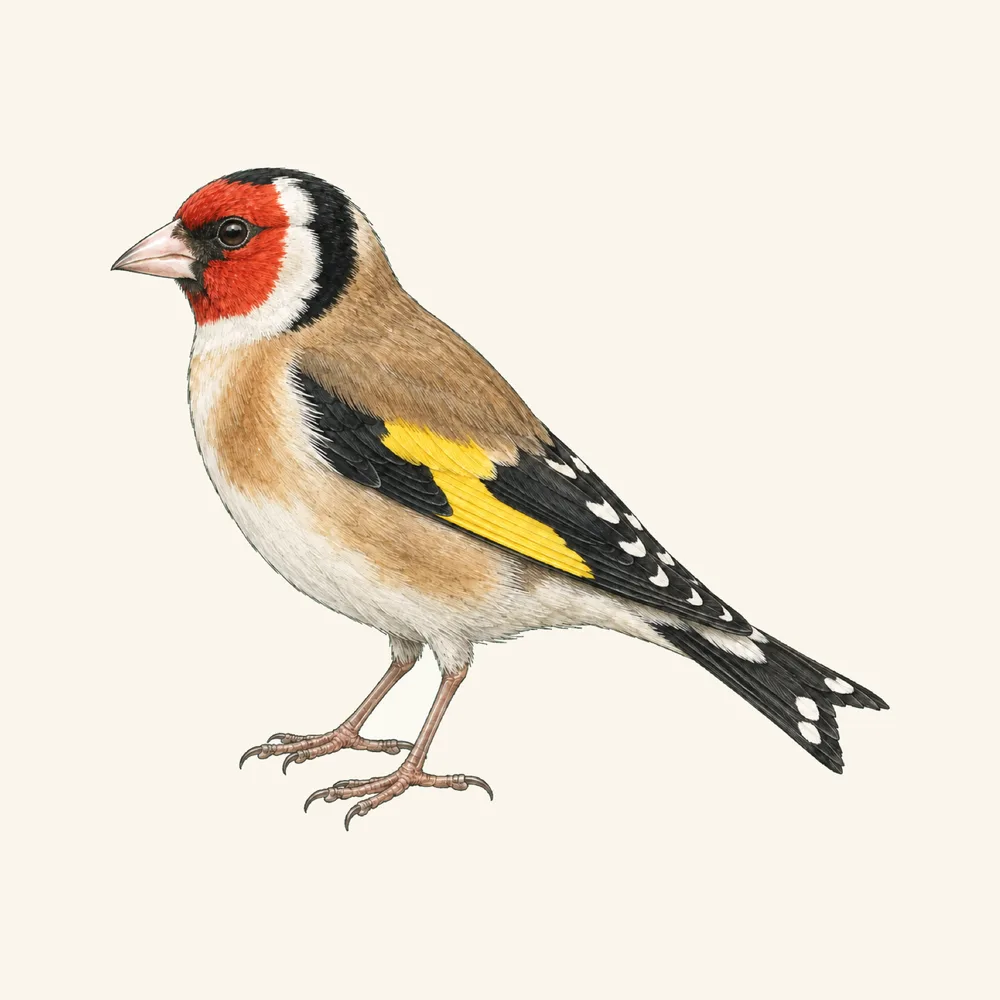
Goldfinch
Carduelis carduelis
Red face, gold wing bar, tinkling call. A specialist seed-eater that has moved into gardens in enormous numbers over thirty years.
In most gardens
Now a year-round garden regular and among the ten most recorded species in the RSPB Big Garden Birdwatch 2026 — a striking change from the 1980s, when it was an occasional visitor.
Green list
Not currently of conservation concern in the UK.
Birds of Conservation Concern 5 records this species as “Green listed”, with a UK population trend of +148% (1995 to 2024). Source.
- Wildlife and Countryside Act 1981, section 1 — It is an offence to intentionally kill, injure or take any wild bird, or to take, damage or destroy the nest of any wild bird while that nest is in use or being built, or to take or destroy its eggs. law
- Wildlife and Countryside Act 1981, section 6 — Restricts sale and possession for sale of live wild birds. Goldfinches were historically trapped in large numbers for the cage-bird trade, which this prohibition ended. law
At a glance
-
Size
Smaller and slimmer than a robin — about 12cm, with a long fine bill.
-
Where you'll see it
Sunflower heart and nyjer feeders, seedheads left standing, and the tops of tall trees.
-
What it eats
Small oil-rich seeds — thistle, teasel, knapweed, lavender, plus sunflower hearts and nyjer at feeders.
-
When
All year, though some UK goldfinches migrate south in autumn and flock sizes shift.
-
Nests
No nest box. Builds a neat cup high in the outer twigs of a tree, often late — May to August.
-
Song
A fast liquid twittering; the flight call is a bright, tinkling 'tickelit' that flocks keep up constantly.
Not to be confused with
- Juvenile Goldfinch — From June to September your feeder will hold small streaky grey-buff finches with completely blank, plain heads — no red, no black, no white. These are young goldfinches, and they are frequently reported as something else entirely. The clincher is the wing: it is identical to the adult's, black with a broad gold-yellow bar. If the head is blank but the wing bar is gold, it is a young goldfinch.
- Siskin — Similar size, similar yellow in the wing, and often on the same nyjer feeder in winter. But a siskin is green-and-yellow and heavily streaked, with a black crown on the male and no red face at all. Goldfinch is warm buff-brown on the back, unstreaked below, with that unmistakable crimson mask.
- Greenfinch — Much bulkier, with a thick pale bill and an olive-green body. Its yellow is a flash along the wing edge and in the tail sides rather than a solid band across a black wing, and it has no facial markings whatsoever. Goldfinch or Greenfinch?
Through the year
Spring
Flocks break up from March. Pairs form and birds spend more time high in trees; nesting often does not start until May.
Summer
Late nester, timed to the seed crop. Two broods are usual, and streaky juveniles with blank heads appear at feeders from June onwards.
Autumn
Flocks reassemble on seedheads — this is the season to leave things standing. Some UK birds, mainly females, migrate to France and Spain.
Winter
Feeder-dependent in hard weather; flocks of twenty or more on sunflower hearts are now common where they were unheard of a generation ago.
Feeding
Takes: sunflower hearts, nyjer seed, standing seedheads of thistle, teasel, knapweed and lavender.
Goldfinches want small, oil-rich seeds and a fine bill is built to get them. Nyjer needs a dedicated feeder with very small ports, but sunflower hearts on an ordinary feeder now bring in far more goldfinches than nyjer does, and go off less readily. Nyjer that has sat damp for weeks will be ignored — buy it in small quantities.
A bird that changed its habits, not its luck
Goldfinch numbers in the UK have risen by 148% since 1995, which makes it one of very few garden birds whose story is genuinely good news. The reason is not conservation work in the countryside — it is garden feeding. Goldfinches were traditionally birds of rough ground, thistle patches and field margins, and they largely ignored gardens. From the late 1980s onwards, nyjer seed and then sunflower hearts appeared in British gardens in quantity, and goldfinches discovered a reliable winter food supply that had never existed before. Winter survival improved, and the population climbed. It is worth being honest about what that means: this is a species whose garden abundance depends on people continuing to feed. It is not a bird that needs rescuing, but it is one whose numbers are, to a real degree, propped up by what is in your feeder.
Do not deadhead everything
The single most useful thing you can do for goldfinches costs nothing and saves you work: leave seedheads standing through autumn and winter instead of cutting them down in September. Lavender is the clearest garden example — the spent flower spikes that most gardeners shear off in late summer are full of small oily seeds, and goldfinches will work along them for weeks. Teasel is the classic, with a bill long enough to reach into the head being essentially a goldfinch speciality, but knapweed, verbena, cardoon, scabious and even a late-bolted lettuce all do the job. The tidy-garden instinct is the problem here. A border cut hard back in September looks neat and offers nothing; the same border left until a hard prune in late February feeds finches all winter and takes one job instead of two.
Feeders: what actually works
Nyjer seed built the goldfinch's garden reputation, but it is no longer the best choice. It needs a special feeder with tiny ports, it absorbs moisture and goes stale quickly, and birds will abandon a feeder full of old nyjer without touching it. Sunflower hearts on a standard tube feeder now attract more goldfinches in most gardens, cost less per bird fed, and suit everything else too. Buy either in quantities you will get through in a few weeks. Because goldfinches feed in tight flocks, crowding at a single feeder is a real issue: several smaller feeders spaced well apart, out of sight of each other, spread the birds out. Clean them regularly in hot soapy water, rinse and dry fully before refilling, and shift their position every few weeks so droppings do not accumulate on one patch of ground below.
Plant this for it
Guides
How we checked this
Checked against the sources above. Reviewed on 2026-09-20. Legal position checked 2026-09-20.