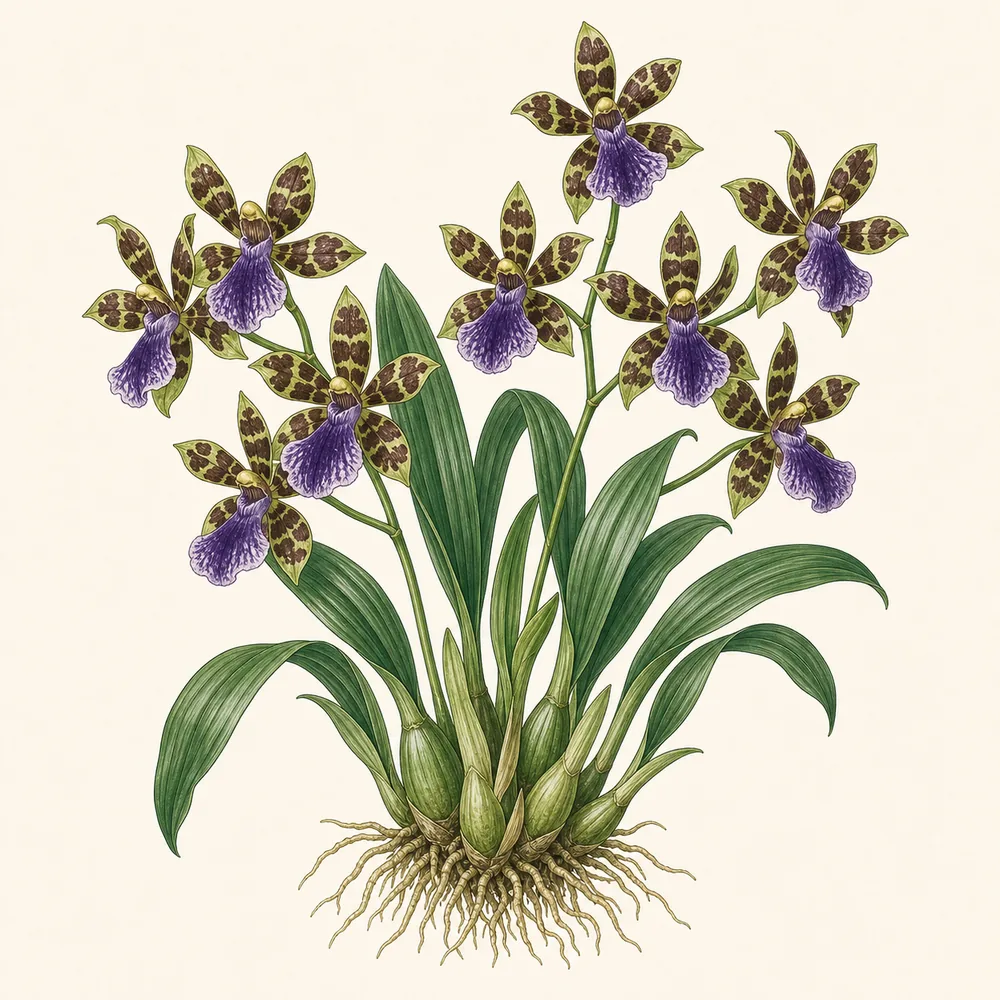
Zygopetalum Orchid
The orchid you smell before you see it — waxy green-and-burgundy blooms with a splashed violet lip and a rich, hyacinth-like scent that fills a room. It's a rewarding grower, but it has one firm rule that trips people up: it hates water sitting on its foliage. Get the watering technique right and the perfume is worth the care.
Not listed by ASPCA
The ASPCA doesn't list the zygopetalum orchid specifically, so we don't stamp it safe. No toxic principle is recorded for it and close relatives are listed non-toxic, but with no database entry for this species we flag the gap honestly rather than assume.
Care at a glance
Everything that matters, in six lines. The detail is further down.
Light
Wants good bright light but no harsh direct sun — an east window, or set back from a brighter one. Too little light and it won't flower.
Water
Water the mix, never the leaves. Keep evenly moist in growth and let it dry a little between soaks; water pooling on foliage causes disfiguring spots and rot.
Temperature
Cooler than the tropical orchids — happy in ordinary rooms with a natural night dip. Avoid extreme heat and cold draughts.
Humidity
Likes humidity but needs air moving to keep the foliage dry. Use a pebble tray rather than misting, which leaves the leaves wet.
Feeding
A dilute orchid feed every few waterings while it's actively growing new pseudobulbs; ease right back once growth finishes.
Soil
A free-draining medium bark mix that holds a little moisture — never ordinary compost, and never left waterlogged.
What to do, and when
New growths and roots appear. Start regular weak feeding, repot if the mix is tired, and keep watering steady at the roots as growth speeds up.
Active growth. Keep it bright but shaded from harsh sun, feed weakly, and make sure air keeps moving so the foliage stays dry.
New pseudobulbs mature and flower spikes often form. Enjoy the scent, ease off feeding, and keep water off the developing buds and leaves.
Slower growth. Water more sparingly but don't let it dry out hard, keep it in good light, and avoid cold, damp, stagnant air.
Keep the leaves dry
The one thing that catches zygopetalum growers out is water on the foliage. Droplets left sitting on the leaves cause ugly black spotting and can lead to rot, so this is an orchid you water carefully at the roots and never mist or splash from above.
Aim the water into the mix, in the morning, so any stray drops dry quickly. If you raise humidity — and it likes humidity — do it with a pebble tray or a nearby humidifier rather than spraying the plant.
Worth it for the scent
Not every orchid is fragrant, but a zygopetalum in bloom perfumes a whole room with a rich, spicy, hyacinth-like scent — strongest in the morning. The waxy flowers, green and chocolate-barred with a splashed violet lip, last for weeks.
Flower spikes rise from the base of each newly maturing pseudobulb, usually in autumn and winter, so a plant that puts on strong new growth through summer rewards you with scent in the darker months.
Growth, feeding and repotting
Zygopetalums grow in a cycle of plump pseudobulbs, each sending up a fan of strappy leaves. Feed weakly and water steadily while a new growth is developing, then ease off once it matures and hardens.
Repot in spring, just as fresh roots appear, using a medium bark mix that drains freely but holds a little moisture. Don't overpot — these orchids flower best when they're comfortably, not loosely, potted.
Common problems
Black spotting on leaves
Water sitting on the foliage, not disease. Water at the roots only, in the morning, and raise humidity with a tray rather than misting.
Pleated or accordion leaves
Uneven watering — the plant went too dry while a new growth was forming. Keep moisture steadier through the growing season.
No flowers
Often too little light, or a weak growing season. Give it bright indirect light and feed well while new pseudobulbs develop.
Rotting base or roots
Waterlogged or broken-down mix. Repot into fresh, free-draining bark and let the surface dry a little between waterings.
Everything a zygopetalum needs
Bright shade, careful root watering, and moving air.
We take no commission on anything in the "save your money" tier — if we don't think you should buy it, we don't link it. How our recommendations work
If you like this, try
Other plants with a similar temperament.
How we checked this
Care cross-checked against the RHS. The ASPCA does not list the zygopetalum orchid, so its pet-safety is unconfirmed and we have not stamped it safe. If our page and these sources ever disagree, believe them — and tell us.
Sources: RHS · ASPCA — toxic & non-toxic plants
Last reviewed · July 2026