Wild Carrot
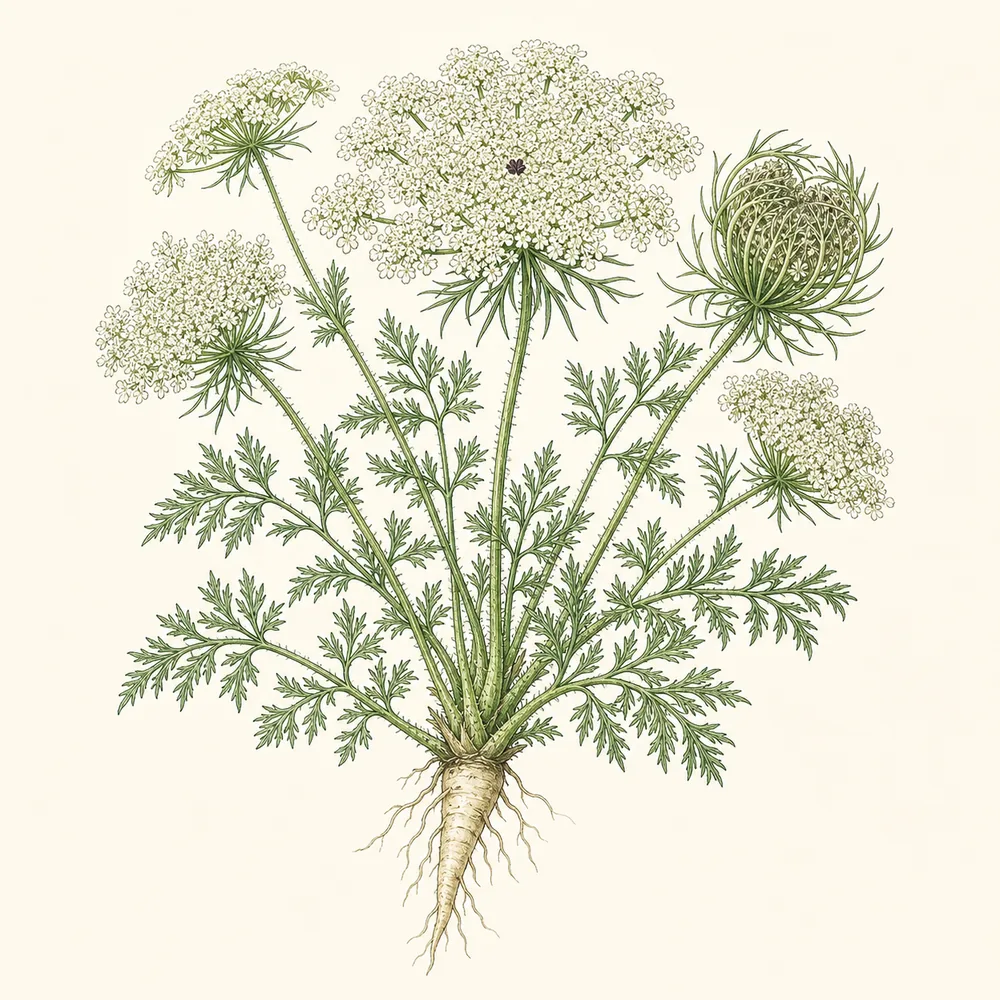
The lacy white umbels of Queen Anne's lace, each often with a single dark red floret at the centre, on tall airy stems above a fern-like rosette. A native biennial that's easy on poor ground and superb for pollinators — but one that closely resembles poisonous hemlock, so confident identification matters.
Not listed by ASPCA
The ASPCA doesn't list wild carrot, so we don't stamp it safe. It has no recorded serious toxicity, but it closely resembles poisonous hemlock — a real reason for caution when foraging or siting it — so with no database entry we flag the gap rather than guess.
Care at a glance
Everything that matters, in six lines. The detail is further down.
Light
Wants an open, sunny spot. It's a plant of grassland and verges and flops or fails to flower well in shade.
Water
Its long taproot makes it self-reliant once rooted. Water new sowings until established, then leave it to fend for itself.
Hardiness
A hardy biennial: it makes a leaf rosette in year one, overwinters, then flowers and seeds in year two before dying.
Habit
A low fern-like rosette in year one, then tall flowering stems the next. Best in the middle or back of a meadow.
Feeding
Thrives on poor, low-fertility ground. Rich soil gives coarse, leafy growth and lets stronger plants crowd it out.
Soil
Happiest on lean, free-draining soil, and especially good on chalk and lime. Avoid rich or waterlogged ground.
What to do, and when
Overwintered rosettes bulk up and send up flowering stems. Sow fresh seed now on bare, poor soil for rosettes that will flower next year.
Peak flowering from June to August — lacy white umbels alive with hoverflies, soldier beetles and solitary bees. Leave plants to flower and set seed.
Umbels curl inward into the cupped 'bird's nest' seed heads. Cut and collect the meadow once seed has ripened, and scatter saved seed on bare ground.
First-year rosettes sit low and hardy through the cold; second-year plants have died after seeding. Nothing to do but leave the patch be.
Know your umbellifer — the hemlock warning
Before anything else: wild carrot belongs to the carrot family, and several of its close relatives are deadly poisonous — hemlock (Conium maculatum) and hemlock water-dropwort among them. To an untrained eye the lacy white flower heads look much alike, so never assume identification from the flowers alone, and never forage any wild umbellifer unless you are completely certain.
Wild carrot has some reliable pointers — hairy, ridged stems (hemlock's are smooth, hollow and blotched purple), a carroty smell to the crushed leaf, three-forked bracts beneath the flower head, and umbels that curl up into a cupped 'bird's nest' as they seed. But if there is any doubt at all, leave it. This is a genuine safety matter, not a technicality.
An easy biennial for poor ground
As a garden wildflower, wild carrot is easy and undemanding. It's a biennial: sow it and the first year makes only a low, fern-like rosette of leaves; the second year it throws up tall, airy stems topped with those lacy white umbels, sets seed, and dies.
It thrives on poor, free-draining soil and is particularly at home on chalk and limestone. Rich ground does it no favours — keep the soil lean and it stays upright, floriferous and able to hold its own among grasses.
Sowing and self-seeding
Sow direct onto bare, weeded soil in autumn or spring. Scatter the seed thinly, press it in and don't bury it deep. Because it's biennial, sowing two years running gives you flowering plants every season rather than every other one.
Once established it self-seeds freely — sometimes a little too freely on open ground. To keep it going without letting it take over, leave a few seed heads to ripen and drop, and cut the rest before the seed sets. New rosettes will appear to carry the patch forward.
Wildlife value and managing the patch
Those flat, open umbels are a landing pad for a huge range of insects — hoverflies, soldier beetles, solitary bees and parasitic wasps that help keep aphids down. Leaving the seed heads standing over winter feeds birds and gives structure to the meadow.
Manage it like the rest of a wildflower patch: let it flower and seed, then give the whole area a single cut in autumn once the seed has ripened, and rake off the cuttings so the soil stays poor. That lean regime is exactly what keeps wild carrot and its meadow companions coming back.
Common problems
Confusion with poisonous relatives
The most important issue. Hemlock and hemlock water-dropwort look similar and are deadly. Check for hairy ridged stems and a carroty smell, and never eat any wild umbellifer without expert confirmation.
Self-seeds too enthusiastically
On open ground it can spread more than you want. Deadhead most umbels before the seed ripens, leaving just a few to keep the patch going.
Coarse and leafy, few flowers
Usually too rich a soil. Grow it lean and in full sun; fed ground gives soft foliage and lets stronger plants crowd it out.
Nothing flowers the first year
That's normal — it's biennial and only makes a leaf rosette in year one. Sow in two consecutive years for flowers every season.
Everything a wild carrot patch needs
Poor free-draining soil, sun, and confident identification.
We take no commission on anything in the "save your money" tier — if we don't think you should buy it, we don't link it. How our recommendations work
If you like this, try
Other plants with a similar temperament.
How we checked this
Care cross-checked against the RHS. The ASPCA does not list wild carrot, so its pet-safety is unconfirmed and we have not stamped it safe. If our page and these sources ever disagree, believe them — and tell us.
Sources: RHS · ASPCA — toxic & non-toxic plants
Last reviewed · July 2026