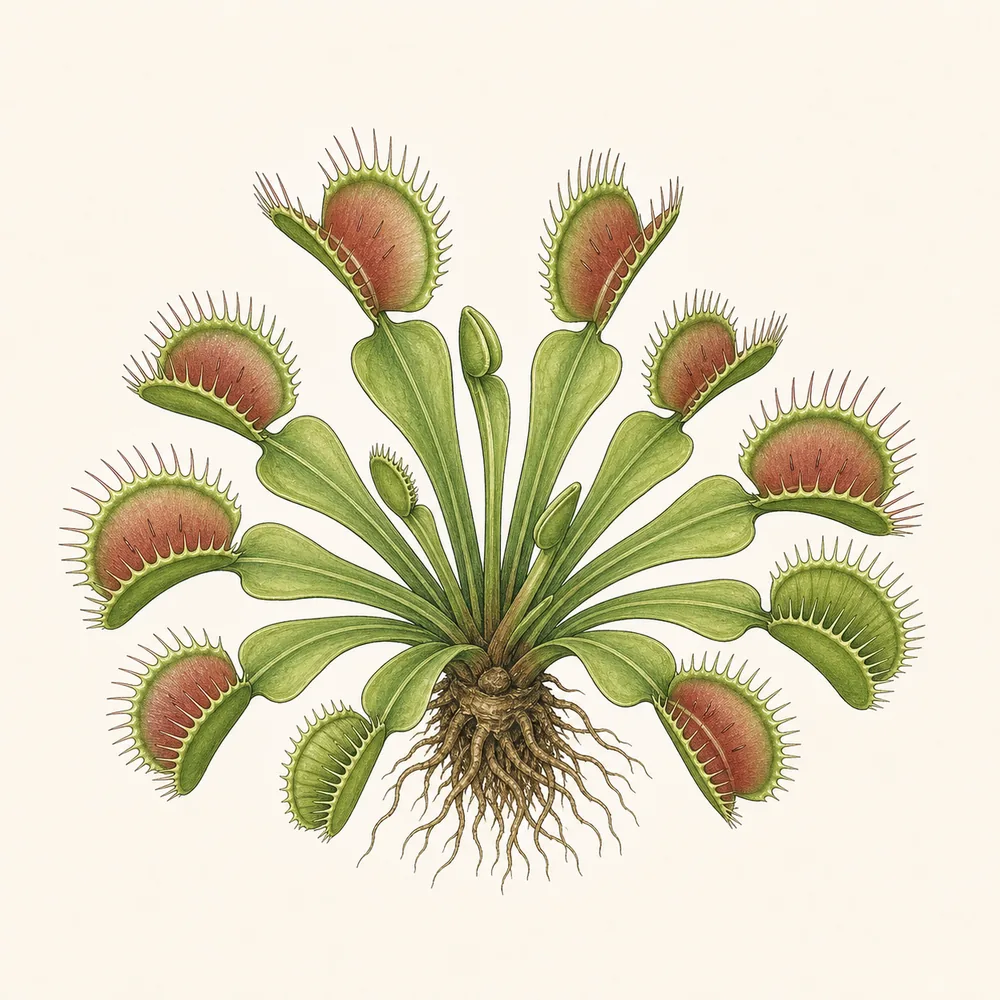
Venus Flytrap
The famous snap-trap plant, and far tougher than its reputation suggests — the trouble is nearly always in the details. Give it rainwater, a nutrient-poor bog mix, all the sun you can, and a genuine cold winter rest, and it will thrive for years catching its own dinner.
Non-toxic to cats, dogs & horses (ASPCA)
The Venus flytrap (Dionaea muscipula) is listed as non-toxic to cats, dogs and horses on the ASPCA database. Its snap-traps catch insects, not pets, so it's harmless to a curious cat or dog — though it's best left undisturbed so the traps aren't triggered and wasted.
Care at a glance
Everything that matters, in six lines. The detail is further down.
Light
As much direct sun as you can give — a south-facing windowsill, or better still outdoors in summer. Strong light is what turns the trap interiors deep red; a shady spot gives weak, all-green traps.
Water
Only rainwater, distilled or RO water — tap and mineral water are full of salts that build up and kill it. Stand the pot in a couple of centimetres of water in a tray and keep the mix wet through the growing season.
Temperature
Happy in ordinary summer warmth, but it must have a cold winter dormancy at roughly 0–10 °C for a few months, or it slowly exhausts itself. An unheated porch, cold greenhouse or a sheltered spot outdoors suits it.
Humidity
Ordinary room or outdoor humidity is fine — the terrarium is a myth. It wants sun and airflow far more than a sealed, steamy case, which actually invites mould.
Feeding
Never add fertiliser to the soil; it feeds itself on insects it catches. If it lives indoors away from flies you can drop the odd small insect into a trap, but don't poke or spring the traps for fun — each one only closes a few times before it dies.
Soil
A nutrient-poor mix — peat-free carnivorous compost, or sphagnum moss with plenty of perlite. Never ordinary potting compost: the nutrients in it will scorch and kill the roots.
What to do, and when
Growth restarts as the days lengthen. New traps unfurl; move it into full sun and keep the tray topped up with rainwater. A flower spike may appear — cut it off on a young plant, as flowering drains its strength.
Peak growth and hunting. Keep it in the brightest, sunniest spot you have, sitting in rainwater, and let it catch its own insects outdoors if you can.
Traps slow and some blacken off — this is normal as it heads for dormancy. Ease off the water so the mix is just damp rather than standing wet, and let it feel the cooling nights.
Full dormancy. It looks half-dead and that's correct — keep it cold (0–10 °C), barely moist and bright, and leave it be. It'll surge back in spring.
Water is where most flytraps die
The single commonest killer is tap water. Flytraps evolved in nutrient-poor bogs and have no tolerance for the dissolved minerals in ordinary tap or bottled mineral water — the salts accumulate in the mix and, over a few months, quietly poison the roots.
Use rainwater, distilled or RO water only, and water by the tray method: stand the pot in a shallow saucer of it and let the plant drink from below. Through summer it can sit permanently in a centimetre or two; never let the mix dry out completely in growth.
It genuinely needs a winter off
A Venus flytrap is not a tropical houseplant — it comes from a temperate corner of the Carolinas with cold winters, and it needs a real cool rest of three to four months to survive long term. Kept warm and growing all year, it burns out and dies, usually in its second spring.
From autumn, let it cool right down to somewhere between about 0 and 10 °C — an unheated porch, a cold greenhouse, or outdoors in a sheltered bog. It'll lose most of its traps and look miserable. Leave it: this is the plant resting, not dying.
Leave the traps alone
It's almost irresistible to tickle the traps shut, but every closure costs the plant energy, and a trap that snaps shut on nothing reopens over a day or two having gained nothing. Each individual trap can only close a handful of times in its life before it stops working and blackens.
Let it catch its own food. Outdoors in summer it'll manage perfectly; on an indoor windowsill it may catch the odd fly, and that's plenty. Blackening traps are normal — the plant is constantly making new ones and retiring old ones.
Common problems
Whole plant weakening over months
Almost always tap water, or no winter dormancy. Switch to rainwater and give it a proper cold rest each winter — these two things fix most long-term decline.
Traps stay green and floppy
Not enough light. Flytraps want full, direct sun; move it to your brightest windowsill or outdoors and the traps will colour up and firm.
Traps turning black
A few blackening traps is normal ageing, especially heading into autumn. Widespread rapid blackening points to shock, tap water, or being over-triggered — check your water and stop poking them.
Grey mould in winter
Dead traps left on a cold, damp, still plant can go mouldy. Snip off obviously dead growth and give it a little more airflow during dormancy.
Everything a Venus flytrap needs
Rainwater, a nutrient-poor mix, full sun, and a cold winter rest.
We take no commission on anything in the "save your money" tier — if we don't think you should buy it, we don't link it. How our recommendations work
If you like this, try
Other plants with a similar temperament.
How we checked this
Care cross-checked against the RHS. Non-toxicity taken from the ASPCA database, which lists the Venus Fly Trap (Dionaea muscipula) as non-toxic. If our page and these sources ever disagree, believe them — and tell us.
Sources: RHS · ASPCA — toxic & non-toxic plants
Last reviewed · July 2026