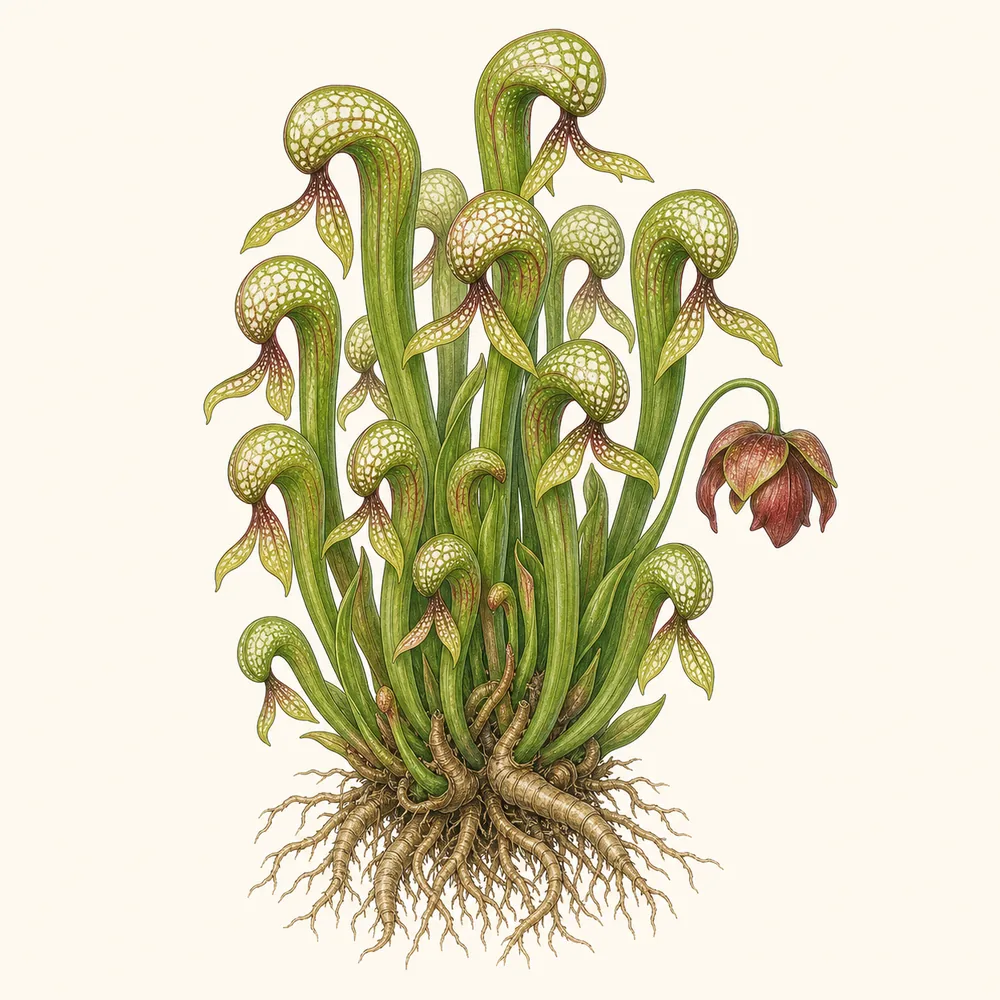
Cobra Lily
A dramatic hooded pitcher plant with a forked, snake-tongue lip, and the connoisseur's carnivore. It has one non-negotiable demand that trips people up: the roots must stay cool. Meet that, with rainwater and a bog mix, and it's a spectacular thing to grow.
Non-toxic to cats, dogs & horses (ASPCA)
The cobra lily (Darlingtonia californica) is listed as non-toxic to cats, dogs and horses on the ASPCA database (as 'California Pitcher Plant'). Safe around pets — the hooded pitchers trap insects, not animals.
Care at a glance
Everything that matters, in six lines. The detail is further down.
Light
Wants bright light to full sun on the leaves, but the catch is the roots must stay cool. A bright cold greenhouse or a sheltered outdoor spot suits it far better than a warm windowsill.
Water
Only rainwater, distilled or RO water — never tap. In the wild cold snowmelt runs constantly past its roots, so water freely and, in heat, flush the pot through with cold water to keep the roots cool.
Temperature
The whole game is cool roots — warm crowns are fine, but roots baking above the low 20s °C is what kills it. It also needs a cold winter dormancy, so an unheated greenhouse or outdoors is ideal.
Humidity
Likes cool, moving, humid air rather than a stuffy warm case. Good ventilation matters as much as moisture.
Feeding
Never add fertiliser to the mix; it draws its nutrients from the insects the hooded pitchers trap. Left in a bright, airy spot it feeds itself perfectly well — no need to drop anything in.
Soil
A nutrient-poor, wet mix — living sphagnum moss, or peat-free carnivorous compost with perlite. Never ordinary potting compost, whose nutrients scorch the roots.
What to do, and when
Growth resumes and fresh pitchers push up. Move it into good light, keep the mix wet with rainwater, and start watching that the roots don't warm up as the sun strengthens.
The tricky season. Keep the roots cool — stand the pot in shade even if the tops are in sun, flush through with cold rainwater in a heatwave, and never let it cook on a hot windowsill.
Growth slows as nights cool. Ease back the watering slightly and let the plant feel the drop in temperature ahead of dormancy.
Cold dormancy. It's hardy and wants a genuine cold rest — an unheated greenhouse or a sheltered outdoor bog. Keep it just damp and leave it cold and bright.
Cool roots are the whole secret
Darlingtonia grows beside cold mountain seeps where snowmelt keeps its roots chilled even in summer sun. Reproduce that and it thrives; let the roots warm up in a hot pot and it sulks, then rots — this is why it has a reputation for being difficult.
The trick is to keep the roots cooler than the tops. Sit the pot in shade or a bigger outer container, use a pale pot that doesn't absorb heat, and in hot spells pour cold rainwater through the mix to flush the warmth away. Outdoors in the UK, in a cool spot, it's often easier than under glass.
Rainwater, and plenty of it
Like all bog carnivores it can't cope with the minerals in tap water, so it's rainwater, distilled or RO only. But unlike a flytrap it likes to be genuinely wet and flushed through, mimicking the constant trickle of its native seeps.
Stand it in a tray of rainwater and top up often. In summer, watering with cold water does double duty — it keeps the mix wet and drops the root temperature at the same time.
It still needs a cold winter
The cobra lily is hardy and, like other temperate carnivores, needs a proper cold dormancy each winter. Kept warm year-round it slowly declines. An unheated greenhouse, cold frame or a sheltered outdoor bog garden gives it the winter chill it's built for.
Through dormancy it slows right down and looks static — keep it cold, just damp, and don't be tempted to bring it into the warmth to 'rescue' it.
Common problems
Sudden collapse in hot weather
Roots overheated and rotted. Keep the pot shaded and cool, flush with cold rainwater in heatwaves, and never let it sit in a hot, sunny spot.
Browning, dying pitchers
Often tap-water damage or warm, stagnant conditions. Switch to rainwater, improve airflow, and keep the roots cool.
Weak, pale growth
Too little light. It wants bright light on the leaves — just make sure brighter light doesn't also cook the roots.
Fails to come back after winter
Usually no true dormancy, or roots that stayed too warm all year. Give it a genuine cold winter rest in an unheated space.
Everything a cobra lily needs
Cool roots, rainwater, a bog mix, and a cold winter rest.
We take no commission on anything in the "save your money" tier — if we don't think you should buy it, we don't link it. How our recommendations work
If you like this, try
Other plants with a similar temperament.
How we checked this
Care cross-checked against the RHS. Non-toxicity taken from the ASPCA database, which lists the California Pitcher Plant (Darlingtonia californica / cobra lily) as non-toxic. If our page and these sources ever disagree, believe them — and tell us.
Sources: RHS · ASPCA — toxic & non-toxic plants
Last reviewed · July 2026