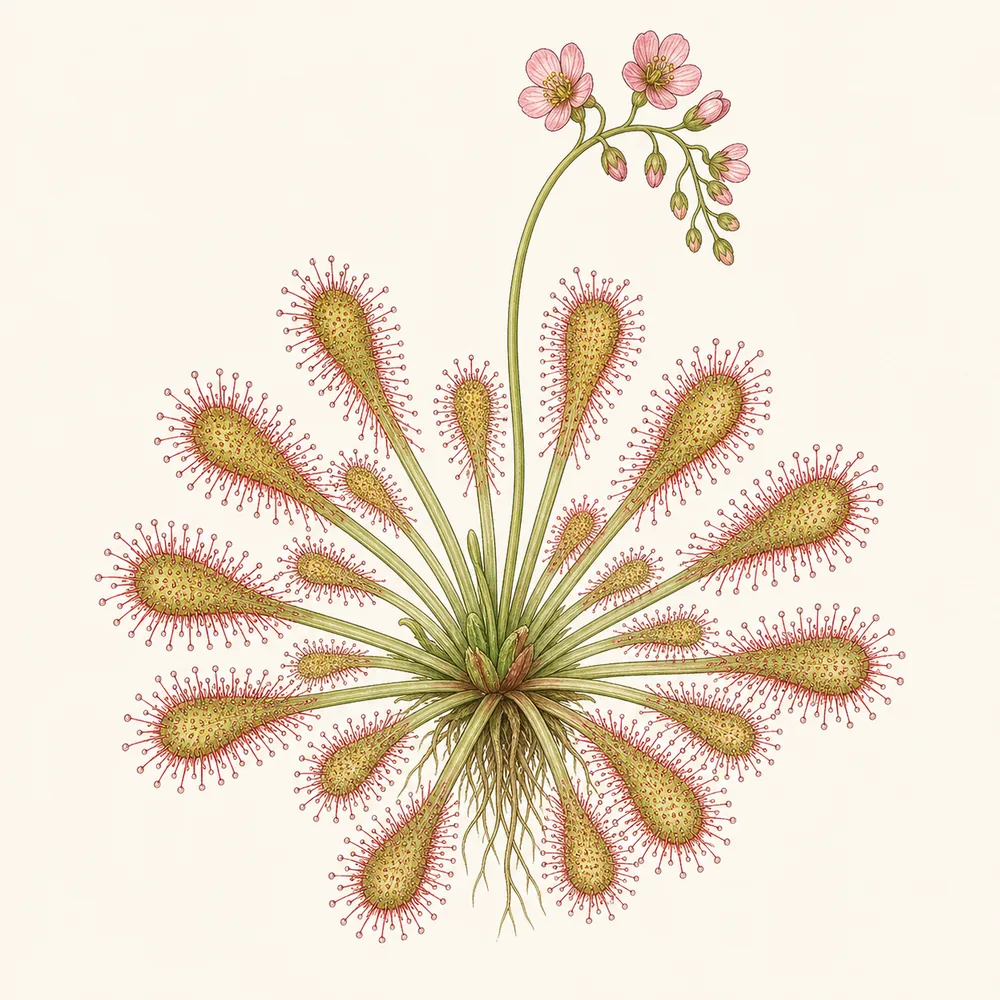
Sundew
The jeweller of the carnivores — leaves studded with glistening, sticky droplets that trap small insects and glint in the sun. Most sundews are easy and quietly effective: give them bright light, rainwater and a wet bog mix and they'll sparkle, and clear a windowsill of fungus gnats into the bargain.
Not listed by ASPCA
The ASPCA doesn't list the sundew (Drosera) specifically, so we don't stamp it safe. No toxic principle is recorded for it and close relatives are listed non-toxic, but with no database entry for this species we flag the gap honestly rather than assume.
Care at a glance
Everything that matters, in six lines. The detail is further down.
Light
The brighter the better. Strong light, including direct sun, is what makes the dewy droplets form and often flushes the leaves red. In poor light the dew thins out and the plant goes green and lax.
Water
Only rainwater, distilled or RO water — never tap. Stand the pot in a tray of it and keep the mix constantly wet; sundews are bog plants and should never dry out in growth.
Temperature
Temperate sundews are hardy and need a cold winter rest; subtropical kinds grow year-round in ordinary warmth. Check which you have — it decides whether yours takes a winter dormancy or not.
Humidity
Appreciates humid air, which helps the dew stay plump, but it isn't as fussy as often claimed. Standing in a wet tray usually keeps enough moisture around it without a terrarium.
Feeding
Never add fertiliser to the mix; the sticky leaves catch small flies and gnats, which is all the feeding it needs. Don't drop big insects on it — oversized prey just rots and spoils the leaf.
Soil
A nutrient-poor, wet mix — peat-free carnivorous compost, or sphagnum with plenty of perlite or sand. Never ordinary potting compost, whose nutrients scorch the fine roots.
What to do, and when
Growth strengthens and the dew returns in earnest. Give it your brightest spot, keep it standing in rainwater, and — if it's a temperate type just out of dormancy — watch for fresh growth from the crown.
Peak dew and hunting. Full light, wet roots and warmth give the best-covered, reddest leaves, catching gnats and small flies all season. Keep the tray topped up.
Subtropical kinds carry on; temperate species start winding down towards dormancy, some forming a tight resting bud (a hibernaculum). Ease off water for the temperate ones as they slow.
Temperate sundews rest cold and look shrunken or bud-like — keep them cool, just damp and bright, and don't fret. Subtropical kinds keep growing on a bright sill in ordinary warmth, still standing in rainwater.
Light is what makes the dew
The magic of a sundew is the sparkling droplets, and those are powered by light. In a bright spot, ideally with some direct sun, the leaves stay thick with dew and often flush a rich red; in a dim corner the dew thins to almost nothing and the plant sprawls, pale and green.
So give it the brightest position you can — a sunny windowsill, a bright greenhouse, or outdoors in summer for the hardy kinds. If yours has stopped 'sweating', more light is nearly always the answer.
Know your type: temperate or subtropical
Drosera is a huge, varied group, and the one thing worth pinning down is whether yours is temperate or subtropical. Temperate sundews come from cold-winter regions and need a genuine dormancy, sometimes shrinking to a tight resting bud; subtropical ones grow steadily all year and never rest.
It matters because it decides your winter care. A subtropical sundew kept cold and dry will suffer; a temperate one kept warm and growing all year gets no rest and slowly weakens. If in doubt, note where the species comes from — that tells you which camp it's in.
A genuinely useful little predator
Beyond looking lovely, sundews earn their keep. Those sticky leaves are superb at catching fungus gnats and small flies, so a pot or two on a windowsill can noticeably thin out the gnats that plague other houseplants' compost.
Let it hunt for itself — it needs no help finding food. Just keep it bright, wet with rainwater and in a nutrient-poor mix, and resist the urge to feed it anything big; oversized prey the leaf can't digest simply rots.
Common problems
No dew on the leaves
Nearly always too little light, sometimes low humidity or a recent move. Give it much brighter light and keep it standing wet, and the droplets should come back.
Pale, sprawling, leggy growth
Reaching for light. Move it to a brighter, sunnier spot so it stays compact and dewy.
Leaves browning or crisping
Usually tap water or the mix drying out. Switch to rainwater and keep it constantly wet in a tray through the growing season.
A temperate sundew 'dying back' in autumn
Often just dormancy, not death — temperate kinds shrink down for winter, some to a small bud. Keep it cool and just damp and wait for spring before writing it off.
Everything a sundew needs
Bright light, rainwater, a wet bog mix — and knowing your type.
We take no commission on anything in the "save your money" tier — if we don't think you should buy it, we don't link it. How our recommendations work
If you like this, try
Other plants with a similar temperament.
How we checked this
Care cross-checked against the RHS. The ASPCA does not list the sundew (Drosera), so its pet-safety is unconfirmed and we have not stamped it safe. If our page and these sources ever disagree, believe them — and tell us.
Sources: RHS · ASPCA — toxic & non-toxic plants
Last reviewed · July 2026