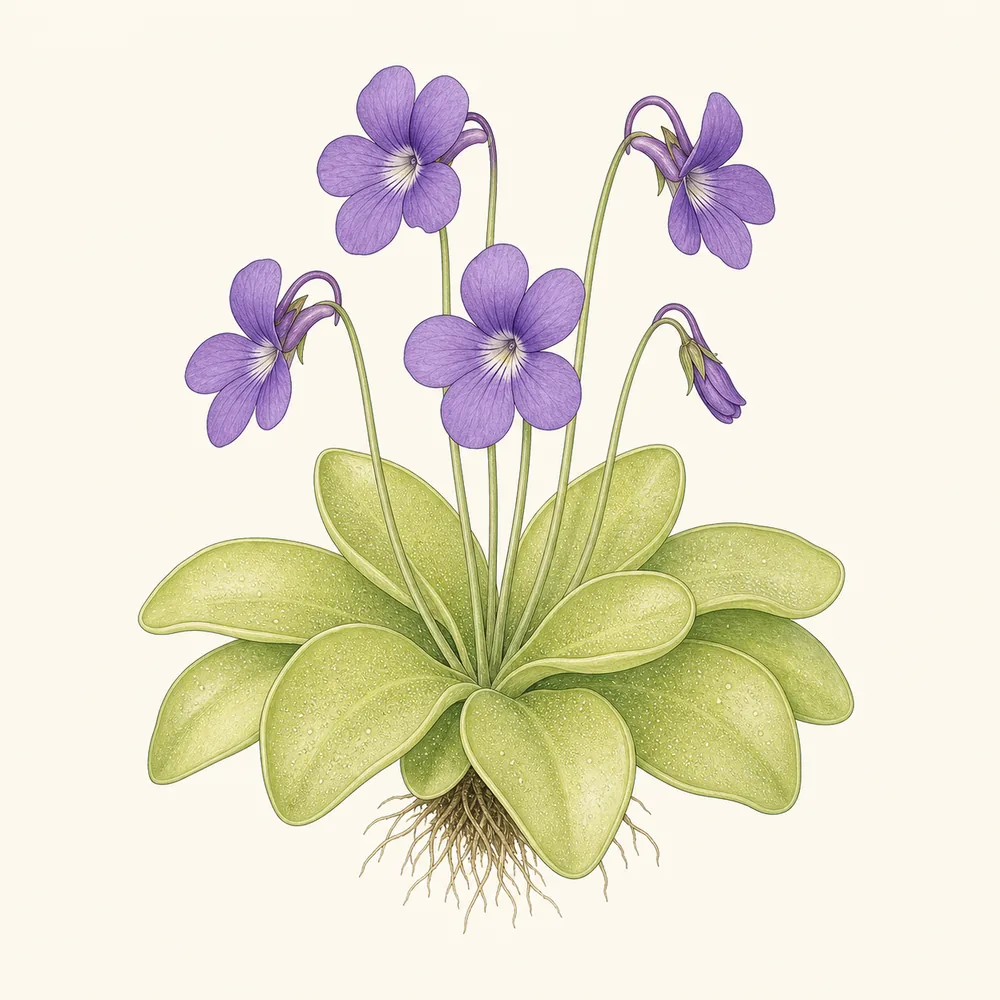
Butterwort
A neat little rosette of greasy-looking leaves that quietly catches gnats on their sticky surface. It's the gentlest way into carnivorous plants — forgiving, pretty in flower, and happy on a bright windowsill as long as you only ever give it rainwater.
Not listed by ASPCA
The ASPCA doesn't list the butterwort (Pinguicula) specifically, so we don't stamp it safe. No toxic principle is recorded for it and close relatives are listed non-toxic, but with no database entry for this species we flag the gap honestly rather than assume.
Care at a glance
Everything that matters, in six lines. The detail is further down.
Light
A bright windowsill with a few hours of gentle sun. Good light keeps the leaves compact and their sticky surface working.
Water
Only rainwater, distilled or RO water — tap and hard water build up minerals that kill it. Stand the pot in a shallow tray of water in growth.
Temperature
Ordinary room warmth suits Mexican types; many like a cooler, brighter winter rest around 10–15 °C.
Humidity
Copes with normal room humidity better than most carnivores — no terrarium needed.
Feeding
Never use soil fertiliser. It feeds on small flies and fungus gnats it traps itself; leave it to catch what it needs.
Soil
A low-nutrient carnivorous mix — peat-free or sphagnum with plenty of perlite and often grit or sand. Never ordinary compost.
What to do, and when
Growth picks up as light returns. Move it back to standing water and repot now if the mix has broken down.
Peak growth and stickiest leaves — plenty caught for it to feed on. Keep the tray topped up with rainwater and the light bright.
Trapping slows as the days shorten. Ease off the water and let the plant settle towards its winter form.
Many Mexican types form a tighter, less sticky winter rosette and prefer to run drier and cooler — damp, not standing wet, and bright.
Why it's the easiest carnivore to start with
Butterworts trap by flypaper, not snapping — the leaves are coated in tiny sticky glands that hold small flies fast, then digest them. There's no trap to trigger, nothing to break, and they shrug off ordinary room humidity, which is why they're the classic beginner's carnivore.
They also earn their keep: a butterwort on a kitchen or bathroom sill is a genuinely effective fungus-gnat trap, quietly clearing the little flies that plague other houseplants.
Water is what makes or breaks it
The single rule that matters most: rainwater, distilled or RO water only. The minerals in tap and hard water accumulate in the lean mix and scorch the roots — it's the commonest way people kill carnivorous plants.
In active growth, stand the pot in a centimetre or two of that water and keep the tray from running dry. Water from below, not over the leaves.
The winter change catches people out
Many popular butterworts are Mexican species that shift into a compact, succulent-looking winter rosette with far fewer sticky leaves. This is normal — not death.
Through that rest they want it cooler, brighter and drier: take them out of standing water so the mix is just damp, and hold off feeding worries — they're barely trapping. Growth and stickiness return in spring.
Common problems
Leaves going brown and mushy
Usually mineral build-up from tap water, or sitting wet through the winter rest. Switch to rainwater and let Mexican types run drier and cooler in winter.
Leaves stop being sticky
Often just the winter rosette forming, which is normal. If it's summer, check the light is bright enough and the water is pure.
No flies being caught
Nothing wrong — it only catches what wanders past. Never force-feed it; it takes what it needs from small flies in the room.
Rosette collapsing
Nearly always the water or the mix. Confirm you're on rainwater and a lean, gritty carnivorous mix, not ordinary compost.
Everything a butterwort needs
Rainwater, a lean mineral mix, and a bright sill.
We take no commission on anything in the "save your money" tier — if we don't think you should buy it, we don't link it. How our recommendations work
If you like this, try
Other plants with a similar temperament.
How we checked this
Care cross-checked against the RHS. The ASPCA does not list the butterwort (Pinguicula), so its pet-safety is unconfirmed and we have not stamped it safe. If our page and these sources ever disagree, believe them — and tell us.
Sources: RHS · ASPCA — toxic & non-toxic plants
Last reviewed · July 2026