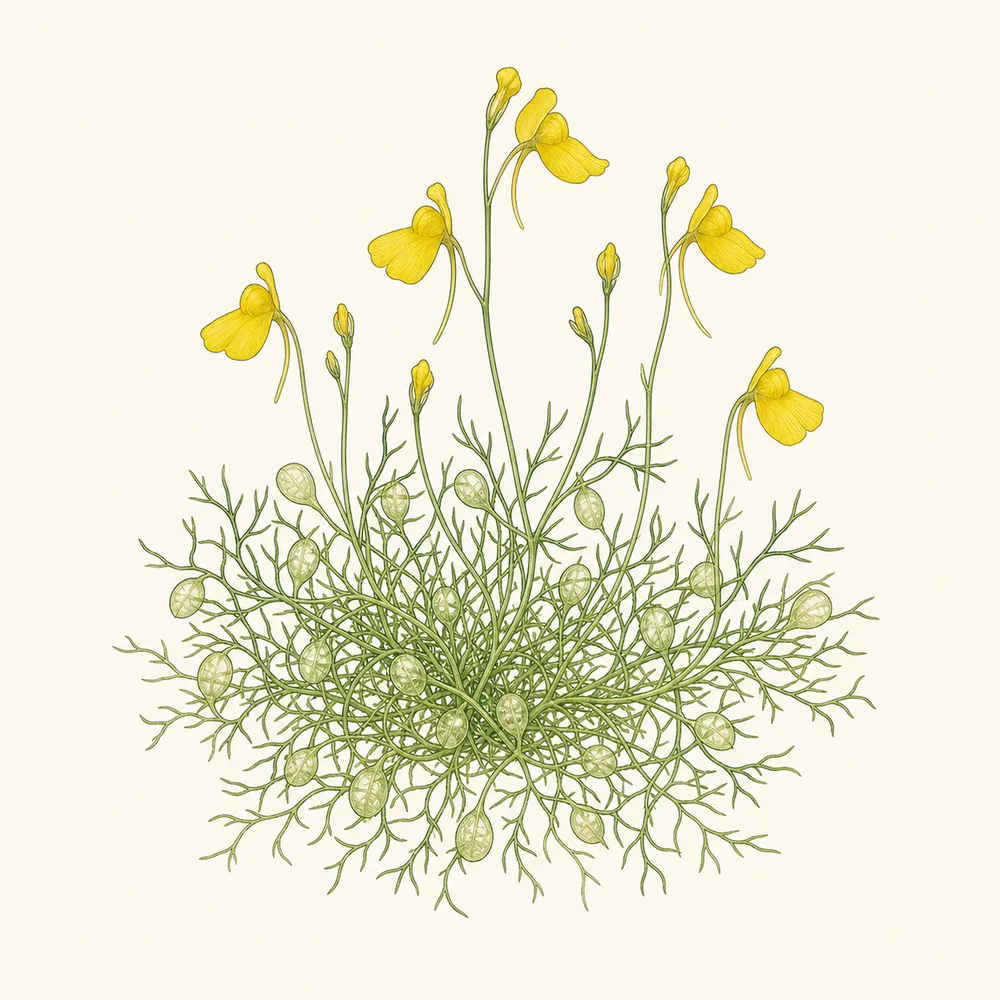
Bladderwort
The fastest trapper in the plant world, hidden in plain sight. The traps are microscopic bladders down among the roots, while above ground it's grown mostly for its surprisingly pretty little flowers. The one firm rule: it must never dry out.
Not listed by ASPCA
The ASPCA doesn't list the bladderwort (Utricularia) specifically, so we don't stamp it safe. No toxic principle is recorded for it and close relatives are listed non-toxic, but with no database entry for this species we flag the gap honestly rather than assume.
Care at a glance
Everything that matters, in six lines. The detail is further down.
Light
A bright sill with a few hours of gentle sun. Good light is what brings on the flowers it's mainly grown for.
Water
Only rainwater, distilled or RO — hard water kills it. Keep it standing in water year-round; the mix must never dry out even briefly.
Temperature
Ordinary room warmth suits the common terrestrial types; no cold rest needed for most grown as houseplants.
Humidity
The permanently wet mix keeps the roots happy, so normal room humidity is enough for terrestrial kinds.
Feeding
Never add fertiliser. Its tiny bladders suck in microscopic soil and water creatures; there's nothing for you to feed.
Soil
A low-nutrient carnivorous mix — peat-free or live sphagnum with sand or perlite, kept soaking. Never ordinary compost.
What to do, and when
Growth speeds up with the light. Top up the water tray and let it fill out; divide congested pots now if needed.
Main flowering season for many terrestrial types. Keep it sitting in water and give it plenty of bright light for the best display.
Growth eases as the days shorten, but keep the mix just as wet — it never wants to dry out.
Ticks over slowly. Hold it wet and bright; most terrestrial houseplant kinds need no dry rest, unlike some other carnivores.
The traps you'll never see
Bladderwort catches prey with hundreds of tiny bladder traps hidden in the wet mix or water. Each one sets like a spring; when a passing water flea or nematode brushes a trigger hair, the bladder snaps open and sucks it in — one of the fastest movements in the whole plant kingdom.
Because the traps are microscopic and out of sight, most people grow bladderwort for what's above ground: dainty, often orchid-like flowers held on slender stems.
Wet, wetter, wettest
Where other carnivores like a moist mix, terrestrial bladderwort wants to be permanently soaking. Stand the pot in water all year and never let the surface dry — even a short dry spell can set it right back.
As always, that water must be rainwater, distilled or RO. Tap and hard water load the lean mix with minerals and quietly kill the plant.
Grow it for the flowers
Treat bladderwort as a flowering plant that happens to be carnivorous. Bright light and steady warmth bring on the best show, and a well-settled pot will often flower freely for weeks.
It spreads by fine underground stems, so a happy plant gradually knits across the surface. Divide and re-pot into fresh wet mix every year or two to keep it vigorous.
Common problems
Plant shrivels or dies back
Almost always the mix dried out or tap water crept in. Keep it permanently standing in rainwater and never let the surface dry.
No flowers
Usually too little light. Move it to your brightest sill; many types need real brightness to bloom.
Green algae or moss taking over
Common on a constantly wet surface. Give more light and airflow, and thin it back; it rarely harms an established plant.
Growth stalls
Check the water is mineral-free and the mix hasn't broken down to a dense sludge. Divide and repot into fresh lean, wet mix.
Everything a bladderwort needs
Rainwater it can sit in permanently, a lean wet mix, and good light.
We take no commission on anything in the "save your money" tier — if we don't think you should buy it, we don't link it. How our recommendations work
If you like this, try
Other plants with a similar temperament.
How we checked this
Care cross-checked against the RHS. The ASPCA does not list the bladderwort (Utricularia), so its pet-safety is unconfirmed and we have not stamped it safe. If our page and these sources ever disagree, believe them — and tell us.
Sources: RHS · ASPCA — toxic & non-toxic plants
Last reviewed · July 2026