Urn Plant
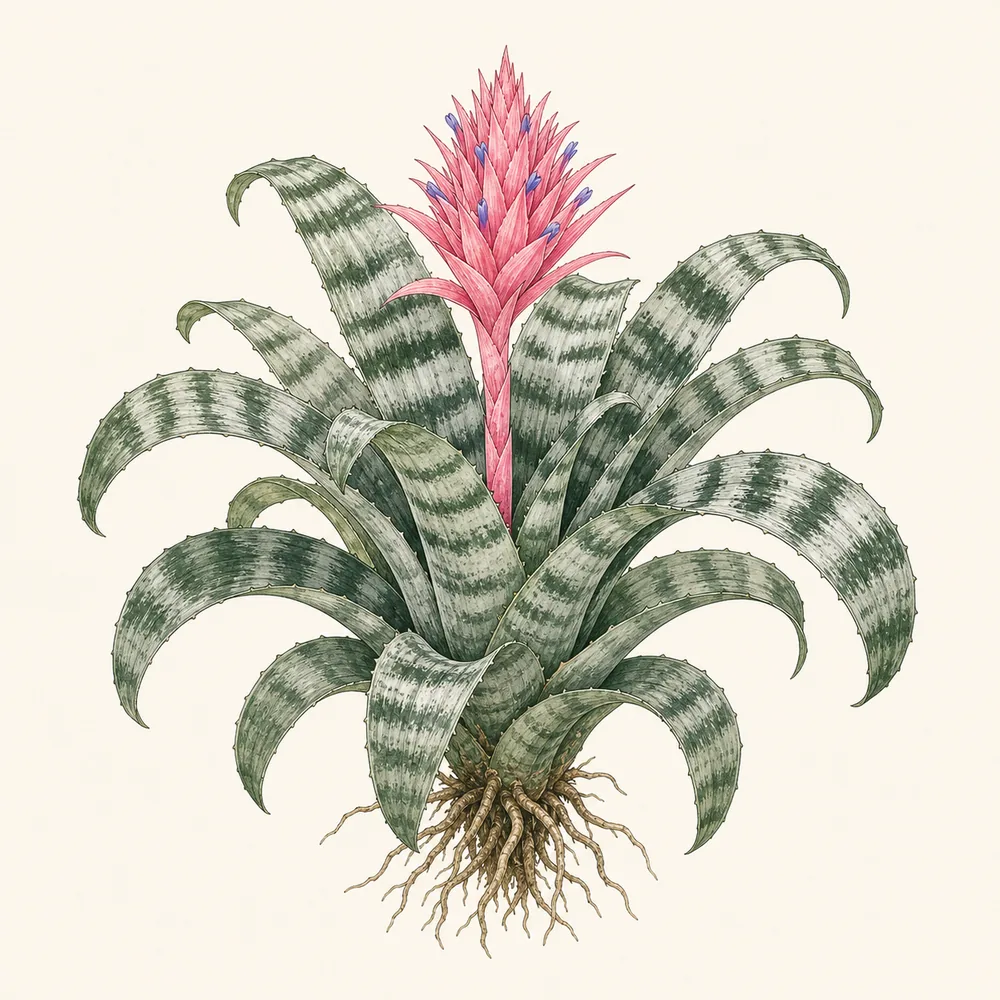
A big, architectural bromeliad with silvery, powder-dusted leaves forming a broad 'urn', topped in flower by a striking pink spike studded with blue. It's one of the toughest and most forgiving of the family — water the central cup, give it bright indirect light, and it more or less looks after itself.
Not listed by ASPCA
The ASPCA doesn't list the urn plant (Aechmea), so we don't stamp it safe. It has no recorded toxic principle and several of its relatives are listed non-toxic, but with no database entry for this species we flag the gap honestly rather than assume.
Care at a glance
Everything that matters, in six lines. The detail is further down.
Light
Bright, filtered light keeps the silvery banding strong. It takes a little more sun than most bromeliads, but shield it from harsh midday glare through glass.
Water
Keep the central urn topped up with rainwater or distilled water, and water the mix only lightly. Tip out and refresh the urn every week or two so it stays clean.
Temperature
One of the more cold-tolerant bromeliads, but still keep it above about 10 °C and away from cold draughts and freezing glass.
Humidity
Copes with ordinary room air better than most bromeliads, but a little extra humidity — misting or a pebble tray — keeps the leaves fresh.
Feeding
A very dilute balanced feed occasionally through spring and summer, into the urn or the mist. Bromeliads are light feeders — keep it weak.
Soil
An epiphyte — pot it in a chunky orchid-bark mix, not heavy compost. The roots mainly anchor the plant and must never sit wet.
What to do, and when
Growth resumes as light returns. Keep the urn fresh, start light feeding, and pot up pups from any plant that has finished flowering.
Active growth. Bright, indirect light keeps the silvery banding crisp. Keep the urn topped up and the air a touch humid through warm spells.
Ease off feeding as the light drops. A plant that flowered this year may begin to fade and produce pups around its base.
The hardiest season-wise of the bromeliads, but still keep it warm and bright. Water the urn sparingly and hold off feeding until spring.
Water the urn, keep the compost dry
Aechmea is an epiphyte, and the broad rosette that gives it its name works like a reservoir — the central urn catches and holds water. Keep that urn topped up with rainwater or distilled water, and give the potting mix only occasional light watering so the roots don't dry out completely.
Overwatering the compost is the quickest way to kill it. The roots want oxygen and a chunky, free-draining bark mix; a dense, water-holding compost sitting wet will rot them. Tip out and refresh the urn every week or two to keep the water clean.
That silvery bloom on the leaves
The powdery, silver-grey banding across the leaves isn't dust — it's a natural waxy coating of tiny scales called trichomes that help the plant absorb water and reflect strong light. It rubs off easily, so handle the leaves as little as you can and don't be tempted to wipe them 'clean'.
For the same reason, skip leaf-shine sprays entirely. They ruin the very finish that makes the urn plant so striking.
The pink spike, then the pups
A mature urn plant throws up a dramatic pink flower spike tipped with small blue flowers — one of the boldest displays in the bromeliad family, and it lasts for months. But like all bromeliads, each rosette flowers only once.
After flowering, the parent slowly declines over many months and produces pups (offsets) around its base. Leave them until they're roughly a third the size of the parent with a few roots, then detach and pot them individually to keep a new generation coming on.
Common problems
Silvery banding rubbing off
That powdery coating is fragile natural wax. Handle the leaves as little as possible and skip leaf-shine sprays and wiping.
Soft, rotting base or centre
A soggy compost or stale water in the urn. Keep the mix on the dry side, refresh the urn regularly, and make sure the pot drains freely.
Brown, crispy leaf tips
Dry air or hard tap water. Raise the humidity a little and use rainwater or distilled water for the urn.
Parent fading after the flower spike
Normal — a bromeliad flowers once then slowly dies. Let it feed the pups, then remove and pot them on.
Everything an urn plant needs
Bright light, an airy mix, and the central urn topped up with rainwater.
We take no commission on anything in the "save your money" tier — if we don't think you should buy it, we don't link it. How our recommendations work
If you like this, try
Other plants with a similar temperament.
How we checked this
Care cross-checked against the RHS. The ASPCA does not list the urn plant (Aechmea), so its pet-safety is unconfirmed and we have not stamped it safe. If our page and these sources ever disagree, believe them — and tell us.
Sources: RHS · ASPCA — toxic & non-toxic plants
Last reviewed · August 2026