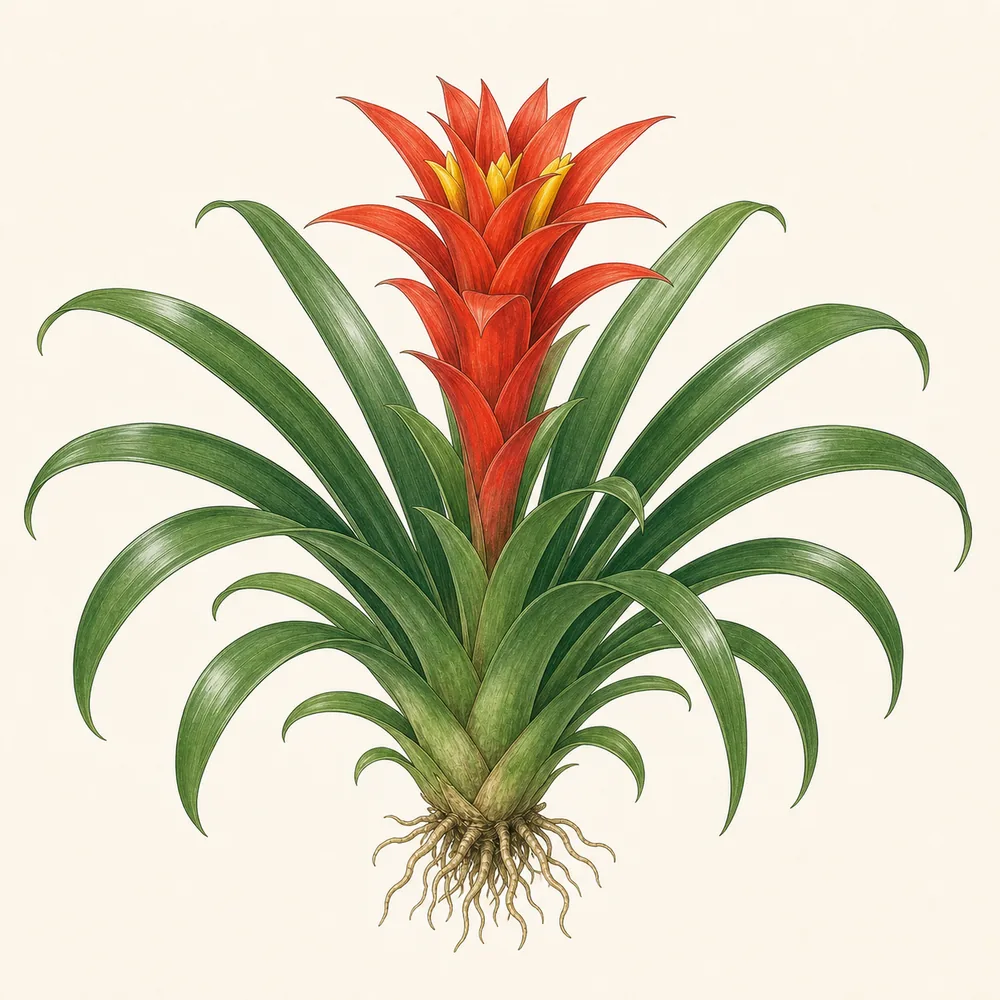
Scarlet Star
The bromeliad you see everywhere in garden centres, topped with a bright star of scarlet, orange or yellow. That colourful 'flower' is really a long-lasting bract that holds for months. Water the central cup with rainwater, give it warmth and bright indirect light, and it's genuinely fuss-free.
Non-toxic to cats, dogs & horses (ASPCA)
The scarlet star (Guzmania) is listed as non-toxic to cats, dogs and horses on the ASPCA database (as 'Orange Star', Guzmania lingulata). A safe, long-lasting flowering bromeliad — the colourful 'flower' is really a bract that lasts for months.
Care at a glance
Everything that matters, in six lines. The detail is further down.
Light
Bright, filtered light keeps the bract colour strong and the leaves glossy. Keep it out of direct midday sun, which scorches the soft foliage.
Water
Keep the cup at the centre of the rosette topped up with rainwater or distilled water, and water the mix only lightly. Tip out and refresh the cup every week or two to keep it clean.
Temperature
Steady warmth suits it — no cold draughts and no chilly windowsills. Keep it above about 13 °C year-round.
Humidity
A tropical plant that appreciates moist air. Mist regularly, group it with other plants, or use a pebble tray in dry rooms.
Feeding
A very dilute balanced feed occasionally in spring and summer, into the cup or the mist. Bromeliads feed lightly — go easy.
Soil
An epiphyte — pot it in a chunky orchid-bark mix, not heavy compost. The roots anchor it and must never sit wet.
What to do, and when
Growth resumes with the returning light. Keep the cup fresh, begin light feeding, and pot on any pups from a plant that has finished flowering.
Active growth. Bright, indirect light and steady warmth keep the colourful bract at its best. Keep humidity up through warm spells.
Ease off feeding as light drops. If the plant flowered this year, the parent may start to fade and throw pups around its base.
Keep it warm, bright and humid indoors. Water the cup sparingly, avoid cold windowsills, and hold off feeding until spring.
The 'flower' is a bract that lasts for months
The dramatic scarlet, orange or yellow star on top of a guzmania isn't a flower — it's a cluster of coloured bracts (modified leaves) surrounding the small, short-lived true flowers deep in the centre. Because they're leaves rather than petals, those bracts hold their colour for weeks, often months, which is exactly why the plant is such reliable value.
Don't expect the colour to come back on the same rosette, though. Once it has flowered, that rosette won't do it again — see below.
Water the cup with rainwater
Guzmania is an epiphyte with a water-holding cup at the centre of its rosette. Keep that cup topped up with rainwater or distilled water, and give the potting mix only occasional light watering to stop the roots drying out.
Rainwater matters here — the lime and salts in hard tap water mark the leaves and can leave a stale film in the cup. Tip the cup out and refresh it every week or two so the water stays clean and doesn't turn stagnant.
Flowers once, then makes pups
Here's the part that surprises people: a bromeliad flowers only once in its life. After the bracts finally fade, the parent rosette slowly declines over several months. That's not you doing something wrong — it's the plant's natural cycle.
Before it goes, the parent produces pups (offsets) around its base. Leave them attached until they're around a third to a half the size of the parent with a few roots of their own, then detach and pot them individually. Each pup will grow on and, in time, flower in its turn.
Common problems
Bract colour fading fast
Some fading over months is normal — the bract has a natural lifespan. Too little light dulls it sooner, so keep it bright and indirect.
Brown, crispy leaf tips
Dry air or hard tap water. Raise the humidity and switch to rainwater or distilled water for the central cup.
Soft, rotting centre
Stale water sitting in the cup, or cold. Refresh the cup regularly, keep the plant warm, and never let it stand cold and wet.
Parent rosette dying after flowering
Normal — a bromeliad flowers once then slowly dies. Let it feed the pups, then remove and pot them on to keep going.
Everything a scarlet star needs
Bright light, an airy mix, and the central cup topped up with rainwater.
We take no commission on anything in the "save your money" tier — if we don't think you should buy it, we don't link it. How our recommendations work
If you like this, try
Other plants with a similar temperament.
How we checked this
Care cross-checked against the RHS. Non-toxicity taken from the ASPCA database, which lists the Orange Star (Guzmania lingulata) as non-toxic. If our page and these sources ever disagree, believe them — and tell us.
Sources: RHS · ASPCA — toxic & non-toxic plants
Last reviewed · August 2026