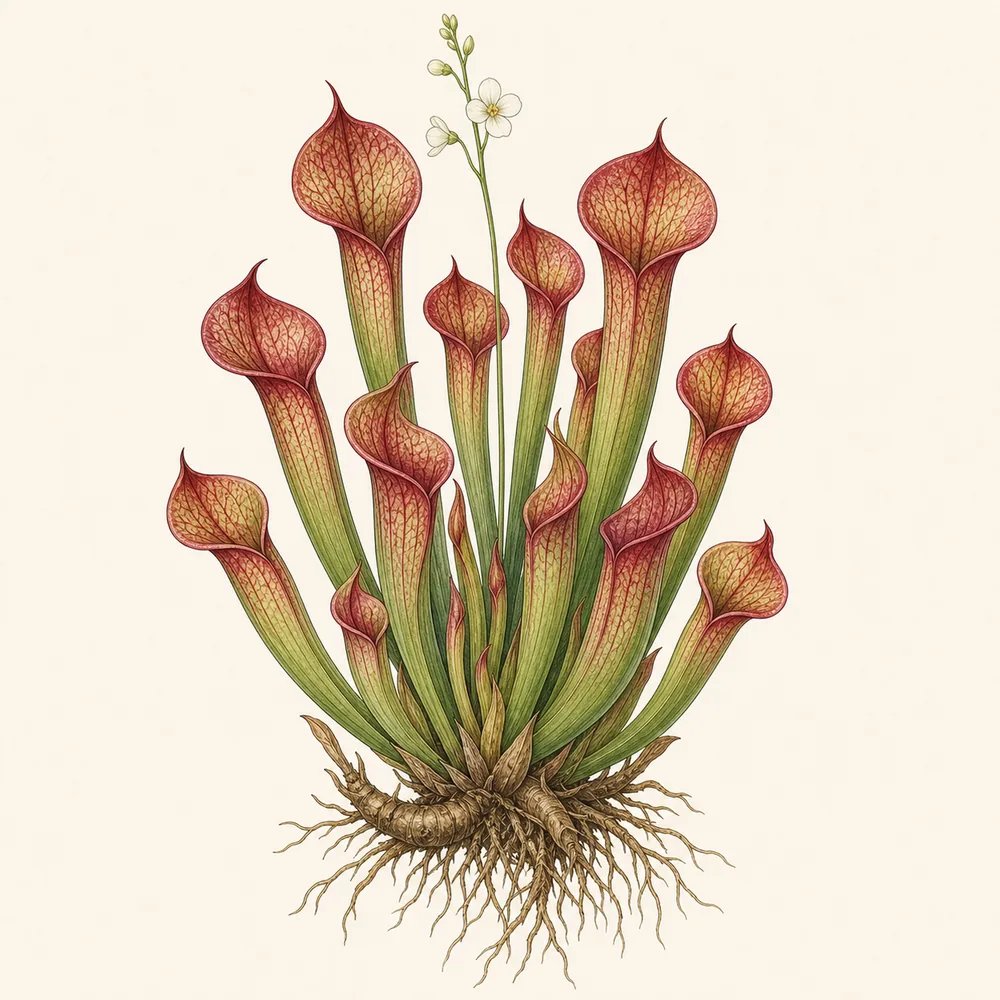
Sun Pitcher
A pitcher plant from the misty, table-top mountains of South America, where days are bright but nights are cold and the air is always wet. It's a specialist: give it cool nights and very high humidity — usually in a terrarium or greenhouse — and it's magnificent. Skip those and it sulks.
Not listed by ASPCA
The ASPCA doesn't list the sun pitcher (Heliamphora) specifically, so we don't stamp it safe. No toxic principle is recorded for it and close relatives are listed non-toxic, but with no database entry for this species we flag the gap honestly rather than assume.
Care at a glance
Everything that matters, in six lines. The detail is further down.
Light
Wants strong light — bright sun or a powerful grow light. Good light brings out the red rim and keeps the pitchers stout.
Water
Only rainwater, distilled or RO water. Keep the mix constantly moist; the pitchers also hold a little water naturally.
Temperature
A highland plant: bright days but distinctly cool nights, ideally dropping to around 10–15 °C. Warm, unchanging rooms wear it down.
Humidity
Needs consistently high humidity — a terrarium or greenhouse is usually essential. Dry room air scorches the pitcher mouths.
Feeding
No soil fertiliser. The pitchers trap and digest insects themselves; don't force-feed them.
Soil
A low-nutrient carnivorous mix — live sphagnum with perlite is a favourite, kept airy and moist. Never ordinary compost.
What to do, and when
Growth strengthens with brighter days. Keep humidity high and refresh tired live sphagnum around the crown now.
The tricky season indoors — warm nights are the main risk. Hold humidity very high, keep it bright, and cool the air overnight if you can.
Cooler nights suit it well and growth often looks its best. Maintain the moisture and light as the days shorten.
No true dormancy — it grows year-round in its cloud-forest home. Keep it bright, moist and humid, with those cool nights maintained.
A plant from the clouds
Heliamphora grows on the tepuis — the isolated, flat-topped mountains of Venezuela and neighbouring countries — where it sits in cool, bright, permanently misty conditions. Its pitchers are simple funnels with a little nectar spoon at the top that lures insects to slip inside.
That mountain home is the whole story of its care: bright light, cool nights and near-constant humidity. Recreate those three and it thrives; miss them and it steadily declines.
Why the cool nights matter
The single hardest condition to give indoors is the night-time temperature drop. On the tepuis, days are warm-ish and bright but nights turn cold, and Heliamphora relies on that swing to stay healthy over the long term.
In a heated home the temperature barely moves, which slowly saps the plant. Growers use cool rooms, cellars, cooled terrariums or unheated greenhouses to give that overnight chill — it's the difference between surviving and thriving.
Humidity, water and mix
Alongside cool nights it wants very high humidity, which is why most people grow it in a terrarium or greenhouse rather than open room air. Dry air browns the delicate pitcher mouths.
Keep the lean mix — often live sphagnum with perlite — constantly moist with rainwater, distilled or RO water only. Tap and hard water load minerals into that lean mix and kill the plant.
Common problems
Slow decline in a warm room
Usually the lack of cool nights. Find a way to drop the night temperature — a cooled terrarium, cellar or unheated greenhouse.
Brown, crisping pitcher mouths
Air too dry. Raise humidity sharply, ideally in an enclosed case or greenhouse, and keep it out of dry, heated room air.
Pale, floppy, stretched pitchers
Too little light. Give much stronger light — bright sun or a powerful grow light — to firm them up and bring back colour.
Blackening and rot at the crown
Often tap water or stagnant, over-warm damp. Switch to rainwater, keep the mix airy, and improve airflow while holding humidity high.
Everything a sun pitcher needs
Bright light, cool nights, very high humidity, and rainwater.
We take no commission on anything in the "save your money" tier — if we don't think you should buy it, we don't link it. How our recommendations work
If you like this, try
Other plants with a similar temperament.
How we checked this
Care cross-checked against the RHS. The ASPCA does not list the sun pitcher (Heliamphora), so its pet-safety is unconfirmed and we have not stamped it safe. If our page and these sources ever disagree, believe them — and tell us.
Sources: RHS · ASPCA — toxic & non-toxic plants
Last reviewed · July 2026