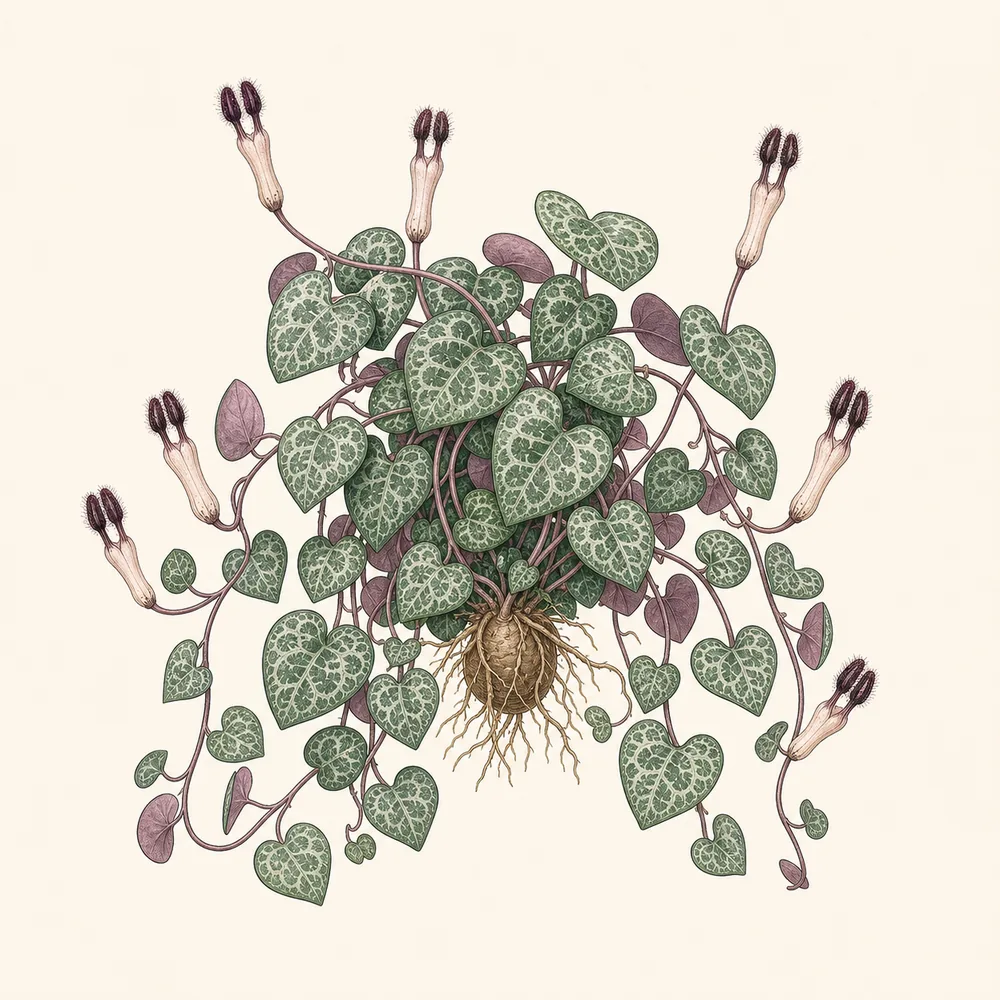
String of Hearts
A delicate trailing succulent with heart-shaped, silver-marbled leaves strung along thread-fine stems. It grows fast in good light and, like most succulents, would far rather be too dry than too wet.
Not listed by ASPCA — treat with caution
Neither the ASPCA nor the Pet Poison Helpline lists string of hearts (Ceropegia woodii), so its pet-safety is unconfirmed. There's no evidence of serious toxicity, but the dangling strands tempt cats, so hang it out of reach and treat it with caution.
Care at a glance
Everything that matters, in six lines. The detail is further down.
Light
The brightest spot you can give it — a little gentle sun deepens the marbling and shortens the gaps between leaves. Poor light leaves it sparse and leggy.
Water
Soak, drain, then wait until the compost is dry all the way through. The tubers and leaves store water, so underwatering is far safer than over.
Temperature
Ordinary room warmth. Keep it above 10 °C and off cold winter glass.
Humidity
A true succulent; normal room air suits it and it dislikes being misted.
Feeding
A weak cactus or succulent feed once a month spring to late summer is plenty; it doesn't need much.
Soil
A cactus and succulent mix, or houseplant compost cut with plenty of grit or perlite so it never stays soggy.
What to do, and when
Growth resumes as light returns. Start watering a little more freely and take cuttings now if you want more plants.
Peak growth — the strands can lengthen quickly. Give it the brightest spot and feed lightly; you may see the curious little pink 'lantern' flowers.
Ease right back on water as the light fades and growth slows.
Near-dormant. Water only occasionally, keep it bright, and hold it above 10 °C away from cold windows.
Why it goes leggy — and how to fix it
Long bare stretches of stem with widely spaced leaves are the plant telling you it wants more light. In a dim spot it stretches toward the window and the hearts thin out.
Move it brighter and new growth tightens up. To thicken an already-sparse plant, coil the bare strands back over the top of the compost — they root where the leaf nodes touch soil and fill the pot out.
Watering the right way
This is a succulent first and a trailer second. Water it thoroughly so the whole rootball wets, let the excess drain away, then leave it until the compost is dry throughout before the next drink.
Yellowing, mushy leaves and blackened stems mean the roots have sat wet — the single most common way these plants are lost. When in doubt, wait another few days.
Easy to multiply
Few plants propagate as easily. Lay a length of stem on fresh gritty compost, keep it barely moist, and it roots from the nodes within a few weeks.
You can also pot up the pea-sized tubers ('beads') that form along the stems, or simply drop cuttings into water. A single plant quickly becomes several.
Common problems
Sparse, leggy strands
Too little light. Move it to your brightest window; new growth will come tighter and better-marbled.
Soft, yellowing leaves
Overwatering. Let the compost dry out fully and make sure the pot drains freely.
Shrivelled, flattening hearts
Thirsty and drawing on its reserves — an easy fix. Give it a proper soak and it plumps back up.
White cottony spots
Mealybugs, which hide where leaf meets stem. Dab them with dilute alcohol and check again weekly.
Everything a string of hearts needs
Bright light, a gritty mix, and the discipline to under-water it.
We take no commission on anything in the "save your money" tier — if we don't think you should buy it, we don't link it. How our recommendations work
If you like this, try
Other plants with a similar temperament.
How we checked this
Care cross-checked against the RHS. Neither the ASPCA nor the Pet Poison Helpline lists string of hearts, so its pet-safety is unconfirmed. If our page and these sources ever disagree, believe them — and tell us.
Sources: RHS · ASPCA — toxic & non-toxic plants
Last reviewed · July 2026