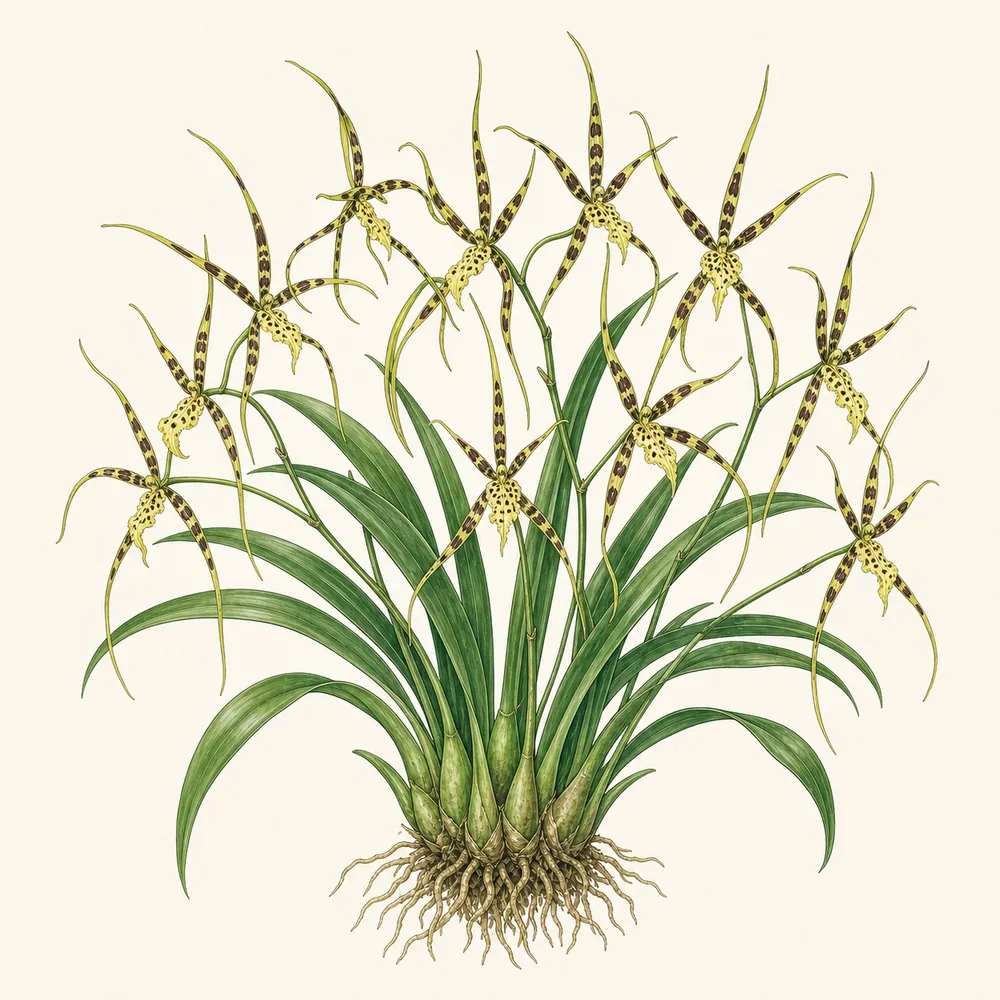
Spider Orchid
Named for its long, spidery petals that dangle like legs, the brassia is a striking and often fragrant orchid that's more forgiving than it looks. Give it bright light, real humidity and, crucially, moving air, and it grows steadily and flowers freely — a genuinely rewarding step up from the supermarket moth orchid.
Not listed by ASPCA
The ASPCA doesn't list the spider orchid (Brassia) specifically, so we don't stamp it safe. No toxic principle is recorded for it and close relatives are listed non-toxic, but with no database entry for this species we flag the gap honestly rather than assume.
Care at a glance
Everything that matters, in six lines. The detail is further down.
Light
Wants plenty of bright light with just a little protection from harsh midday sun — an east or lightly shaded south window is ideal.
Water
Water thoroughly, let it drain fully, then let the mix approach dryness before the next soak. Never leave it standing wet.
Temperature
Ordinary warm rooms suit it, with a natural drop at night. Keep it above about 13 °C and away from cold draughts.
Humidity
Loves humidity but needs air moving to match it — a pebble tray or humidifier plus a gently circulating breeze keeps it healthy.
Feeding
A dilute orchid feed with most waterings through the growing season, easing off in winter as growth slows.
Soil
A free-draining medium bark mix that gives the roots plenty of air — never ordinary compost, which holds too much water.
What to do, and when
Growth picks up with the light. Start regular weak feeding, repot into fresh bark if the mix is tired, and step watering back up.
Peak growth and often flowering. Keep it bright but shaded from scorching sun, feed weakly, and keep humidity and airflow high in the heat.
New pseudobulbs finish maturing. Ease feeding as light fades but keep watering steady while growth continues.
Slower now. Water more sparingly, keep it warm, bright and out of draughts, and don't let humidity crash in a heated room.
Bright, humid — and moving air
Brassias grow high on trees in warm, breezy cloud forest, and the detail people miss is that last part: moving air. Plenty of growers get the bright light and the humidity right, then stand the plant in a still, stuffy corner where the leaves and roots stay damp and problems set in.
Pair good humidity — a pebble tray or humidifier — with gentle airflow from an open door, a nearby window or a small fan on low. Bright, humid and breezy is the combination a spider orchid really wants.
Those spidery flowers
The show is all in the flower: long, narrow petals and sepals that trail downward like spider legs, often barred and speckled in green, yellow and brown, and frequently carrying a warm scent. A mature plant can throw an arching spray of several at once.
In the wild that shape mimics a spider to lure in a particular hunting wasp — a bit of natural theatre behind an orchid that earns its place for looks alone.
Watering and growth cycle
Like many orchids, a brassia grows in a rhythm of plump pseudobulbs, each producing a fan of leaves and, when mature, a flower spray. Water thoroughly, let the mix approach dryness, then soak again — the roots want air as much as water.
Feed weakly and regularly while new growths develop, then ease off in winter. Repot in spring as fresh roots appear, using a free-draining medium bark that won't stay soggy around the roots.
Common problems
Fungal spots or rot
High humidity in stagnant air. Add airflow — an open window or a small fan — so the foliage and roots dry between waterings.
Pleated, accordion leaves
The plant went too dry while a new growth was forming. Keep watering steadier and humidity up through the growing season.
Scorched patches on leaves
Harsh direct midday sun. Move it to bright but filtered light, especially in summer.
No flowers
Usually too little light or a weak growing season. Brighten its spot and feed well while new pseudobulbs develop.
Everything a spider orchid needs
Bright light, real humidity, and moving air.
We take no commission on anything in the "save your money" tier — if we don't think you should buy it, we don't link it. How our recommendations work
If you like this, try
Other plants with a similar temperament.
How we checked this
Care cross-checked against the RHS. The ASPCA does not list the spider orchid (Brassia), so its pet-safety is unconfirmed and we have not stamped it safe. If our page and these sources ever disagree, believe them — and tell us.
Sources: RHS · ASPCA — toxic & non-toxic plants
Last reviewed · July 2026