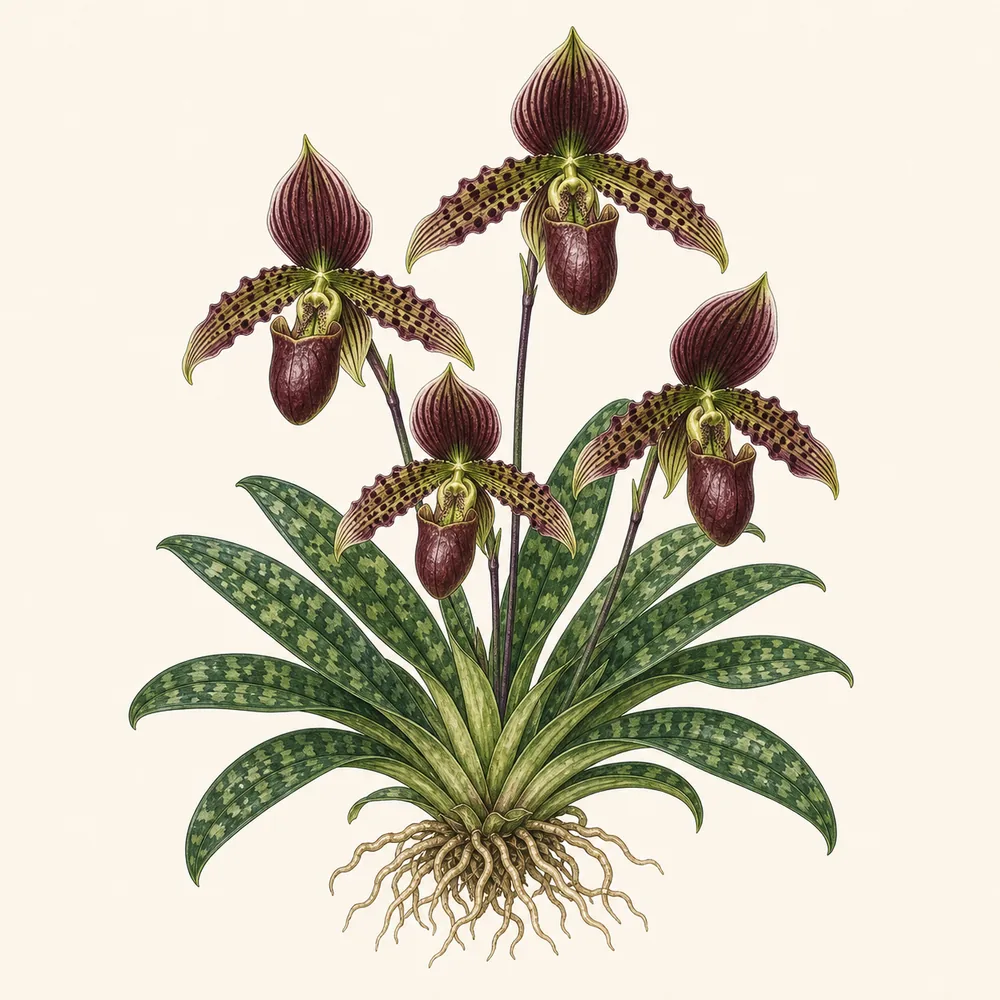
Slipper Orchid
The orchid for a spot that's too shady for the others — named for the curious pouch on each flower. Unlike most orchids it has no dry rest and no craving for blazing sun; it wants steady shade, steady moisture and warmth all year. That makes it one of the most beginner-friendly orchids once you stop treating it like a moth orchid.
Not listed by ASPCA
The ASPCA doesn't list the slipper orchid (Paphiopedilum) specifically, so we don't stamp it safe. No toxic principle is recorded for it and close relatives are listed non-toxic, but with no database entry for this species we flag the gap honestly rather than assume.
Care at a glance
Everything that matters, in six lines. The detail is further down.
Light
A genuinely shade-tolerant orchid. A north or east window suits it; keep it out of direct sun, which scorches the soft leaves.
Water
It has no water-storing pseudobulbs and no dormancy, so keep the mix lightly moist year round. Don't let it dry out hard, and don't leave it standing wet.
Temperature
Ordinary warm room temperatures all year. Mottled-leaved types like it warmer; plain-green types tolerate a touch cooler.
Humidity
Average room humidity is usually fine; a pebble tray helps in a dry, heated room. Avoid water sitting in the crown.
Feeding
A dilute orchid feed every few waterings through the growing season. Flush with plain water now and then, as the fine roots resent salt build-up.
Soil
A fine, moisture-retentive bark mix — finer than for most orchids, to suit the delicate roots. Never ordinary compost.
What to do, and when
Active growth resumes. Begin regular weak feeding and repot now if needed, as the fine bark breaks down faster than coarse orchid mixes.
Keep it shaded, warm and evenly moist. Feed weakly through the season and make sure it never bakes in a sunny window.
Growth continues — there's no dry rest to trigger. Ease feeding as light fades but keep the mix lightly moist.
Many slipper orchids flower now. Keep watering steadily, hold it warm and shaded, and avoid cold, wet mix that rots the roots.
The orchid that likes shade
Most orchid advice starts with 'give it plenty of light' — and most of it doesn't apply here. Slipper orchids grow on shady forest floors and in leaf litter, so they're happy in a north or east window where a moth orchid or cymbidium would sulk.
That makes them one of the easiest orchids for a dimmer room. Direct midday sun is the real danger: it scorches the soft, strappy leaves, some of which carry beautiful mottled markings worth keeping unblemished.
No pseudobulbs, no dry rest
Unlike cymbidiums or dendrobiums, a slipper orchid has no fat pseudobulbs to store water and no dormant dry season. That changes how you water: keep the mix evenly, lightly moist all year rather than letting it dry right out between soaks.
It won't forgive being left bone dry, and it won't forgive sitting in water either. Steady, gentle moisture in a fine, free-draining bark mix is the balance to aim for.
Fine bark and gentle feeding
The roots are finer and more delicate than a typical orchid's, so a slipper orchid is grown in a finer bark mix that holds a little more moisture. That mix breaks down faster, so plan to repot every year or two, ideally in spring.
Feed weakly and regularly through the growing season, but flush the pot through with plain water occasionally — the fine roots are sensitive to fertiliser salts building up in the mix.
Common problems
Scorched or bleached leaves
Too much direct sun. Move it to a shadier north or east window — this is a low-light orchid, not a windowsill sun-lover.
Collapsed, mushy centre
Crown rot from water pooling in the growth. Water the mix, not the crown, and keep it out of a cold, stagnant spot.
Leaf tips going brown
Often salt build-up from feeding, or hard water. Flush the pot with plain water and feed more weakly.
Won't flower
Usually a plant not yet mature, or one kept too dark. Give it steady warmth and bright shade, and be patient with a young fan.
Everything a slipper orchid needs
Shade, steady moisture, and a fine bark mix.
We take no commission on anything in the "save your money" tier — if we don't think you should buy it, we don't link it. How our recommendations work
If you like this, try
Other plants with a similar temperament.
How we checked this
Care cross-checked against the RHS. The ASPCA does not list the slipper orchid (Paphiopedilum), so its pet-safety is unconfirmed and we have not stamped it safe. If our page and these sources ever disagree, believe them — and tell us.
Sources: RHS · ASPCA — toxic & non-toxic plants
Last reviewed · July 2026