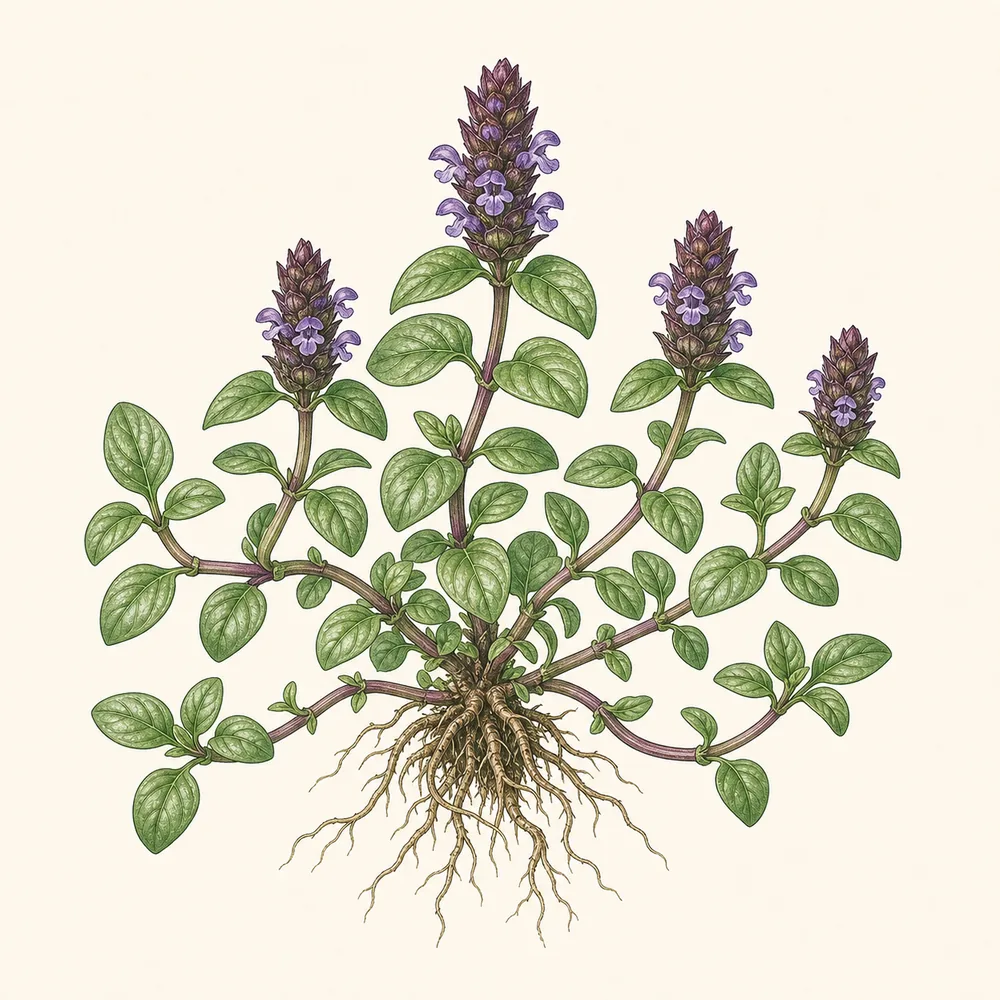
Selfheal
A tough, low-growing native that creeps along the ground and throws up stubby spikes of violet-purple flowers all summer. It shrugs off mowing and foot traffic, which makes it one of the best wildflowers for weaving into a lawn — and the bees adore it.
Not listed by ASPCA
The ASPCA doesn't list selfheal, so we don't stamp it safe. It's a UK native wildflower with no recorded serious toxicity to pets, but with no database entry we flag the gap honestly rather than guess.
Care at a glance
Everything that matters, in six lines. The detail is further down.
Light
Happiest in full sun but genuinely relaxed about part shade — one of the few meadow flowers that flowers well under light shade.
Water
Copes with ordinary dry spells once its roots are down. Only water new plug plants through their first summer while they knit in.
Temperature
Hardy right across the UK. The mat of leaves stays green through mild winters and shrugs off hard frosts.
Habit
Spreads by creeping stems that root as they go, forming a dense low mat rarely more than 15 cm tall in flower.
Feeding
Never feed it. Like most meadow flowers it flowers best on lean, unfertilised ground where the grass can't bully it.
Soil
Grows on clay, loam or chalk. It prefers ground that holds a little moisture but tolerates most soils that aren't parched all summer.
What to do, and when
Fresh leaf rosettes spread across the ground as it warms. A good time to plant pot-grown plants or plugs into gaps in turf or a border.
The main show — squat spikes of violet-purple flowers from June, working with bees and butterflies right through to September.
Flowering tails off and seed sets. Leave the spent heads to self-sow, then the plant settles back into an evergreen mat for winter.
The low leaf mat sits tight and green through the cold. Nothing to do — it needs no protection and no cutting back.
The wildflower that lives happily in a lawn
Most meadow flowers can't take being walked on or mown, which is what makes selfheal special. It grows as a low, creeping mat that ducks under the mower blades, so it flowers even in a lawn that's cut every few weeks — you just raise the blades a notch and let it bloom between cuts.
This is the honest way into a wildflower lawn without digging up your grass. Plant plugs into the turf in spring or autumn, keep the mowing high and occasional, and within a season you'll have ribbons of purple where there was only green.
Sowing and planting
Selfheal grows easily from seed sown in autumn or spring, but for an existing lawn or a patch of rough grass, plug plants are far more reliable — the seed struggles to compete with established turf.
Sow seed thinly onto raked, weed-free ground and barely cover it; it needs light to germinate. On poorer soil the plants stay compact and flower hard. On rich ground they grow lusher but the grass around them grows lustier still, so keep fertility low.
Why the bees keep coming back
Each of those stubby spikes is packed with small tubular flowers that open a few at a time over weeks, so a patch stays in bloom for most of the summer. That long, steady supply of nectar is exactly what bumblebees and honeybees want.
It's also a food plant for several moth caterpillars. In a mixed meadow or flowering lawn, selfheal is one of the quiet workhorses — never spectacular, always earning its place.
Common problems
Swamped by vigorous grass
On rich soil, coarse grasses outgrow it. Stop feeding, cut and remove the clippings to lower fertility, and it will hold its own.
Won't establish from seed in a lawn
Seed rarely wins against established turf. Use plug plants instead, popped into small bare patches, and keep them watered until rooted.
Spreading further than you wanted
The creeping stems root as they travel. In a formal border simply pull back the edges each spring; in a lawn this spreading is the whole point.
Sparse flowering
Usually too much shade or too much feeding. Give it more sun and leaner ground, and cut the surrounding grass short before it flowers.
Everything a patch of selfheal needs
Lean ground, a high mower, and a few plugs to get started.
We take no commission on anything in the "save your money" tier — if we don't think you should buy it, we don't link it. How our recommendations work
If you like this, try
Other plants with a similar temperament.
How we checked this
Care cross-checked against the RHS. The ASPCA does not list selfheal, so its pet-safety is unconfirmed and we have not stamped it safe. If our page and these sources ever disagree, believe them — and tell us.
Sources: RHS · ASPCA — toxic & non-toxic plants
Last reviewed · July 2026