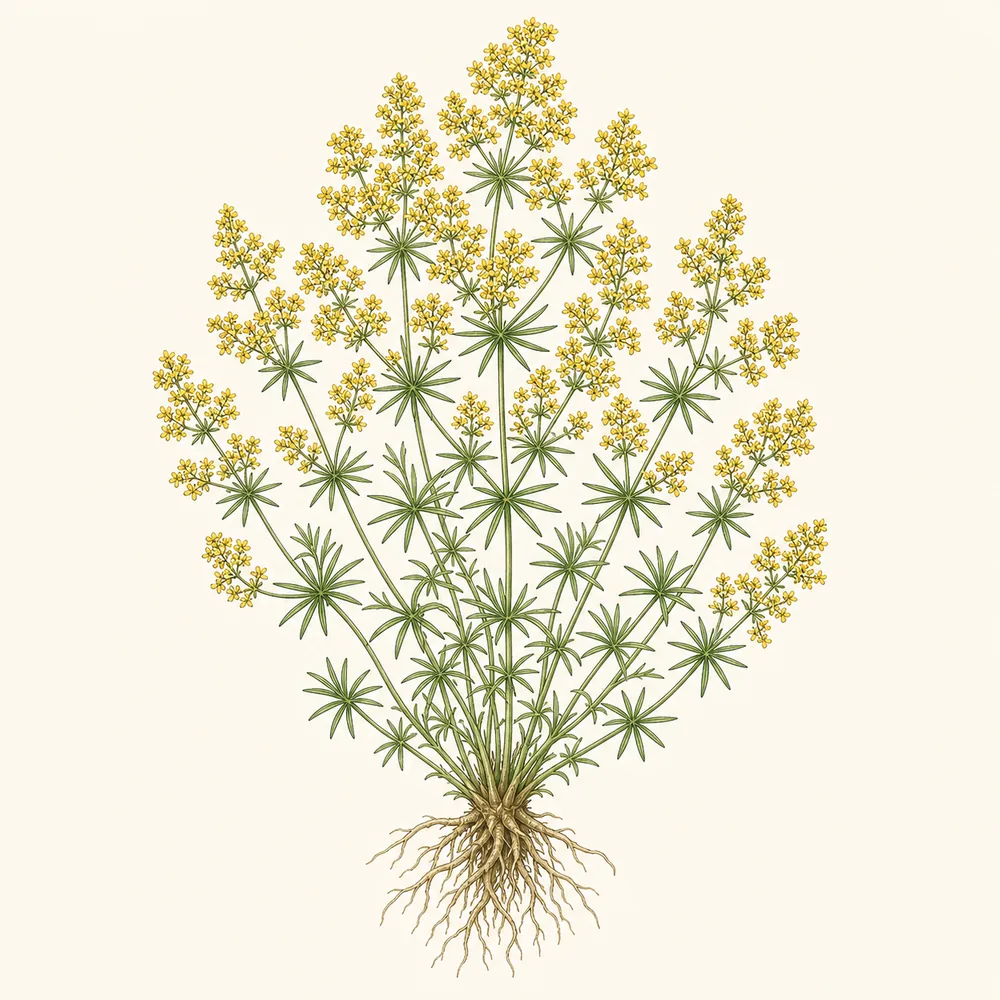
Lady's Bedstraw
A low, mat-forming native that carpets dry, sunny grassland with a froth of tiny golden flowers in high summer. Brush it or dry it and the foliage smells sweetly of new-mown hay — which is exactly why it was once stuffed into mattresses. Tough, drought-proof and quietly lovely in a meadow.
Not listed by ASPCA
The ASPCA doesn't list lady's bedstraw, so we don't stamp it safe. It's a UK native wildflower with no recorded serious toxicity to pets, but with no database entry we flag the gap honestly rather than guess.
Care at a glance
Everything that matters, in six lines. The detail is further down.
Light
A plant of open, sunny banks and dunes — it wants full sun and flowers thinly in any real shade.
Water
Deep-rooted and built for dry ground; it sails through summer droughts. Only water new plants while they root in.
Temperature
Hardy across the UK. It forms a low mat that persists through winter and reshoots strongly in spring.
Habit
Spreads by creeping roots into a dense low mat of fine, whorled leaves, sending up wiry flowering stems in summer.
Feeding
Never feed it. Like other meadow flowers it flowers best on lean, unimproved ground and gets leggy on rich soil.
Soil
Loves free-draining sandy, chalky and gravelly soils — including dunes and dry banks. It dislikes heavy, wet clay.
What to do, and when
The low leaf mat greens up and spreads. A good time to plant plugs or pot-grown plants into a sunny, well-drained meadow or bank.
The high point — a haze of tiny honey-scented golden flowers from June to August, buzzing with small bees and hoverflies.
Flowering finishes and seed sets. Leave stems to self-sow, then take a late cut and remove the cuttings to keep fertility low.
The mat sits low and largely evergreen through the cold. Fully hardy — no protection needed, just leave it undisturbed.
The sweet-scented carpet of a dry meadow
Lady's bedstraw is the flower for hot, dry, sunny ground where richer plants give up — sandy banks, thin chalky turf, even coastal dunes. It creeps into a dense low mat of needle-fine leaves and then, in high summer, foams over with countless tiny golden flowers.
The name is the giveaway: dried, the whole plant smells of fresh hay (from a compound called coumarin), and it was genuinely once used to stuff mattresses. In the garden it's a superb, no-fuss carpeter for a dry meadow, a green roof or a sunny gravel bank.
Sowing and planting
It grows from seed sown in autumn, which lets the seed take a spell of winter cold before germinating in spring. Sow thinly onto raked, weed-free ground, or raise plants in trays; for slotting into existing turf, plug plants are the more reliable route.
Keep fertility low. On rich soil the grass grows too strong and the bedstraw thins out, so never feed and never mulch with anything rich. On free-draining, hungry ground it settles in and slowly knits together into a spreading mat.
The cut-and-collect regime
Like the rest of a wildflower meadow, lady's bedstraw is kept in balance by a once-a-year cut. Let it flower and set seed through the summer, then cut the meadow in late summer or autumn and — crucially — rake off and remove the cuttings.
Taking the cuttings away is what keeps the soil poor: leave them lying and they rot down, raise fertility and let the grass take over. Clear them off and the low mat comes back leaner and denser each year, spreading gently by its creeping roots.
Common problems
Leggy, sparse flowering
Too rich a soil or too much shade. Grow it hard in full sun on poor, free-draining ground and stop all feeding.
Rots on heavy, wet clay
It hates cold, waterlogged winter soil. Add grit to open up clay, or grow it on a raised, sharply drained bank instead.
Powdery mildew in dry spells
A white bloom on drought-stressed foliage. It rarely does lasting harm — improve airflow and the mat grows through it.
Spreading into neighbours
The creeping roots travel in loose soil. Pull back the edges each spring in a border; in a meadow the spread is exactly what you want.
Everything lady's bedstraw needs
Full sun, sharp drainage, poor soil, and a yearly cut.
We take no commission on anything in the "save your money" tier — if we don't think you should buy it, we don't link it. How our recommendations work
If you like this, try
Other plants with a similar temperament.
How we checked this
Care cross-checked against the RHS. The ASPCA does not list lady's bedstraw, so its pet-safety is unconfirmed and we have not stamped it safe. If our page and these sources ever disagree, believe them — and tell us.
Sources: RHS · ASPCA — toxic & non-toxic plants
Last reviewed · July 2026