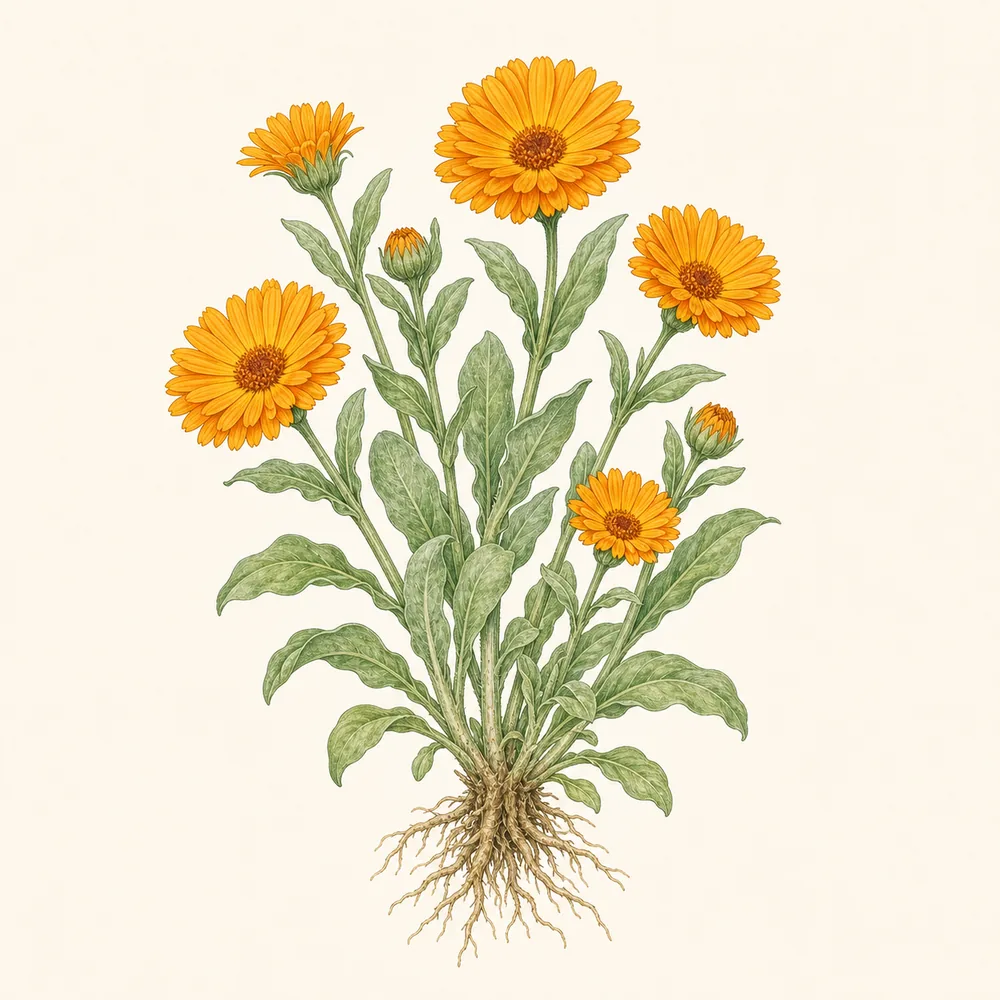
Pot Marigold
About as easy as a flower gets — scatter the seed where you want it, and pot marigold does the rest, throwing out cheerful orange and yellow daisies for months and quietly self-seeding for next year. The petals are edible, bees love it, and it's non-toxic to pets, which makes it one of the most useful annuals you can grow.
Non-toxic to cats & dogs (ASPCA)
Pot marigold (Calendula officinalis) is listed as non-toxic to cats and dogs on the ASPCA database. A safe, cheerful, edible-petalled annual for a pet-friendly border or veg patch — and not to be confused with the toxic French/African marigolds (Tagetes).
Care at a glance
Everything that matters, in six lines. The detail is further down.
Light
Flowers best in full sun but tolerates a little shade. The more sun it gets, the more flowers you'll pick over the season.
Water
Water new sowings and young plants in dry spells; established plants are tough and shrug off dry weather with little help.
Temperature
Hardy enough to sow straight outdoors and to overwinter as young self-sown plants in milder gardens. Frost rarely troubles it.
Deadheading
Pick or snap off faded flowers to keep new ones coming. Leave a few late heads to set seed if you want it to come back.
Feeding
It flowers happily on poor soil and needs no feeding. Rich ground and heavy feed just give you leaf at the expense of flower.
Soil
Grows in almost any soil that isn't waterlogged. Poor to average ground actually suits it — it's a genuinely unfussy plant.
What to do, and when
Sow straight into the ground from March to May where you want it to flower, and thin the seedlings. Overwintered self-sown plants get going now and flower early.
In full flower for weeks on end. Keep picking and deadheading to prolong the show — a few minutes here and there is all it asks.
Still flowering into autumn until the frosts. Let some late heads ripen and drop their curved seeds, and you'll get free plants next year.
Largely over, but young self-sown seedlings often sit out mild winters and flower early. Little to do beyond leaving them be or thinning the crowd.
The easiest flower to start with
If you've never grown anything from seed, pot marigold is the one to begin with. Scatter the curved seed straight onto raked soil where you want it, cover lightly, keep it damp until it germinates, and thin the seedlings. There's no need for pots, propagators or a windowsill.
It asks almost nothing after that — no feeding, little watering once established, and no fuss. On poor soil in full sun it flowers all the harder.
It comes back on its own
Leave a few of the last flowers to ripen into their distinctive curved seeds and pot marigold will quietly self-seed, popping up again the following year without you lifting a finger. In a mild garden the seedlings often overwinter and flower early.
If you'd rather it didn't wander, simply deadhead thoroughly and pull out any seedlings you don't want — they come up where you can see them and are easy to move or remove while small.
Edible petals — and a useful neighbour
The petals are edible: scatter them over salads, rice or soups for a splash of colour, which is where the old kitchen-garden name comes from. Only ever eat Calendula officinalis, the true pot marigold — and be sure of your identification before eating any plant.
It earns its keep in the veg patch too. The open, nectar-rich flowers pull in bees and hoverflies, whose larvae feast on aphids, so a few clumps among your vegetables genuinely help.
Common problems
Powdery mildew
A white dusty coating on the leaves in hot, dry spells late in the season. Improve airflow, water the roots in droughts, and clear affected plants at the end of their run.
Aphids on shoot tips
Blackfly and greenfly gather on soft new growth. The flowers draw in ladybirds and hoverflies that usually deal with them — squash early clusters by hand if needed.
Self-seeds too freely
Left to seed, it can pop up everywhere. Deadhead more thoroughly and pull unwanted seedlings while small — they're shallow-rooted and easy to remove.
Leggy with few flowers
Usually too much shade or over-rich, over-fed soil. Grow it in full sun on leaner ground and keep deadheading to push out more bloom.
Everything a pot marigold needs
A packet of seed, a sunny patch of soil, and almost nothing else.
We take no commission on anything in the "save your money" tier — if we don't think you should buy it, we don't link it. How our recommendations work
If you like this, try
Other plants with a similar temperament.
How we checked this
Care cross-checked against the RHS. Non-toxicity taken from the ASPCA database, which lists Pot Marigold (Calendula officinalis) as non-toxic. If our page and these sources ever disagree, believe them — and tell us.
Sources: RHS · ASPCA — toxic & non-toxic plants
Last reviewed · August 2026