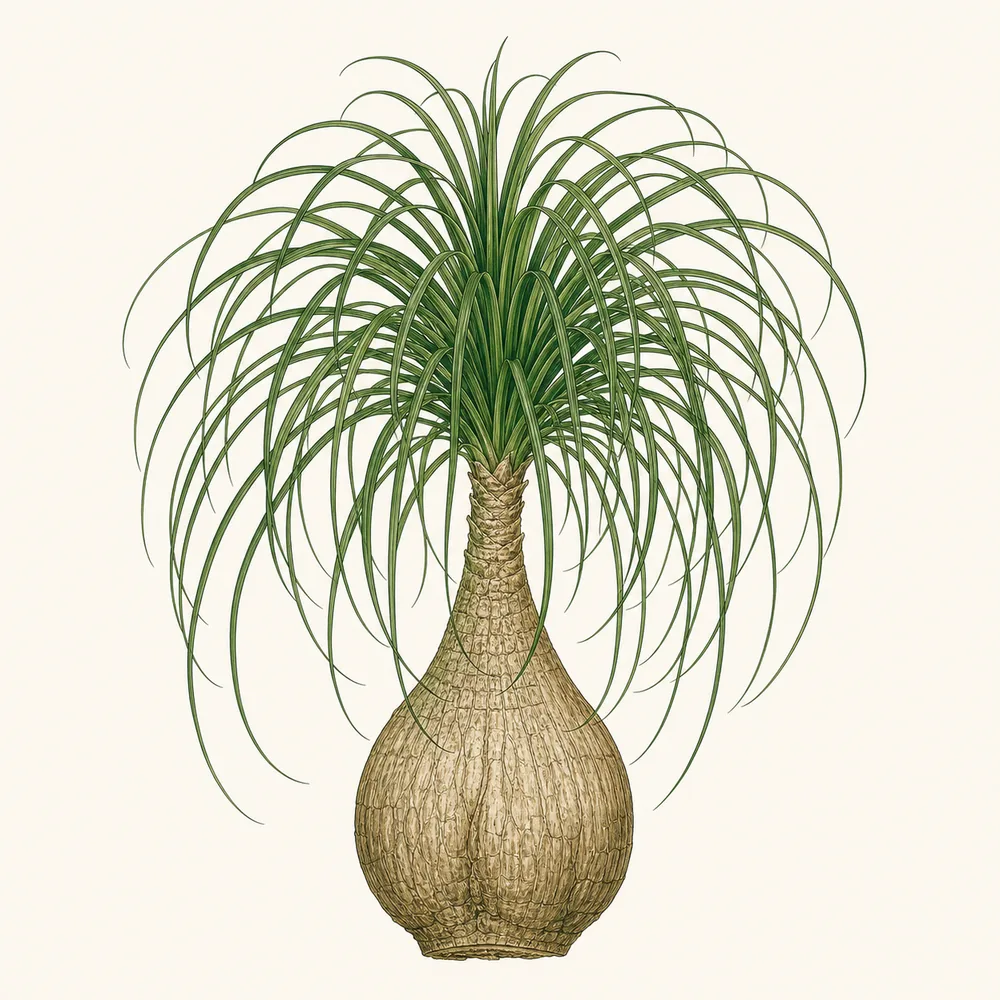
Ponytail Palm
A swollen, water-storing base topped with a fountain of long, arching, ribbon-like leaves. Despite the name it isn’t a palm at all but a succulent — near-indestructible, slow, characterful, and safe around pets.
Safe around cats & dogs
Listed <strong>non-toxic to cats, dogs and horses</strong> by the ASPCA. A genuinely pet-safe, sculptural plant — and, unlike the deadly sago “palm” it’s sometimes shelved beside, no danger at all if a leaf is chewed. Source: ASPCA.
Care at a glance
Everything that matters, in six lines. The detail is further down.
Light
The brightest spot you have. It loves sun and sulks in gloom.
Water
Every 2–4 weeks, less in winter. The swollen base stores water — err firmly on the dry side.
Temperature
Room warmth. Not frost-hardy; keep it above 10 °C.
Humidity
Completely happy in dry household air.
Feeding
A weak feed once or twice in summer, if at all.
Soil
Cactus and succulent mix, ideally in a terracotta pot.
What to do, and when
Slow growth resumes. Water as it dries and repot only when it’s truly bursting the pot.
Its active season. Give it lots of sun; water when dry and feed once, weakly.
Cut back on water as light fades.
Near-dormant. Water monthly at most; keep it cool, bright and dry.
Not a palm — a water tank on a stick
The bulbous “foot” at the base isn’t just for looks: it’s a water store that lets the plant ride out long droughts, which is exactly why it survives forgetful owners. It’s a succulent relative, not a true palm, so treat it like a cactus rather than a fern.
Give it the sunniest spot you have and water only when the soil is thoroughly dry. In winter it can go weeks between drinks.
Slow, safe and long-lived
A ponytail palm grows slowly and lives for decades, gradually thickening its base into something genuinely sculptural. Don’t rush it into a big pot — it flowers and grows best a little snug, and over-potting just holds excess wet.
Because it’s ASPCA non-toxic, it’s an easy pick for a sunny windowsill in a pet household — a rare pet-safe plant that actively wants direct sun.
Common problems
Soft, browning base
Overwatering and rot — the main risk. Keep it dry and bright.
Brown leaf tips
Tap-water salts or the odd dry spell. Cosmetic — trim if you like.
Pale, floppy leaves
Too little light. Move it to your sunniest window.
Very slow growth
Completely normal — it’s a slow plant by nature.
Everything a ponytail palm needs
Sun, grit, and benign neglect.
We take no commission on anything in the "save your money" tier — if we don't think you should buy it, we don't link it. How our recommendations work
If you like this, try
Other plants with a similar temperament.
From the Notebook
Seasonal notes and guides that mention the ponytail palm.
How we checked this
Care cross-checked against the RHS and NC State Extension. Non-toxic status confirmed directly against the ASPCA “pony tail” entry — non-toxic to cats, dogs and horses. A succulent (Asparagaceae), not a true palm; not to be confused with the toxic sago palm (Cycas revoluta). If our page and these sources ever disagree, believe them — and tell us.
Sources: RHS · NC State Extension · ASPCA — Pony Tail
Last reviewed · July 2026