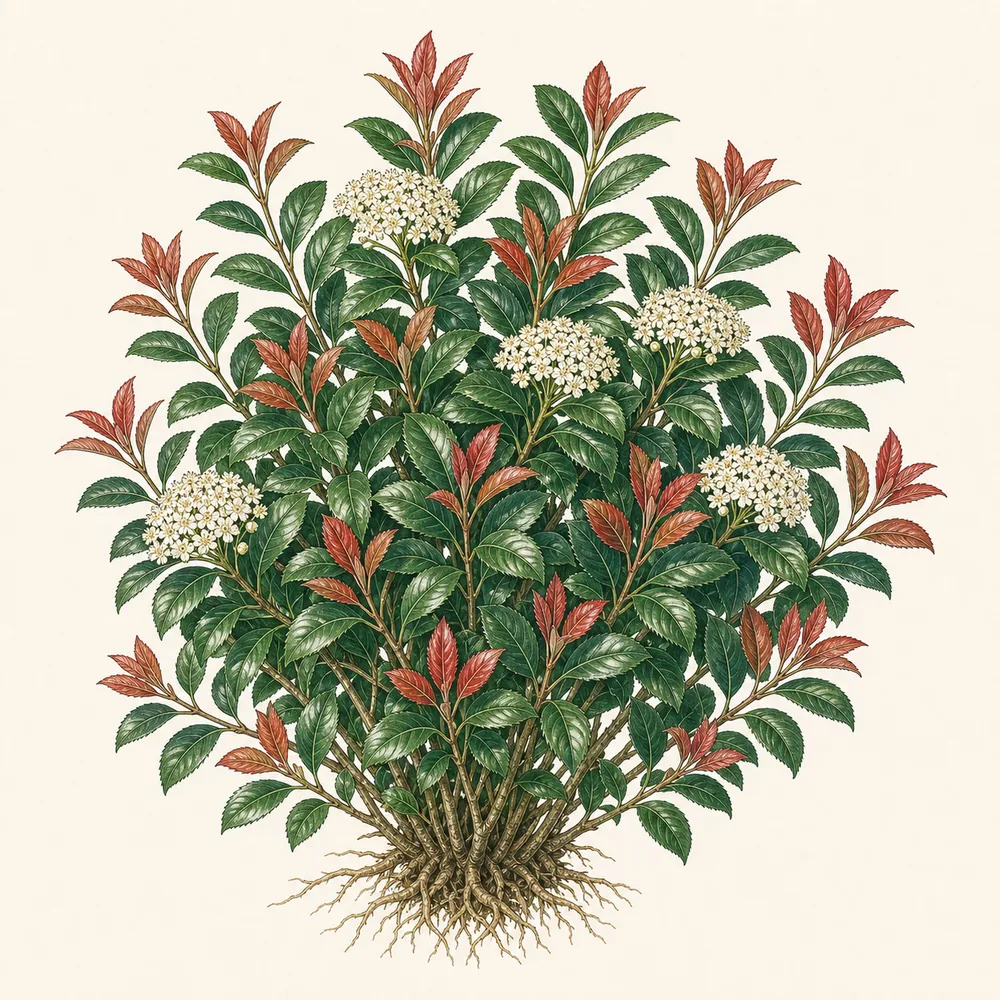
Photinia
A fast, glossy evergreen whose new leaves flush brilliant red before turning green — hence 'Red Robin'. A go-to for hedges and screening, and the more you trim it, the more of that fiery new growth you get.
Not listed by ASPCA
The ASPCA doesn't list photinia, so we don't stamp it safe. With no database entry we flag the gap honestly rather than guess.
Care at a glance
Everything that matters, in six lines. The detail is further down.
Position
The red new growth is brightest in full sun. It takes light shade but colours less vividly and grows a touch sparser.
Water
Keep it watered through its first year or two, especially in a hedge. Established plants tolerate short dry spells.
Hardiness
Hardy in most of the UK but new growth can be nipped by late frosts. Shelter it from cold, drying winds.
Soil
Grows on most soils that don't stay wet. Waterlogged ground is the quickest way to lose a photinia to root problems.
Feeding
A spring feed and mulch fuels the vigorous, colourful regrowth — particularly worthwhile after trimming a hedge.
Pruning
Each trim triggers a fresh flush of red leaves. Clip two or three times through the growing season for the best colour.
What to do, and when
The main flush of scarlet new leaves; small white flowers may appear. Trim after the first flush to drive more colour.
Keep clipping hedges lightly through summer — each cut prompts another burst of red new growth. Feed and water.
Ease off pruning by early autumn so soft new shoots harden before frost. A fine time to plant new photinias.
Evergreen and steady, holding its glossy leaves. Avoid pruning now, as fresh growth would be caught by the cold.
Trim it to keep the red coming
The scarlet new leaves are the whole appeal, and the trick is that every trim triggers a fresh flush. A photinia left unclipped gives one burst of red in spring and then settles to plain green for the rest of the year.
So clip it two or three times over the growing season — after the spring flush, and again in summer — to keep pushing out new red growth. Stop by early autumn, though, so the last shoots harden off before the frosts arrive.
A quick, glossy screen
'Red Robin' is one of the most popular evergreen hedging shrubs for good reason: it's fast, dense, glossy and evergreen, making a solid screen for privacy far quicker than yew or holly. Plants set 60–90 cm apart knit together in a couple of seasons.
It also works as a freestanding specimen or a large shrub in a mixed border, where the contrast of red new growth against dark, glossy older leaves earns its place. Just give it room — it's vigorous and gets big if you let it.
Watch for leaf spot
The main thing that troubles photinia is leaf spot, a fungal problem that shows as dark red or purple blotches on the leaves, often followed by leaf drop. It's worse in wet seasons, on stressed plants, and where air can't move freely.
Keep plants healthy and airy: clear up fallen leaves (the fungus overwinters on them), avoid clipping in wet weather, don't crowd the planting, and feed and mulch to keep growth vigorous. A stressed photinia is far more likely to succumb.
Common problems
Dark red or purple spots on leaves
Photinia leaf spot, a fungus worse in damp seasons. Clear fallen leaves, improve airflow, and keep the plant vigorous.
Leaves dropping heavily
Often leaf spot, drought stress, or waterlogging. Check drainage, water in dry spells, and remove and bin affected leaves.
Little or no red new growth
It hasn't been trimmed, or it's in too much shade. Clip through the season and grow in full sun for the brightest flush.
Scorched or blackened young shoots
Late frost or cold wind catching soft growth. Shelter from wind and stop pruning by early autumn so shoots harden off.
Everything a photinia needs
Sun, free-draining soil, shelter from cold wind, and regular clipping for that red new growth.
We take no commission on anything in the "save your money" tier — if we don't think you should buy it, we don't link it. How our recommendations work
If you like this, try
Other plants with a similar temperament.
How we checked this
Care cross-checked against the RHS. The ASPCA does not list photinia, so its pet-safety is unconfirmed and we have not stamped it safe. If our page and these sources ever disagree, believe them — and tell us.
Sources: RHS · ASPCA — toxic & non-toxic plants
Last reviewed · August 2026